

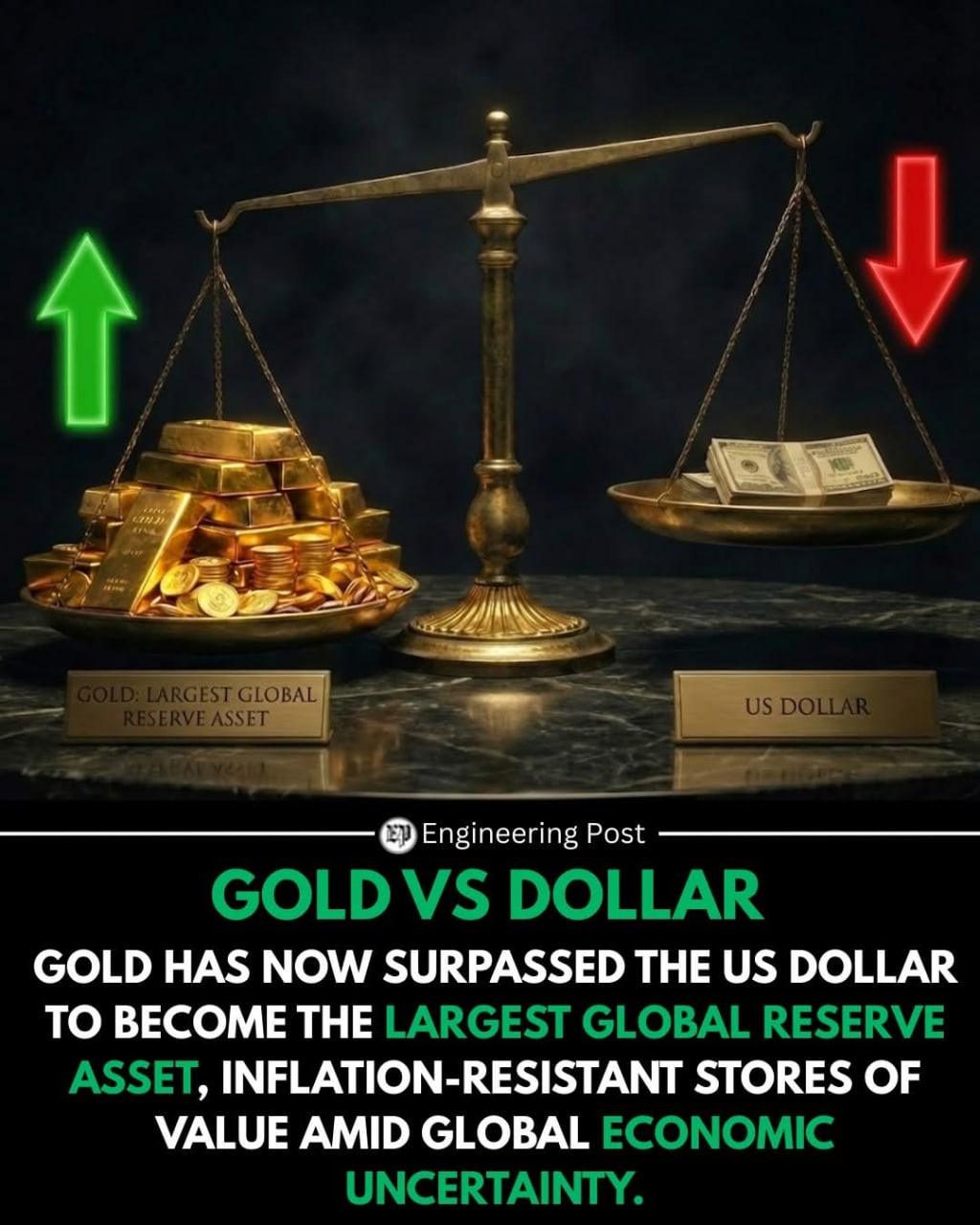
Gold Vs. Dollar: Why the Precious Metal Has Surpassed the U.S. Dollar as the World’s Largest Reserve Asset
For decades, the U.S. dollar stood unchallenged as the cornerstone of the global financial system — the dominant reserve currency, the main medium for cross-border trade, and the bedrock of international monetary stability. But in a historic reordering of global assets, gold has now surpassed U.S. Treasury holdings to become the largest reserve asset held by central banks worldwide, signaling a dramatic shift in how nations protect and preserve wealth amidst inflation, economic uncertainty, and geopolitical tensions.�
Gold Eagle +1
A Historic Turn in Global Reserves
Official data from the World Gold Council and recent financial reports reveal that central banks now hold more gold by value than U.S. government debt (Treasuries) for the first time since 1996. This is not just a numerical milestone — it marks a symbolic reassessment of risk and value at the highest levels of global finance. Gold holdings have climbed above $4 trillion while holdings of U.S. Treasuries stand slightly below that level, driven by robust gold price gains and deliberate reserve diversification.�
Gold Eagle
Traditionally, foreign exchange reserves — the assets held by national monetary authorities to back liabilities and influence monetary policy — have been dominated by the dollar. Even as recently as 2024, the U.S. dollar accounted for around 46 % of total reserve assets, dwarfing gold’s share at about 20 %. However, when gold is aggregated with currency reserves and Treasuries, recent estimates suggest its share has grown — pushing the dollar’s effective proportion below the historic 50 % threshold.�
CoinCodex
What’s Driving the Shift?
Several key forces have propelled this shift:
1. Inflation and Currency Risk:
Persistent inflationary pressures in major economies have eroded confidence in fiat currencies, especially as central banks engage in unprecedented monetary easing. Gold, a tangible asset with intrinsic value, has long been seen as an inflation hedge — a reliable store of value when purchasing power falls. This perception has strengthened markedly among central bank reserve managers over the past few years.�
FinancialContent
2. Geopolitical Uncertainty:
Heightened geopolitical tensions — from trade conflicts to sanctions and shifting alliances — have underscored vulnerabilities in dollar-based assets. Nations wary of exposure to U.S. economic policy or political leverage are increasingly diversifying their portfolios into assets like gold that are not tied to any single government’s fiscal or monetary stance.�
FinancialContent
3. Central Bank Buying Frenzy:
Central banks have been accumulating gold in record volumes. For several consecutive years, official sector purchases have exceeded 1,000 metric tonnes annually — a level not seen since the height of the Bretton Woods era. Emerging economies such as India, China, and Turkey are among the most active buyers, reflecting both economic ambition and strategic caution.�
Forbes
Why This Matters
This historic shift has multiple implications:
Global Financial Stability: A reserve system anchored by tangible assets like gold can act as a counterbalance to volatility in fiat currencies. Gold’s neutrality — it isn’t tied to any nation’s political agenda — makes it particularly attractive in a fragmented global economy.�
FXStreet
Investor Behavior: Retail and institutional investors are also taking note. As gold has surged to multi-year price highs — driven in part by central bank demand — it has reclaimed space not only as a hedge but as a strategic portfolio allocation. This trend has sparked renewed interest in gold ETFs, bullion, and commodities exposure across global markets.�
Investopedia
U.S. Dollar’s Role: While this shift doesn’t signal the immediate end of dollar dominance — the currency still plays a central role in trade settlement and financial markets — it does highlight a gradual de-dollarization trend. According to recent analysis from major financial institutions, the dollar’s reserve share has been declining, and policy decisions in Washington could accelerate or stabilize this trend.�
Reuters
Caveats and Perspective
It’s important to clarify that gold hasn’t literally replaced the U.S. dollar as the number one reserve currency in absolute terms — the dollar remains the dominant single reserve asset. Rather, gold has overtaken U.S. Treasury bonds as the most valuable single reserve asset held by central banks, underscoring a broader diversification strategy rather than an outright repudiation of dollar hegemony.�
CoinCodex
Moreover, interpreting this shift requires nuance: the International Monetary Fund (IMF) still classifies gold separately from foreign exchange reserves, meaning its role is seen through a different lens than currency assets. Institutional shifts happen gradually, and the dollar’s deep liquidity and network effects continue to sustain its central role in global finance.
What the Future Might Hold
Looking ahead, gold’s role as a strategic reserve asset is unlikely to retreat. As inflation concerns, geopolitical pluralism, and questions about debt sustainability persist, gold is poised to remain at the forefront of central bank strategy. For investors and policymakers alike, understanding this evolving landscape is critical — not as a signal of crisis, but as an indication of broader financial diversification in an increasingly interconnected world.
About the Creator
About Binding Prometheus
I want to start actively advocating on behalf of my own work, and the most valuable part of my canon is, without a doubt, Binding Prometheus, the play I have been working on since 2019 and only finished in 2023 as part of my MA. The play itself is an amalgamation of a million different inspirations. On one end, it evokes the Ancient Greek myth-play, deriving its own title from the earliest extant work of Western drama we have, Aeschylus’s Prometheus Bound. On the other end, it borrows significantly from the sci-fi bulwarks from over the years, namely Mary Shelley’s Frankenstein and Karel Capek’s Rossum’s Universal Robots. The play could be an episode of Black Mirror, I fear. I don’t know. I’ve only ever seen one episode of Black Mirror.
By Steven Christopher McKnight24 days ago in Futurism
Saudi Arabia Smart Grid Network Market: Real-Time Energy Monitoring, Grid Modernization & Expansion
Saudi Arabia's smart grid network market expands through Vision 2030, integrating IoT, AI, and data analytics for real-time grid management. Automation hits 40% of distribution networks, while 5G boosts efficiency and renewable energy integration like solar projects. According to IMARC Group's latest research publication, Saudi Arabia smart grid network market size reached USD 361.8 Million in 2024. The market is projected to reach USD 867.7 Million by 2033, exhibiting a growth rate of 10.2% during 2025-2033.
By Jeffrey Wilson6 days ago in Futurism




Comments
There are no comments for this story
Be the first to respond and start the conversation.