
Global Sea Freight Forwarding Market Size & Forecast 2025–2033
Rising Global Trade, Cost-Efficient Shipping, and Port Modernization Propel Steady Growth in Maritime Logistics

Introduction
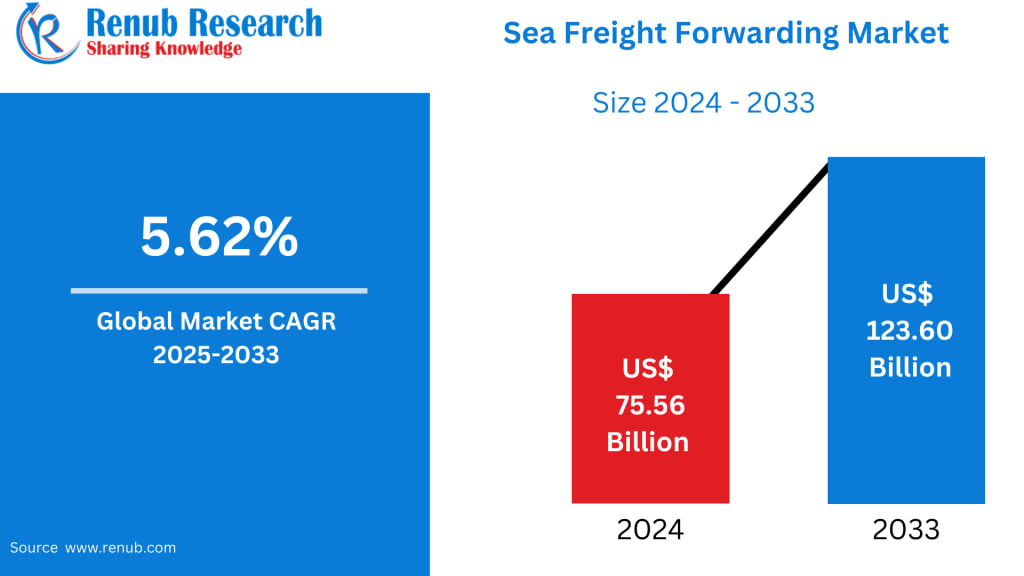
The Global Sea Freight Forwarding Market is entering a period of sustained expansion, supported by rising global trade volumes, increasing cross-border e-commerce, and continued investment in maritime infrastructure. According to Renub Research, the market is expected to grow from US$ 75.56 Billion in 2024 to US$ 123.60 Billion by 2033, registering a Compound Annual Growth Rate (CAGR) of 5.62% during 2025–2033.
Sea freight forwarding plays a foundational role in international commerce, acting as the backbone of global supply chains. By enabling the large-scale movement of goods across oceans, freight forwarders ensure that industries ranging from manufacturing and retail to healthcare and agriculture can operate efficiently and cost-effectively. As businesses increasingly prioritize scalability, sustainability, and resilience, sea freight forwarding continues to gain strategic importance within global logistics ecosystems.
Global Sea Freight Forwarding Market Outlook
Sea freight forwarding refers to the coordination and management of transporting goods via maritime routes. Freight forwarders act as intermediaries between exporters, importers, shipping lines, customs authorities, and insurers. Their services encompass cargo booking, documentation, customs clearance, packaging, warehousing, insurance, and final delivery coordination.
Globally, sea freight accounts for more than 80% of international trade by volume, making it the most economical and scalable transportation mode for bulk and heavy cargo. Compared with air freight, maritime shipping offers significantly lower per-unit transportation costs, making it indispensable for large manufacturers, FMCG companies, and commodity exporters.
Beyond cost efficiency, sea freight forwarding also aligns with sustainability goals. Maritime transport produces lower carbon emissions per ton-kilometer compared to air logistics, positioning it as a preferred option for companies adopting greener supply chain practices. With globalization continuing to shape consumption and production patterns, sea freight forwarding remains a crucial enabler of international trade and economic development.
Market Growth Drivers in the Sea Freight Forwarding Industry
Expansion of Global Trade and Cross-Border E-commerce
The steady expansion of global trade and international e-commerce is a major driver of the sea freight forwarding market. As consumers increasingly purchase goods from overseas suppliers, businesses rely on sea freight to transport large volumes of products efficiently and affordably.
Manufacturers exporting electronics, machinery, textiles, and consumer goods depend heavily on maritime logistics to access international markets. Freight forwarders are responding by offering technology-enabled services such as real-time cargo tracking, digital documentation, and integrated supply chain management, improving reliability and transparency for global shippers.
Rising Demand for Cost-Efficient Logistics Solutions
In an environment of rising operating costs and competitive pricing pressure, businesses are actively seeking logistics solutions that balance affordability with reliability. Sea freight forwarding offers unmatched cost advantages for bulk shipments, particularly through containerization.
Industries such as retail, FMCG, and manufacturing increasingly rely on freight forwarders not only for transportation but also for value-added services including customs brokerage, consolidation, warehousing, and inventory management. These integrated solutions help companies reduce logistics complexity while optimizing costs.
Port Infrastructure Development and Modernization
Investments in port infrastructure and maritime corridors are significantly enhancing the efficiency of sea freight forwarding worldwide. Governments and private operators are expanding container terminal capacity, automating cargo handling processes, and implementing smart port technologies.
Advanced port systems now offer real-time cargo visibility, faster turnaround times, and improved coordination between shipping stakeholders. These improvements reduce congestion, enhance schedule reliability, and strengthen the overall competitiveness of maritime logistics compared with alternative transport modes.
Challenges Facing the Sea Freight Forwarding Industry
Port Congestion and Supply Chain Disruptions
Despite technological progress, port congestion remains a persistent challenge for the sea freight forwarding industry. Events such as the COVID-19 pandemic, geopolitical tensions, and labor shortages have exposed vulnerabilities in global maritime supply chains.
Delays caused by vessel backlogs, container shortages, and unpredictable schedules increase operational costs and complicate inventory planning for businesses. Freight forwarders must continuously invest in digital tools, contingency planning, and strategic partnerships to mitigate these disruptions.
Environmental Regulations and Sustainability Pressures
Environmental sustainability has become a defining challenge for the sea freight sector. Regulations such as IMO 2020 require lower sulfur emissions, compelling shipping lines and freight forwarders to adopt cleaner fuels, energy-efficient vessels, and emissions monitoring systems.
While sustainability initiatives support long-term environmental goals, compliance increases operating costs. Balancing affordability with environmental responsibility remains a critical challenge for freight forwarders navigating an increasingly regulated landscape.
Market Segmentation Analysis
Full Container Load (FCL) Sea Freight Forwarding Market
Full Container Load services dominate the sea freight forwarding market due to their cost efficiency, reduced handling risks, and faster transit times. FCL shipments allocate an entire container to a single shipper, making them ideal for high-volume exporters.
Manufacturers and large retailers prefer FCL solutions for improved cargo security and predictable schedules. As global manufacturing output and export volumes rise, FCL demand is expected to remain strong throughout the forecast period.
Packaging and Labelling Sea Freight Forwarding Market
Packaging and labelling services are essential value-added offerings in sea freight forwarding. Proper packaging protects goods during long maritime transits, while compliant labelling ensures smooth customs clearance and accurate inventory tracking.
Industries such as FMCG, pharmaceuticals, and chemicals increasingly require specialized packaging solutions, including temperature-controlled containers. Growing regulatory requirements and quality standards continue to drive demand for professional packaging and labelling services.
Charter Services Sea Freight Forwarding Market
Charter services cater to businesses with oversized, project-based, or specialized cargo requirements. Industries such as construction, energy, and defense rely on chartered vessels for transporting heavy machinery and equipment.
With global supply chains demanding greater flexibility, charter services are gaining importance as freight forwarders expand their capabilities and strategic alliances to support customized shipping solutions.
End-Use Industry Insights
Retail and FMCG
Retail and FMCG sectors are major consumers of sea freight forwarding services due to their reliance on bulk transportation and global sourcing. Sea freight enables retailers to manage inventory efficiently while maintaining competitive pricing.
The growth of e-commerce and omnichannel retailing further strengthens demand for scalable and cost-effective maritime logistics solutions.
Healthcare
Healthcare logistics require specialized handling, regulatory compliance, and temperature-controlled transport. Sea freight forwarding supports the bulk shipment of pharmaceuticals, medical devices, and healthcare equipment across international markets.
As healthcare supply chains become more globalized, demand for compliant and secure sea freight forwarding solutions continues to rise.
Manufacturing
Manufacturing industries rely heavily on sea freight forwarding for transporting raw materials, components, and finished goods. Automotive, electronics, and heavy machinery manufacturers benefit from the scalability and affordability of maritime logistics.
Increasing industrialization in emerging economies is expected to further boost sea freight forwarding demand within the manufacturing sector.
Regional Market Insights
United States Sea Freight Forwarding Market
The United States remains a critical hub for global maritime trade, supported by major ports and advanced logistics infrastructure. Digitalization, sustainability initiatives, and strong consumer demand continue to drive steady growth in the U.S. sea freight forwarding market.
Germany Sea Freight Forwarding Market
Germany serves as Europe’s logistics powerhouse, with ports like Hamburg and Bremerhaven playing a central role in global trade. Strong infrastructure, industrial exports, and a focus on sustainable logistics strengthen Germany’s position in the sea freight forwarding market.
India Sea Freight Forwarding Market
India’s sea freight forwarding market is expanding rapidly, driven by rising exports, government-led port modernization initiatives, and increasing integration into global supply chains. Despite infrastructure challenges, technological adoption is improving operational efficiency.
UAE Sea Freight Forwarding Market
The UAE stands as a major maritime hub in the Middle East, benefiting from strategic geography and world-class port infrastructure. Continued investment in smart ports and green shipping reinforces its leadership in regional and global sea freight forwarding.
Competitive Landscape and Key Players
The global sea freight forwarding market is moderately fragmented, with both multinational logistics providers and regional specialists competing on service quality, technology, and network reach. Key companies covered in the market include:
Agility Logistics
Bolloré Logistics
C.H. Robinson Worldwide Inc.
CEVA Logistics
Deutsche Bahn AG
Deutsche Post AG
Expeditors International
GEODIS
Hellmann Worldwide Logistics SE & Co. KG
Kerry Logistics Network Limited
Each company has been analyzed across five viewpoints: overview, key personnel, recent developments, SWOT analysis, and revenue performance.
Final Thoughts
The Global Sea Freight Forwarding Market is poised for consistent growth through 2033, underpinned by expanding global trade, rising e-commerce activity, and ongoing infrastructure modernization. While challenges such as port congestion and environmental compliance persist, innovation, digitalization, and sustainability initiatives are reshaping the industry.
According to Renub Research, the market’s rise from US$ 75.56 Billion in 2024 to US$ 123.60 Billion by 2033 reflects the enduring importance of sea freight forwarding as a cornerstone of global commerce. As businesses continue to seek reliable, cost-efficient, and environmentally responsible logistics solutions, sea freight forwarders will remain indispensable players in the evolving global supply chain landscape.
About the Creator
Marthan Sir
Educator with 30+ years of teaching experience | Passionate about sharing knowledge, life lessons & insights | Writing to inspire, inform, and empower readers.
Keep reading
More stories from Marthan Sir and writers in Futurism and other communities.
Global Sea Freight Forwarding Market Size & Forecast 2025–2033
Introduction The Global Sea Freight Forwarding Market is entering a period of sustained expansion, supported by rising global trade volumes, increasing cross-border e-commerce, and continued investment in maritime infrastructure. According to Renub Research, the market is expected to grow from US$ 75.56 Billion in 2024 to US$ 123.60 Billion by 2033, registering a Compound Annual Growth Rate (CAGR) of 5.62% during 2025–2033.
By Marthan Sir10 days ago in Futurism
About Binding Prometheus
I want to start actively advocating on behalf of my own work, and the most valuable part of my canon is, without a doubt, Binding Prometheus, the play I have been working on since 2019 and only finished in 2023 as part of my MA. The play itself is an amalgamation of a million different inspirations. On one end, it evokes the Ancient Greek myth-play, deriving its own title from the earliest extant work of Western drama we have, Aeschylus’s Prometheus Bound. On the other end, it borrows significantly from the sci-fi bulwarks from over the years, namely Mary Shelley’s Frankenstein and Karel Capek’s Rossum’s Universal Robots. The play could be an episode of Black Mirror, I fear. I don’t know. I’ve only ever seen one episode of Black Mirror.
By Steven Christopher McKnight11 days ago in Futurism
AR and VR Smart Glasses Market: Smart Displays, AI Integration & Market Growth
According to IMARC Group's latest research publication, The global AR and VR smart glasses market size reached USD 18.6 Billion in 2024. Looking forward, IMARC Group expects the market to reach USD 53.6 Billion by 2033, exhibiting a growth rate (CAGR) of 11.82% during 2025-2033.
By James Whitman5 days ago in Futurism
If You Love Me, You'll Do It
I met Jason when I was five years old. I could say that I loved him from the moment I saw him. He was so handsome to me and I felt in awe by his presence. When they introduced him as the new kid in school, I wanted to be his friend right away. I remember it like it was yesterday. I remember his smile and how he didn't seem shy. He appeared confident and ready to learn. I waved at him and said "hello," before anyone else could even say a word. He sat next to me, and I asked him if he wanted to be friends. He looked so happy as he said, "Yes!"
By Sidney Smith (Sid Smith)6 days ago in Fiction


Comments
There are no comments for this story
Be the first to respond and start the conversation.