
Global Personal Computers Market Size & Forecast 2025–2033
A Digital Backbone Powering Work, Learning, and Entertainment Worldwide

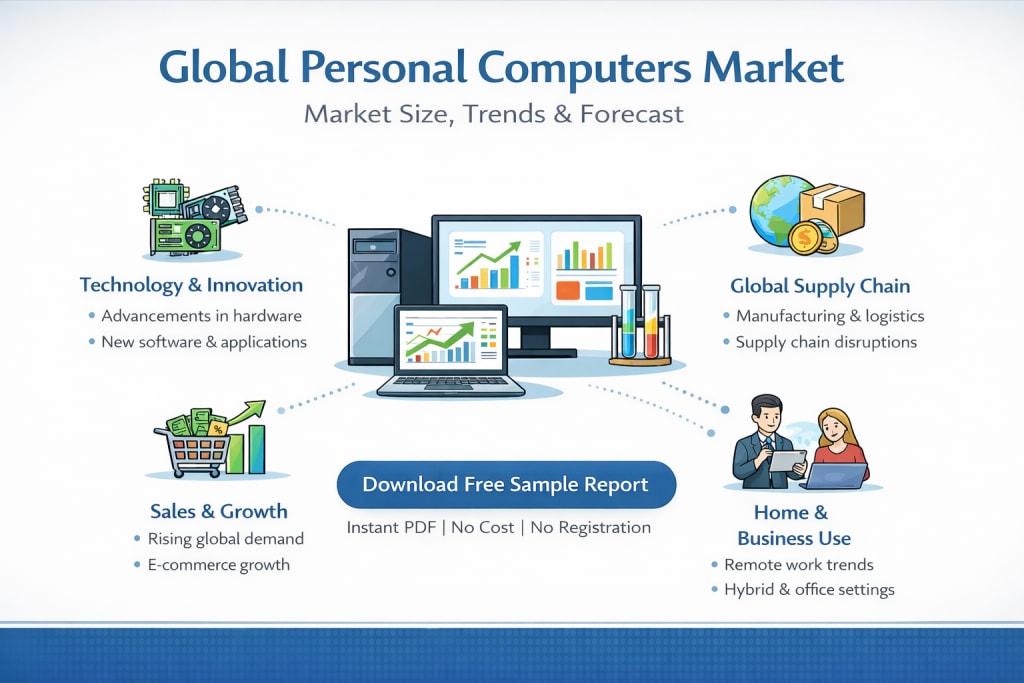
Global Personal Computers Market Outlook
The Global Personal Computers (PCs) Market continues to stand as one of the most critical pillars of the digital economy. According to Renub Research, the market is projected to grow at a CAGR of 7.88% from 2025 to 2033, reaching a value of US$ 311.15 billion by 2033, up from US$ 157.22 billion in 2024.
Personal computers—encompassing desktops, laptops, all-in-one systems, and hybrid devices—remain indispensable tools for productivity, communication, education, entertainment, and digital creation. While smartphones dominate casual connectivity, PCs retain their edge in performance-intensive tasks such as professional work, gaming, software development, data analysis, and multimedia production.
The market’s steady growth reflects long-term structural shifts: remote work becoming permanent in many industries, digital learning transforming education systems, and rising global demand for reliable, high-performance computing hardware.
What Are Personal Computers and Why Do They Matter?
Personal computers are single-user computing devices equipped with essential hardware components such as processors, RAM, storage, and display units, operating on platforms like Windows, macOS, ChromeOS, or Linux.
Across homes, PCs enable work-from-home setups, online education, content streaming, and gaming. In business environments, they are central to data management, finance modeling, software development, and enterprise operations. Healthcare, design, engineering, and entertainment sectors also rely heavily on PCs for specialized workloads.
Even in an era of cloud computing and mobile devices, PCs remain the backbone of serious digital productivity worldwide.
Global Growth Drivers Shaping the Personal Computers Market
Remote Work, E-Learning, and Hybrid Models
The post-pandemic world has permanently redefined how people work and learn. Organizations now rely on distributed teams, virtual collaboration tools, and cloud-based workflows—each requiring dependable personal computing devices. Educational institutions have also embedded digital learning into curricula, boosting long-term demand for affordable and mid-range PCs.
Major technology firms are responding with AI-enabled PCs that enhance productivity, security, and personalization, signaling a new upgrade cycle across consumer and enterprise segments.
Rising Digitalization and Internet Penetration
Rapid digital expansion in emerging economies such as India, Brazil, and parts of Africa continues to unlock fresh demand. With over two-thirds of the global population now online, PCs remain vital tools for accessing digital services, e-commerce, online banking, and remote employment opportunities.
For small businesses and freelancers in developing regions, entry-level and mid-range PCs serve as gateways to global digital participation.
Gaming, Content Creation, and Performance Innovation
PC gaming and digital content creation are powerful demand engines. High-performance desktops and gaming laptops equipped with advanced CPUs, GPUs, SSDs, and high-refresh displays continue to attract enthusiasts, streamers, and creative professionals.
Continuous innovation in processing power, thermal design, and AI acceleration fuels frequent upgrades, particularly in the premium and gaming price bands.
Key Challenges in the Global Personal Computers Market
Supply Chain Disruptions and Cost Pressures
Despite recovery from pandemic-era shocks, the PC industry remains vulnerable to semiconductor shortages, geopolitical tensions, and fluctuating component prices. Processors, memory, displays, and graphics cards account for a large share of system costs, and any disruption can impact pricing and availability—especially in cost-sensitive markets.
Market Saturation in Developed Economies
In regions such as North America and Western Europe, PC penetration is already high. Improved hardware durability and extended software support cycles mean consumers are holding devices longer. As a result, vendors must rely on innovation—AI features, form-factor evolution, and bundled services—to stimulate replacement demand.
Segment Analysis: Where Growth Is Coming From
Laptops / Notebooks Market
Laptops and notebooks dominate global shipments thanks to portability, versatility, and improving performance. Ultrabooks, 2-in-1 convertibles, and gaming laptops cater to professionals, students, and enthusiasts alike. Mobility remains a decisive purchasing factor, particularly in hybrid work environments.
Consumer Personal Computers Market
Consumer PCs—used for browsing, streaming, casual work, and gaming—benefit from competitive pricing, attractive designs, and bundled software. Brand recognition and ease of use strongly influence buying decisions, especially among first-time users in emerging economies.
Government and Education PCs
Public sector and educational institutions represent stable, high-volume buyers. Digital classrooms, e-governance initiatives, and standardized IT infrastructure programs continue to support large-scale procurement of affordable, secure PC systems.
ARM-Based Personal Computers
ARM-based PCs are gaining momentum due to power efficiency, long battery life, and instant-on performance. As software compatibility improves and performance increases, ARM architectures are emerging as viable alternatives to traditional x86 systems—particularly for mobile professionals and students.
Mid-Range PCs: The Market Sweet Spot
Priced between USD 600 and USD 1,200, mid-range PCs balance performance and affordability. They appeal to students, office professionals, and SMBs, making this segment one of the most resilient and widely adopted across regions.
Offline Retail and VARs
Despite the rise of e-commerce, offline retail stores and value-added resellers remain essential—especially in emerging markets. Personalized advice, local service support, and configuration flexibility ensure these channels retain strong relevance.
Windows Operating System Dominance
Windows continues to lead globally due to extensive software compatibility and enterprise manageability. Businesses, governments, and educational institutions heavily favor Windows PCs, ensuring sustained long-term demand.
Regional Insights: Country-Level Market Highlights
United States
The U.S. remains one of the largest and most mature PC markets globally. Strong demand for premium devices, gaming systems, and enterprise solutions underpins market stability. Corporate IT refresh cycles and government procurement contribute significantly to volumes.
France
France’s PC market is steady, supported by corporate IT spending, education digitization, and creative industries. Laptops dominate consumer sales, while desktops maintain relevance in professional environments.
India
India is among the fastest-growing PC markets worldwide. Government digital education programs, rising internet access, and a growing middle class drive strong demand for entry-level and mid-range systems. Local manufacturing incentives further support market expansion.
Brazil
Brazil’s PC demand is fueled by SMB growth, remote work adoption, and education digitization. While price sensitivity remains high, local assembly and partnerships help improve affordability and availability.
Saudi Arabia
Saudi Arabia’s PC market benefits from Vision 2030 initiatives focused on digital transformation, education, and e-government. Demand spans from institutional bulk purchases to premium consumer laptops, supported by a tech-savvy urban population.
Market Segmentation Snapshot
By End User
Consumer
Small & Medium Business
Large Enterprise
Government & Education
By Processor Architecture
x86 (Intel–AMD)
ARM-based
RISC-V & Others
By Price Band
Entry-Level (< USD 600)
Mid-Range (USD 600–1200)
Premium / Gaming (> USD 1200)
By Distribution Channel
Offline Retail & VARs
E-commerce & Direct-to-Consumer
By Operating System
Windows
macOS
ChromeOS
Linux Distributions
Competitive Landscape and Key Players
The global PC market is highly competitive, driven by innovation, brand loyalty, and scale efficiencies. Major players profiled by Renub Research include:
Lenovo Group Limited
HP Inc.
Dell Technologies Inc.
Apple Inc.
Acer Incorporated
Microsoft Corporation
Samsung Electronics Co., Ltd.
Huawei Technologies Co., Ltd.
Xiaomi Corporation
LG Electronics Inc.
Each company is analyzed across five viewpoints: Overview, Key Personnel, Recent Developments, SWOT Analysis, and Revenue Performance, providing a holistic competitive perspective.
Final Thoughts
The Global Personal Computers Market is entering a transformative phase. No longer driven solely by replacement cycles, growth is increasingly powered by structural shifts in work, education, gaming, and digital creativity. AI-enabled computing, ARM architectures, and hybrid form factors are redefining what a personal computer can do.
With emerging economies accelerating adoption and developed markets focusing on innovation-led upgrades, the PC industry remains resilient, relevant, and future-ready. As digital lifestyles continue to evolve, personal computers will remain essential tools—bridging productivity, creativity, and connectivity well into the next decade.
About the Creator
Janine Root
Janine Root is a skilled content writer with a passion for creating engaging, informative, and SEO-optimized content. She excels in crafting compelling narratives that resonate with audiences and drive results.
Keep reading
More stories from Janine Root and writers in Futurism and other communities.
Global Brain Computer Interface Market Size & Forecast 2025–2033
Global Brain Computer Interface Market Outlook The Global Brain Computer Interface (BCI) Market is projected to reach US$ 181.52 billion by 2033, expanding from US$ 158.33 billion in 2024, at a CAGR of 1.53% during 2025–2033, according to Renub Research. While the growth rate appears moderate, the long-term significance of BCIs is transformative, positioning them as one of the most disruptive technologies of the coming decades.
By Janine Root 17 days ago in Futurism
About Binding Prometheus
I want to start actively advocating on behalf of my own work, and the most valuable part of my canon is, without a doubt, Binding Prometheus, the play I have been working on since 2019 and only finished in 2023 as part of my MA. The play itself is an amalgamation of a million different inspirations. On one end, it evokes the Ancient Greek myth-play, deriving its own title from the earliest extant work of Western drama we have, Aeschylus’s Prometheus Bound. On the other end, it borrows significantly from the sci-fi bulwarks from over the years, namely Mary Shelley’s Frankenstein and Karel Capek’s Rossum’s Universal Robots. The play could be an episode of Black Mirror, I fear. I don’t know. I’ve only ever seen one episode of Black Mirror.
By Steven Christopher McKnight12 days ago in Futurism
Edible Cutlery Market: Sustainable Utensils, Eco-Friendly Alternatives & Zero-Waste Dining Trends
According to IMARC Group's latest research publication, global edible cutlery market size was valued at USD 37.7 Million in 2025. Looking forward, IMARC Group expects the market to reach USD 76.9 Million by 2034, exhibiting a growth rate (CAGR) of 7.38% during 2026-2034.
By sujeet. imarcgroup4 days ago in Futurism




Comments
There are no comments for this story
Be the first to respond and start the conversation.