
Global Human Microbiome Manufacturing Services Market Poised to Triple by 2031, Reaching $270 Million as Live Biotherapeutics Revolution Accelerates
Strategic Investments in GMP-Compliant Production and Next-Generation Microbial Therapeutics Drive Robust 16.7% CAGR Through 2031

The global human microbiome manufacturing services market is entering a transformative growth phase, advancing from $110 million in 2025 to a projected $270 million by 2031, representing a compelling CAGR of 16.7%. This expansion reflects a fundamental shift in how pharmaceutical and biotechnology companies approach live biotherapeutic product (LBP) development, as specialized manufacturing capabilities become essential for bringing next-generation microbial therapeutics from clinical trials to commercial reality.
Download PDF Brochure of Human Microbiome Manufacturing Services Market
Why This Market Matters Now
The accelerating development of live biotherapeutic products is creating unprecedented demand for specialized manufacturing expertise. As pharmaceutical companies increasingly recognize the limitations of in-house production capabilities, they are turning to contract development and manufacturing organizations (CDMOs) for GMP-compliant microbiome production. This outsourcing trend is driven by the complex requirements of anaerobic fermentation, microbial process scale-up, precision formulation, and fill-finish operations—capabilities that require substantial capital investment and technical expertise.
What's Driving Market Momentum
Three converging forces are propelling market expansion. First, the robust pipeline of live biotherapeutic products transitioning from research into clinical trials is creating sustained demand for manufacturing partnerships. Second, strong investments in next-generation microbial therapeutics are accelerating as pharmaceutical companies recognize the therapeutic potential of microbiome-based interventions. Third, the growing sophistication of microbiome science is enabling multi-strain formulations and personalized therapeutics that require advanced manufacturing platforms.
Who Dominates the Market Landscape
North America commanded the largest market share in 2024, driven by concentrated CDMO activity and robust biopharmaceutical investment. Industry leaders Lonza, Evonik, and Eurofins Scientific have established themselves as star players through strong market positioning and comprehensive service footprints. Meanwhile, emerging competitors including Cerbios-Pharma SA, List Biological Labs, Inc., and Elise Biopharma are carving out specialized niches, positioning themselves as potential future market leaders.
Where Growth Is Concentrated
Fermentation and downstream processing represents the fastest-growing segment, expected to advance at 16.8% CAGR through 2031. This dominance reflects the central importance of these processes in producing high-quality, scalable, and GMP-compliant live biotherapeutic products. The segment's growth underscores how manufacturing complexity is becoming a competitive differentiator in bringing microbiome therapeutics to market.
Which Therapeutic Areas Lead Adoption
Gastrointestinal diseases accounted for the largest share in 2024, reflecting the concentration of clinical programs targeting gut-related conditions including inflammatory bowel disease, irritable bowel syndrome, and recurrent Clostridium difficile infection. This therapeutic focus aligns with scientific understanding of the microbiome's most significant impact on human health and represents the most mature area of microbiome therapeutic development.
How Pharmaceutical Companies Are Responding
Pharmaceutical and biotechnology companies represented the largest end-user segment in 2024, driven by extensive R&D investments and commercialization initiatives. These organizations increasingly rely on specialized CDMOs to accelerate clinical programs while reducing internal infrastructure costs. The strategic rationale is clear: outsourcing enables faster time-to-market, access to specialized expertise, and capital efficiency as companies navigate the complex path from clinical development to commercial production.
Market Transformation and Industry Disruption
The market is witnessing a fundamental shift from traditional small-scale microbial fermentation toward GMP-grade, large-scale production utilizing automated, closed-system platforms. This transformation is creating new revenue streams through advanced manufacturing services for live biotherapeutics, precision multi-strain formulations, and integrated chemistry, manufacturing, and controls (CMC) development. These capabilities enable pharmaceutical, academic, and clinical organizations to adopt high-throughput, standardized workflows that deliver faster development cycles, improved product safety, higher reproducibility, and reduced operational costs.
Strategic Market Dynamics
Growth opportunities are emerging at the intersection of artificial intelligence and automated microbial manufacturing platforms. AI-driven systems are optimizing microbial strain selection, fermentation protocols, and quality control procedures, while automated manufacturing enhances scalability, traceability, and operational efficiency. These technologies reduce human error, accelerate time-to-market, and decrease production costs—compelling value propositions for pharmaceutical firms and biotech enterprises investing in next-generation live biotherapeutic production.
However, significant challenges remain. Limited availability of GMP-compliant infrastructure and specialized technical expertise constrains productive capacity and elevates costs, particularly for small and mid-sized biotech companies. Additionally, the complex and evolving global regulatory landscape for live biotherapeutics creates compliance challenges. Stringent guidelines across regions encompassing safety, potency, stability, and labeling requirements, combined with variability in approval pathways between the US, Europe, and Asia Pacific, complicate commercialization strategies and increase development timelines.
Strategic Implications for Decision-Makers
The market's robust growth trajectory presents compelling opportunities for pharmaceutical executives evaluating manufacturing partnerships, biotechnology leaders assessing competitive positioning, and investment professionals analyzing the microbiome therapeutics ecosystem. The shift toward standardized, regulatory-compliant manufacturing represents a strategic inflection point as live biotherapeutics transition from research novelty to commercial reality.
Market Ecosystem and Value Chain
The human microbiome manufacturing services ecosystem comprises specialized service providers (Lonza, Novonesis, Eurofins), regulatory authorities (FDA, EMA, UK Government), raw material suppliers (ProDigest, Novonesis, Lesaffre), and end users (pharmaceutical companies, research institutes, healthcare organizations). This integrated value chain demonstrates how manufacturing capabilities have become central to translating microbiome science into therapeutic applications.
Recent Strategic Developments
In September 2024, Lonza expanded its microbial manufacturing capacity in Germany, scaling production capabilities for live biotherapeutic products. This strategic investment underscores industry leaders' confidence in sustained market growth and reflects the competitive imperative to build GMP-compliant capacity ahead of anticipated demand from clinical-stage and commercial programs.
When Market Leaders Are Making Their Moves
The current market environment favors early movers establishing manufacturing partnerships and building production capabilities. As live biotherapeutics advance through clinical development, companies securing manufacturing capacity and regulatory expertise are positioning themselves for commercial success. The market's 16.7% CAGR through 2031 signals sustained growth momentum that rewards strategic positioning and operational excellence.
Strategic Takeaways for C-Suite Executives
For pharmaceutical and biotechnology leaders, the expanding human microbiome manufacturing services market represents both opportunity and imperative. Companies must evaluate their manufacturing strategies, assess partnership opportunities, and build regulatory capabilities to capitalize on the live biotherapeutics revolution. The market's trajectory from $110 million to $270 million over six years reflects not just growth but fundamental transformation in how microbial therapeutics are developed, manufactured, and commercialized.
About This Market Analysis
This comprehensive market assessment covers the period 2023-2031, with 2024 as the base year and forecasts extending through 2031. The analysis encompasses strain development and optimization, fermentation and downstream processing, formulation and fill-finish services across gastrointestinal, metabolic, immune, and infectious disease applications. Geographic coverage includes North America, Europe, Asia Pacific, Latin America, and Middle East and Africa, providing global strategic perspective for decision-makers evaluating this high-growth market.
About the Creator
Keep reading
More stories from Juan Martinez and writers in Futurism and other communities.
Europe Pen Needles Market Poised for Steady Expansion, Reaching US$1.10 Billion by 2031 Amid Diabetes Growth and Home-Care Shift
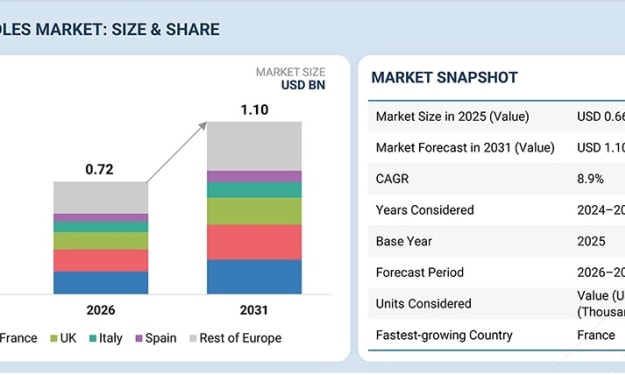
Europe’s pen needles market is entering a period of sustained, value-driven growth as chronic disease burden, demographic shifts, and home-based care adoption reshape injectable therapy delivery across the region. Valued at US$0.66 billion in 2025, the market increased to US$0.72 billion in 2026 and is projected to expand at a resilient CAGR of 8.9% from 2026 to 2031, reaching a forecasted US$1.10 billion by 2031.
By Juan Martineza day ago in Futurism
About Binding Prometheus
I want to start actively advocating on behalf of my own work, and the most valuable part of my canon is, without a doubt, Binding Prometheus, the play I have been working on since 2019 and only finished in 2023 as part of my MA. The play itself is an amalgamation of a million different inspirations. On one end, it evokes the Ancient Greek myth-play, deriving its own title from the earliest extant work of Western drama we have, Aeschylus’s Prometheus Bound. On the other end, it borrows significantly from the sci-fi bulwarks from over the years, namely Mary Shelley’s Frankenstein and Karel Capek’s Rossum’s Universal Robots. The play could be an episode of Black Mirror, I fear. I don’t know. I’ve only ever seen one episode of Black Mirror.
By Steven Christopher McKnight27 days ago in Futurism
Whiskey At Dusk
Guess the whiskey was more important to you in the end, wasn’t it? It was more than the well-being of your friends; more vital than showing up to the places you promised you would and could come to; more critical of a matter than fulfilling your damn responsibilities and getting the press off your back.
By Snarky Lisa4 days ago in Humans


Comments
There are no comments for this story
Be the first to respond and start the conversation.