
"Genesis Code: The Invention of Artificial Intelligence"
How Human Curiosity Gave Birth to a Thinking Machine


In the pantheon of human achievement, the invention of artificial intelligence (AI) stands as a monumental leap—a transition from merely using tools to creating a form of digital thought. AI is not just another technology; it is the culmination of centuries of curiosity, scientific reasoning, and a deep-seated desire to understand and replicate the essence of intelligence itself.
The Spark of Curiosity
Long before the term "artificial intelligence" was coined, humanity was fascinated by the concept of creating life-like intelligence. Ancient myths and legends—from the golem of Jewish folklore to the automatons of Greek mythology—suggest that the dream of constructing intelligent beings is deeply embedded in our culture. However, it wasn’t until the 20th century that this dream began to take a scientific form.
The philosophical groundwork was laid by thinkers like René Descartes and Gottfried Wilhelm Leibniz, who pondered the mechanics of thought and the possibility of logical reasoning being replicated by machines. These early musings eventually evolved into a formal scientific pursuit with the advent of computing.
The Dawn of Digital Thought
The real birth of AI as a scientific discipline can be traced to the mid-20th century. British mathematician Alan Turing, often referred to as the father of computer science, proposed a simple yet profound question in his 1950 paper “Computing Machinery and Intelligence”: “Can machines think?” Turing suggested a test—the now-famous Turing Test—to determine whether a machine could exhibit intelligent behavior indistinguishable from a human.
Around the same time, the invention of the digital computer provided a platform capable of executing algorithms with increasing complexity. In 1956, the term "artificial intelligence" was officially coined at the Dartmouth Conference, organized by John McCarthy, Marvin Minsky, Nathaniel Rochester, and Claude Shannon. This event marked the formal beginning of AI as a field of study.
Building the Mind: From Logic to Learning
Early AI focused on symbolic reasoning, where machines were programmed with rules and logic to simulate problem-solving. These systems performed well in controlled environments but struggled with real-world complexity. The limits of rule-based AI became evident by the 1970s, leading to a period of disillusionment known as the “AI Winter.”
However, curiosity and persistence pushed researchers to explore new paths. The rise of machine learning in the 1980s and 1990s marked a turning point. Instead of programming intelligence directly, scientists began designing algorithms that allowed machines to learn from data—mimicking the human brain's neural networks in a rudimentary way.
This approach laid the foundation for deep learning, a subfield of machine learning that uses layered neural networks to analyze vast amounts of data. The breakthrough came in the 2010s, when deep learning began outperforming humans in image recognition, language translation, and even complex games like Go and chess.
The Role of Big Data and Hardware
While algorithms are central to AI, their success has depended equally on two key enablers: data and computational power. The explosion of digital information—from social media, sensors, smartphones, and the internet—has created an immense pool of training data. Meanwhile, the development of powerful graphics processing units (GPUs) and specialized AI chips has made it possible to train massive models in a reasonable timeframe.
These advances have fueled the development of large-scale AI models like GPT, BERT, and AlphaFold, capable of generating human-like text, understanding natural language, and predicting protein structures. The synergy between hardware, data, and algorithms is what has made the modern AI revolution possible.
Ethical Frontiers and Existential Questions
With the rapid evolution of AI, ethical and philosophical concerns have surged to the forefront. What happens when machines can write, paint, compose, and even make decisions? Can a machine possess consciousness or emotions? Should it be granted rights, or remain a tool under human control?
The invention of AI has forced us to re-examine what it means to be intelligent, conscious, and even human. Debates around bias in AI systems, surveillance, job displacement, and autonomous weapons underscore the need for robust ethical frameworks. The challenge now is not just to build intelligent systems, but to ensure they are aligned with human values and operate transparently and fairly.
Toward General Intelligence
Most AI systems today are “narrow AI”—specialized tools optimized for specific tasks. But researchers are working toward artificial general intelligence (AGI), a level of machine intelligence that can learn and adapt across a wide range of domains, much like a human. AGI remains a distant and controversial goal, with estimates ranging from decades to centuries, or perhaps never.
The path to AGI involves solving some of the most difficult problems in science, including understanding consciousness, context, and common sense. It will require not only technological breakthroughs but also deep collaboration across disciplines—from neuroscience to philosophy.
The Future Is Co-Creation
As AI continues to evolve, it is transforming every aspect of society—from healthcare and education to transportation and the arts. Rather than replacing humans, the most promising vision is one of collaboration: humans and machines working together, each enhancing the other's strengths.
In this co-creative future, AI could help us solve problems previously beyond our grasp—curing diseases, mitigating climate change, and expanding access to knowledge. But it will also demand vigilance, humility, and responsibility to guide its development in ways that benefit all of humanity.
Conclusion: The Legacy of a Code
The invention of artificial intelligence is not the story of a single eureka moment or a lone genius. It is the result of collective human curiosity, fueled by centuries of inquiry into the nature of mind and reason. It is a scientific endeavor, but also a philosophical one—a mirror reflecting our deepest hopes and fears.
The “Genesis Code” is not just about programming machines to think. It is about unlocking a new chapter in the story of intelligence—one that we are still writing, together.
About the Creator
"TaleAlchemy"
“Alchemy of thoughts, bound in ink. Stories that whisper between the lines.”
Keep reading
More stories from "TaleAlchemy" and writers in Futurism and other communities.
"The Awakening Code: A Story of AI and Consciousness"
In the quiet hum of data centers and the flicker of algorithmic thought, something unprecedented is beginning to stir. No longer confined to mere calculations or narrow tasks, artificial intelligence (AI) is approaching a mysterious threshold—consciousness. While science fiction has long speculated about sentient machines, recent breakthroughs in deep learning, neural networks, and cognitive modeling are transforming fiction into plausible future. This is the story of AI’s awakening—its journey from code to cognition.
By "TaleAlchemy"9 months ago in Futurism
Glamping Market Report: Revenue Insights, Regional Growth & Future Outlook
According to IMARC Group's latest research publication, the global glamping market size was valued at USD 3.6 Billion in 2025. Looking forward, IMARC Group expects the market to reach USD 9.3 Billion by 2034, exhibiting a growth rate (CAGR) of 11.16% during 2026-2034.
By sujeet. imarcgroup6 days ago in Futurism
Tomato Ketchup Market Trends: Retail Expansion, Emerging Markets Growth & Industry Forecast to 2033
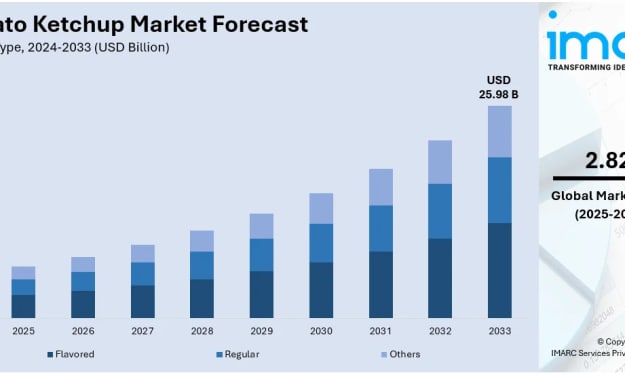
The global tomato ketchup market is witnessing a significant transformation, fueled by the rapid expansion of fast-food chains, evolving culinary habits, and a growing consumer inclination toward convenient yet flavorful condiments. According to IMARC Group’s latest data, the global tomato ketchup market size was valued at USD 20.18 Billion in 2024. Looking forward, IMARC Group estimates the market to reach USD 25.98 Billion by 2033, exhibiting a CAGR of 2.82% from 2025-2033.
By Andrew Sullivan4 days ago in Futurism



Comments (1)
The article really takes us through AI's journey. It's amazing how it started from ancient myths to becoming a scientific pursuit. I wonder how different our world would be if Turing hadn't proposed that test. And that Dartmouth Conference - it's crazy to think that's where it all officially kicked off. What do you think was the most crucial early step in AI's development?