

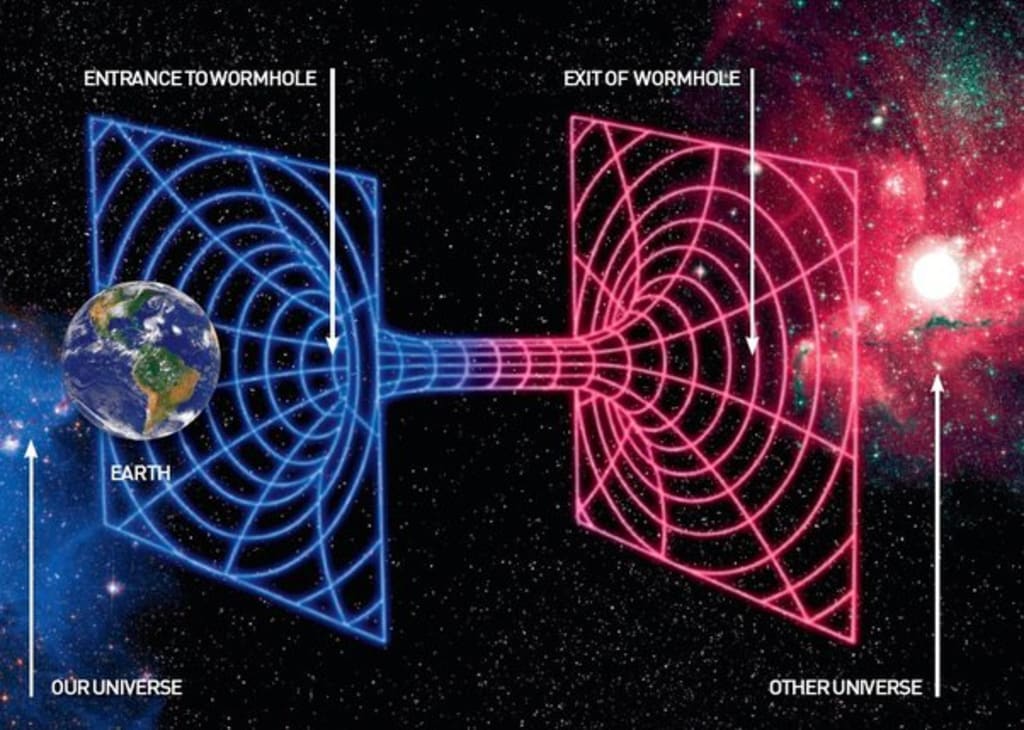
If you were to witness a real wormhole, it would look spherical, much like a black hole, and allow light to pass through, providing a glimpse into a distant place. Once crossed, your old home would recede into the shimmering spherical window as the other side comes fully into view. However, the question remains:
Are wormholes real or merely a mystical disguise for physics and mathematics?
If they do exist, how do they function?
where can we discover them? Hang on.
Let's visualize this concept in 2D: Our universe resembles a large, flat sheet, skillfully bent to enable wormholes to connect two remote locations with a short bridge enabling nearly instantaneous travel across the universe, even faster than the speed of light! It’s kind of like a shortcut to enter another parallel universe as in sci fi films. Sounds amazing huh ?
As for the whereabouts of these wormholes, at present, they only exist on paper. While general relativity suggests their potential existence, it doesn't guarantee they are real. General relativity is a mathematical framework, with numerous potential solutions, but not all mathematical concepts correspond to reality.
The initial concept of wormholes, known as Einstein-Rosen Bridges, theorized that every black hole could serve as a gateway to an infinite parallel universe. Meaning if you were to fall into a black hole and come out from the opposite end which is impossible by the way because you never survive falling into, but let’s assume you do! Woah congrats ,you end up in a parallel universe. You fall through the black hole again ? well another parallel universe 😊 Sounds like a dream ,isn’t it ?
In a 2D representation, empty space-time begins flat but becomes curved by objects within it. When an object is compressed, space-time curves more and can ultimately collapse into a black hole. At this point, an event horizon forms—a one-way barrier where anything can enter but nothing can escape.
However, an alternative possibility exists: on the other side of the black hole, there might be a universe resembling ours but inverted, with time running backward. Who knows whether another you exists in this parallel universe ! Unfortunately, these Einstein-Rosen bridges cannot be traversed in practice. Crossing over to the opposite universe would take an infinite amount of time, and they pinch shut in the middle.
For humans to achieve rapid cosmic travel, they require a distinct type of wormhole known as a Traversable Wormhole.
If string theory or one of its variants accurately describes our universe, we might be fortunate, as our universe could be filled with an intricate network of countless existing wormholes. Shortly after the Big Bang, quantum fluctuations on scales much smaller than an atom could have generated numerous traversable wormholes. These wormholes are intertwined with cosmic strings. In the first fraction of a second after the Big Bang, these tiny wormholes were stretched light-years apart and dispersed throughout the universe. If such wormholes were created in the early universe, possibly with cosmic strings or another mechanism, they might be scattered throughout, awaiting discovery, and one might be closer than we think.
However, wormholes have a darker side. Even creating a single wormhole can disrupt the universe in fundamental ways, potentially leading to time travel paradoxes and violating the causal structure of reality. Many scientists believe that these challenges suggest not only the impossibility of creating wormholes but also their existence. For now, we know wormholes exist in theory and in our imaginations, perhaps waiting to be discovered 😊
About the Creator
Sakuni Bandara
Just Another average girl !
Keep reading
More stories from Sakuni Bandara and writers in Futurism and other communities.
How Accurate Interstellar Really Is?
When Interstellar hit theaters in 2014, it didn’t just entertain audiences , it rewired our brains. Christopher Nolan didn’t want another sci-fi fantasy. He wanted a film where space looked like space, where gravity behaved like gravity, and where black holes appeared the way the universe actually paints them. And standing behind him was Nobel Prize winning physicist Kip Thorne, whose job was to keep the movie grounded in real physics…at least, as real as physics allows when you’re folding spacetime like origami.
By Sakuni Bandara3 months ago in Futurism
Launch and Scientific Impact of NASA’s Nancy Grace Roman Space Telescope (2026)
In 2026, NASA is preparing to launch one of the most ambitious space observatories of the decade: the Nancy Grace Roman Space Telescope. Designed to survey the universe at an unprecedented scale in near-infrared light, Roman is expected to reshape modern astrophysics by combining high resolution with an extraordinarily wide field of view. If the Hubble Space Telescope revealed the fine details of the cosmos, Roman will provide the panoramic context.
By Holianyk Ihor6 days ago in Futurism
Australia Cold Chain Logistics Market: Temperature-Controlled Capacity, Food & Pharma Demand & Technology Integration
According to IMARC Group, the Australia cold chain logistics market was valued at USD 5.2 Billion in 2025 and is projected to reach USD 7.3 Billion by 2034, exhibiting a compound annual growth rate (CAGR) of 3.80% during 2026–2034. The market’s steady expansion reflects the growing importance of temperature-controlled supply chains across Australia. Rising investments in refrigerated transportation fleets, advanced cold storage warehouses and smart inventory systems are strengthening logistics infrastructure nationwide. As food safety standards tighten and pharmaceutical distribution becomes increasingly complex, cold chain logistics is emerging as a strategic pillar of supply chain resilience.
By Shrestha Roy4 days ago in Futurism


Comments (1)
I think the text is well-written and informative. It provides a good overview of the concept of wormholes for a general audience.