
From Tons of Iron to a Gram of DNA – The Fascinating Evolution of Data Storage
The incredible shrinking history of how we save our digital world.

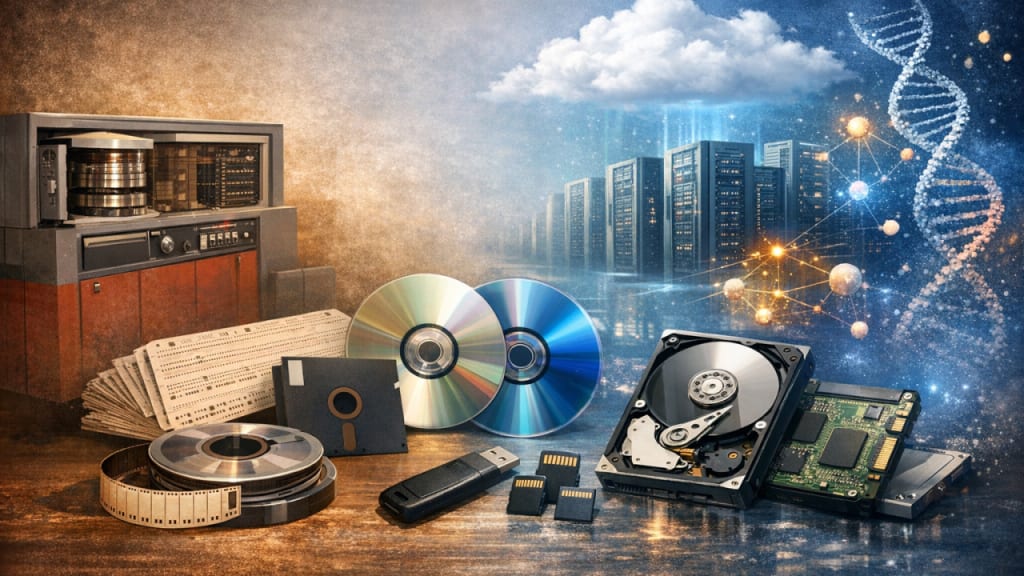
Did you know that the first hard drive in 1956 weighed over a ton, was the size of two refrigerators, and could hold just 5 MB of data? Today, the same amount of information fits on an area smaller than a fingernail, and technology keeps moving forward.
The history of data storage is a journey that shows how dramatically our needs have changed. It’s no longer just about “storing data” – today, instant access, mobility, and security matter. Let’s take a closer look at the path we’ve traveled.
📜 Beginnings: Punched Cards (1950s–70s)
Our first digital steps were made on paper. A standard IBM card held only 80 characters. Powerful machines read the data at speeds from a few dozen to even 1,000 cards per minute. It may sound prehistoric today, but these “punched sheets” enabled the computerization of the first enterprises.
📼 Magnetic Tapes: Durability That Stands the Test of Time
Introduced in the 1950s, tapes revolutionized archives. Although data access was sequential (you had to rewind the entire tape), their cost-efficiency was unbeatable.
Fun fact: tapes are still alive today! Modern LTO-9 cartridges hold up to 18 TB and remain the safest long-term storage in banks and data centers.
💾 The Floppy Disk Era: Birth of Mobility
Floppy disks gave us something new: the ability to take files home.
8-inch: up to 1 MB
5¼-inch: 360 KB – 1.2 MB
3½-inch: the legendary 1.44 MB, still iconic as a save symbol in many programs.
💿 Optical Media: The Multimedia Breakthrough
CDs, DVDs, and Blu-rays dominated the 1990s and early 2000s. We jumped from megabytes to gigabytes, enabling HD movies and huge games to be distributed.
Blu-ray: up to 50 GB per disc, read speeds up to 72 MB/s.
⚡ HDDs and the SSD Revolution
Hard drives (HDDs) were the heart of PCs for decades, evolving from 5 MB to today’s massive 20–30 TB units. But Flash technology changed the rules. The shift to SSDs wasn't just about speed; it brought a new level of durability. Since they have no moving parts, our devices became much more resistant to physical shocks, finally sealing the fate of the fragile mechanical drive in laptops. Latest NVMe PCIe 5.0 drives reach mind-blowing speeds of 12,000 – 14,000 MB/s.
☁️ Cloud Storage: Data Without Limits
Today, physical drives are optional. The cloud offers virtually unlimited storage and access from anywhere in the world. This technology also redefined collaboration. Real-time synchronization allows teams across different continents to work on the same file simultaneously, shifting the responsibility for data backups from the individual user to massive, secure data centers.
🧬 The Future: What’s Next?
Silicon is reaching its limits, so science is looking to nature and quantum physics:
DNA Storage: 1 gram of DNA can hold up to 215 PB (215,000 TB) of data – information that could survive thousands of years.
Decentralized Storage: distributed databases (blockchain/IPFS) that are hard to delete or censor.
Summary
The evolution of storage is more than just numbers – it’s a story of how we’ve become an information-driven society. The pace of this revolution is staggering, considering we moved from room-sized machines to microscopic circuits in just seven decades. From clay tablets to threads of DNA, we’ve always searched for ways to preserve knowledge. As we stand on the brink of biological storage, the very definition of "memory" is set to change once again.
What about you? Do you remember your first data storage device? Was it the iconic floppy disk, or did your journey start with a USB drive? Share in the comments! I am looking forward to hear it! 👇
About the Creator
Piotr Nowak
Pole in Italy ✈️ | AI | Crypto | Online Earning | Book writer | Every read supports my work on Vocal
Keep reading
More stories from Piotr Nowak and writers in Futurism and other communities.
AI as a Confidant: Between Salvation and the Abyss 🤖💔
More and more often, we encounter situations where people treat a chatbot as a confidant, a confessor, a friend, or their only companion. It is in human nature to need to "vent" and release difficult emotions 🗣️. Sometimes a lack of family, a lack of trust in one's surroundings, or most often, paralyzing shame, makes us write to a chat window instead of a fellow human being.
By Piotr Nowakabout 11 hours ago in Futurism
Durable Medical Equipment Industry Landscape: Regulatory Framework & Growth Potential
The aging population worldwide, coupled with the rising number of people living with chronic conditions like diabetes, heart disease, and respiratory disorders, is reshaping healthcare delivery and pushing durable medical equipment (DME) to the center of patient care strategies. According to IMARC Group's latest data, the global durable medical equipment (DME) market size was valued at USD 228.93 Billion in 2024. Looking forward, IMARC Group estimates the market to reach USD 370.38 Billion by 2033, exhibiting a CAGR of 5.05% from 2025-2033. North America currently dominates the market, holding a significant market share of over 35.0% in 2024.
By sujeet. imarcgroup4 days ago in Futurism
Australia Electric Vehicle Charging Market: Infrastructure Expansion, Policy Support & Technology Advancement
According to IMARC Group, the Australia electric vehicle (EV) charging market reached a value of USD 304.4 Million in 2025 and is projected to expand rapidly to USD 1,692.2 Million by 2034, exhibiting a strong compound annual growth rate (CAGR) of 21.00% during 2026–2034. This exceptional growth reflects the accelerating shift toward electric mobility and the critical role charging infrastructure plays in enabling large-scale EV adoption. As transport electrification becomes a central pillar of national decarbonization strategies, charging networks are evolving from early-stage infrastructure into a core component of Australia’s energy and mobility ecosystem. Expansion across urban centers, regional corridors and remote areas is improving accessibility and consumer confidence, positioning EV charging as a strategic growth market across Australia.
By Shrestha Roy3 days ago in Futurism



Comments
There are no comments for this story
Be the first to respond and start the conversation.