
From Information to Recompassion: The Future of Information
Beyond Hype, Toward Our Future with AI

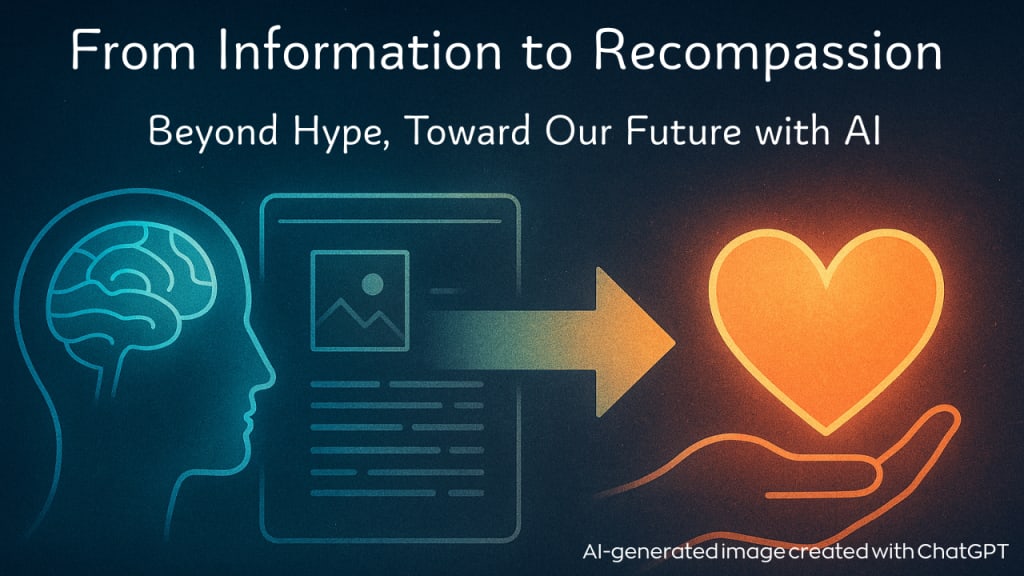
Is this the worst timing in the AI hype cycle?
When we talk about the future of AI, the term “hype cycle” often comes up. New technologies rise to a “peak of inflated expectations,” then fall into a “trough of disillusionment,” and eventually settle into practical uses. I sometimes call this wave, half in jest, the “bubble cycle.”
Right now, we may be standing in the most uncomfortable spot—caught between excitement and disappointment. We are dazzled by possibility yet unsettled by doubt. It feels less like smooth progress and more like a historical crossroad.
⸻
1. Between enthusiasm and disillusionment
Expectations for AI have never been higher. Text, images, music, even code—it is treated like a universal tool.
Yet at the same time, its outputs are often called “banal, lacking in humanity.”
Just as people once worried that calculators would erode mental arithmetic, today we fear that AI may weaken our human capacity for expression.
⸻
2. What history shows us
Technological innovation has never completely erased culture.
The printing press did not eliminate handwriting, and word processors did not wipe out calligraphy.
Roles shifted, but human practice continued in other forms.
Steve Jobs famously brought his fascination with calligraphy from college into the Macintosh, implementing the world’s first proportional fonts.
By removing the handicap of “bad handwriting,” computers began to carry human sensibility and became truly personal.
⸻
3. What AI removes
What AI is now erasing is the handicap of “not being able to write well.”
People who had things to say but could not put them into words—long excluded from the arena of recognition—are now finding a voice through AI.
On the other hand, those who relied only on “writing skill” to hold value now see their positions shaken.
Readers, too, benefit. Insights once hidden behind dense, inaccessible writing are being clarified by AI and reaching wider audiences.
But new doubts emerge. When anyone can generate polished text instantly, how do we know whether words are truly alive with feeling—or only appear that way?
⸻
4. Rediscovering Information: Toward a Joho (情報) Society
The English word information derives from Latin informatio, from informare—“to give shape, to form within.” This capacity—to shape raw facts into form—is exactly what AI excels at.
Japanese, however, expresses “information” as 情報 (joho), a compound of 情 (jo, emotion and human sensitivity) and 報 (ho, recompense, report, to repay). Unlike the English idea of mere neutral data, joho carries reciprocity and human connection at its very core.
To capture this nuance, I propose the word “recompassion.”
It fuses compassion (empathy, care) with recompense (to repay, to return).
Here, recompassion is not just data neatly collected by digital systems, but the glimmer of warmth that remains within—something that quietly touches the human heart.
It means “to respond with empathy,” “to repay with feeling.” In a sense, recompassion points to the missing dimension of information: the warmth of reciprocity, the return of humanity into our shared exchanges.
AI can process information, but it cannot create recompassion. Ironically, its spread highlights the uniquely human power to embed emotion and reciprocity into communication.
⸻
5. The value that remains
When proportional fonts erased the handicap of bad handwriting, the focus shifted to structure and ideas.
Likewise, if AI erases the handicap of poor writing, the next question becomes: What do we say, and what do we ask?
The breath of lived experience—travel, meals, love—these cannot be replicated by machines.
It is here that recompassion, uniquely human, will define value in the age ahead.
⸻
6. Aftertaste
AI organizes information. But only humans can add “emotion and response.”
Like ink spreading across paper, human traces will always bleed into the age of AI. Or like warmth lingering in a room long after someone has left, our presence endures in subtle ways.
After the worst timing passes, the value of human expression recompassion will rise and remain.
⸻
Author’s Note: This article was translated and partially drafted with AI assistance; all final decisions were made by the author.
About the Creator
Satoshi Orimo
I write conversations with a cat who talks way too much.
He’s a grumpy tabby who speaks in an Osaka dialect and somehow knows things he shouldn’t.
I never asked for his advice—but he keeps showing up anyway.
Keep reading
More stories from Satoshi Orimo and writers in Futurism and other communities.
The Anti-Aging Hype Cycle
The world’s largest anti-aging competition, XPRIZE Healthspan, is now underway. With a prize pool of $100 million, the challenge is ambitious yet clear: help people between the ages of 50 and 80 regain ten years of strength, cognition, and immune function. More than 600 teams from 58 countries have joined, and even Japan—a nation known for longevity—has contenders reaching for the finalist stage.
By Satoshi Orimo6 months ago in Longevity
Generative AI In Insurance Market to Surpass USD 13,862.7 Mn By 2033
Generative AI in Insurance Market Overview The global Generative AI in Insurance Market is projected to reach approximately USD 13,862.7 Million by 2033, expanding from about USD 731.7 Million in 2023. This represents a strong CAGR of 34.2% during the forecast period from 2024 to 2033. Market growth is largely influenced by the increasing adoption of artificial intelligence technologies across insurance operations, including underwriting, claims management, fraud detection, and customer engagement.
By Roberto Crum5 days ago in Futurism
Australia AI-as-a-Service Market: Cloud AI Adoption, Automation Demand & Enterprise Integration
According to IMARC Group, the Australia AI-as-a-service market reached a value of USD 530.6 Million in 2025 and is projected to reach USD 4,633.6 Million by 2034, growing at a compound annual growth rate (CAGR) of 27.23% during 2026–2034. The market is expanding rapidly as organizations across Australia increasingly adopt cloud-based artificial intelligence solutions to enhance operational efficiency and data-driven decision-making. AI-as-a-service platforms allow businesses to access advanced machine learning models, analytics tools and intelligent automation capabilities without investing heavily in in-house infrastructure. Growing cloud adoption, strong government investments in AI research and the rising number of AI startups are accelerating innovation within the market. Industries such as healthcare, finance, retail and manufacturing are integrating AI-driven technologies to improve productivity, customer experiences and predictive analytics capabilities. As enterprises continue embracing digital transformation strategies, AI-as-a-service is emerging as a key technology enabling scalable and cost-effective artificial intelligence adoption.
By Shrestha Roy3 days ago in Futurism
TUS NUA - ch 53
TUS NUA – ch 53 New Beginnings – Mia and Midnight (*)(*)(*) Finola knew Ali’s brother-in-law needed to put his mind at rest. She fed her arm through his and led him outside. “We’ll sit here. If you like, I can put a block around us so our conversation will be private.”
By Margaret Brennan6 days ago in Fiction



Comments
There are no comments for this story
Be the first to respond and start the conversation.