
"From Code to Content: How Tech Transforms Information"
"Exploring the Journey of Raw Data into Meaningful Digital Experiences"


In a world where attention spans are short and digital content floods every screen, it's easy to forget the silent engines running in the background — lines of code. Code is the unseen force powering your favorite apps, websites, games, and even the voice you’re reading this in. But how does this abstract, structured language of machines become the smooth, engaging content we consume daily?
Let’s take a journey into the world where code becomes content — a behind-the-scenes look at how technology transforms raw data into meaningful human experiences.
---
What Is Code, Really?
At its core, code is a set of instructions written in programming languages like Python, JavaScript, or C++. These instructions tell computers what to do, how to do it, and when. But on its own, code is cold, logical, and emotionless. It doesn’t mean anything to the average user until it’s translated into something we understand — text, images, videos, or interactive tools.
So, how does that transition happen?
---
The Journey: From Backend to Frontend
The transformation begins in the backend, where developers write code to interact with data — from user names to product prices to social media posts. This backend code talks to databases, processes information, applies logic, and prepares it for presentation.
The frontend is where the magic becomes visible. It’s the user interface (UI) — the buttons you click, the videos you stream, and the articles you read. This frontend is also code, but it’s written to present information beautifully and intuitively.
Imagine this article you're reading. Somewhere in the background, code stored it in a database, managed its formatting, added styles, and ensured it looked good on your screen — whether you’re using a phone, tablet, or desktop. That’s the power of code transforming into content.
---
Information Is the Fuel, Tech Is the Engine
Whether you're reading breaking news on a website, watching a YouTube tutorial, or checking the weather, what you're really interacting with is information. But that information doesn’t exist in a neat package. It comes in fragments — numbers, text, timestamps, coordinates — all stored in databases.
Technology works like a refinery. It takes those raw bits of data and uses code to polish, sort, and arrange them into useful, beautiful, digestible formats.
For instance:
A weather app uses satellite data (code), converts it into temperatures and forecasts (processed information), and shows it with visuals and alerts (content).
A shopping app pulls product descriptions and images from a server (code), filters them based on your preferences (logic), and presents them in a clean, scrollable layout (content).
Without the layers of tech in between, this information would be meaningless numbers and gibberish.
---
From Static to Smart: The Role of AI and Machine Learning
Today’s transformation of information doesn’t stop at presentation. With artificial intelligence (AI) and machine learning (ML), tech has evolved from showing data to understanding and adapting it.
Have you noticed how YouTube recommends exactly the kind of videos you like? Or how your newsfeed shows articles you're interested in? That’s not luck — that’s smart code learning from your behavior and adjusting content accordingly.
AI systems digest vast amounts of information, recognize patterns, and then convert those into personalized content. This means you're not just seeing information anymore — you're seeing the right information for you, at the right time.
---
Why This Matters: Code Is the New Language of Creativity
It’s easy to see code as something technical, reserved for engineers in hoodies sitting in dark rooms. But today, code is the language of creativity.
Writers use code-powered platforms to share stories.
Musicians distribute their songs through streaming apps.
Artists generate digital masterpieces using code-assisted tools.
Entrepreneurs build entire businesses — from idea to execution — on code-based platforms.
Behind every successful Instagram reel, viral blog post, or online course is a complex web of code transforming thoughts into content.
---
Challenges in the Transformation
Of course, not everything is perfect. As information travels through tech layers, it can be manipulated, misinterpreted, or misused. Misinformation spreads just as fast as truth — sometimes faster. Algorithms can become biased, and poorly written code can lead to bugs, crashes, or even security breaches.
That’s why transparency, ethics, and digital literacy matter more than ever. We must learn to understand not just the content we consume but the systems that deliver it.
---
The Future: Voice, Vision, and Virtual Realities
Looking ahead, the way tech transforms information is only going to grow more immersive.
Voice assistants are turning spoken language into actionable tasks.
Augmented Reality (AR) is blending real-world visuals with digital data.
Virtual Reality (VR) is transporting us into fully coded, content-rich environments.
Soon, code won’t just convert information into content — it will turn it into experiences.
---
Final Thoughts
From lines of code typed into a dark screen to vibrant videos, helpful apps, and powerful stories — the journey of information through technology is nothing short of magical.
The next time you read a blog post, watch a video, or scroll through an app, remember: it all started as code. And thanks to the brilliant bridge built by technology, that code became something meaningful — something human.
About the Creator
Keep reading
More stories from Ubaid Khan and writers in Futurism and other communities.
"The Last Broadcast from Room 104"
Ava Rivera was known for her fearless ghost-hunting livestreams. Her fans adored her for venturing into haunted places alone, with only a flashlight, a camera, and her signature sarcastic commentary. But none of them expected her final stream to come from a cheap roadside motel in the middle of nowhere — or that they’d never see her again.
By Ubaid Khan7 months ago in Horror
Australia Oral Care Market: Preventive Hygiene, Consumer Awareness & Product Innovation
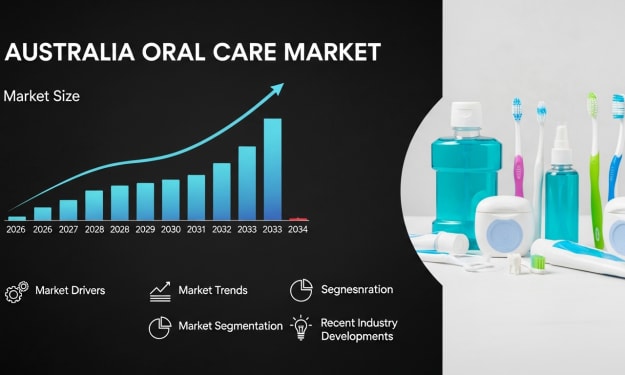
According to IMARC Group, the Australia oral care market reached a value of USD 1.1 Billion in 2025 and is projected to expand to USD 2.3 Billion by 2034, exhibiting a compound annual growth rate (CAGR) of 7.74% during 2026–2034. This strong growth trajectory highlights a structural shift in how consumers perceive oral hygiene—from a basic daily routine to a core component of preventive healthcare and overall wellness. Rising awareness of the link between oral health and systemic conditions such as cardiovascular disease and diabetes is reshaping purchasing behavior, while innovation in products and delivery formats is broadening market appeal. As consumer expectations evolve toward efficacy, convenience and sustainability, oral care has become a dynamic and innovation-driven segment of the broader personal care market across Australia.
By Shrestha Roya day ago in Futurism
Worlds Where the Night Is Hotter Than the Day
On Earth, the rhythm of temperature feels intuitive. When the Sun rises, the ground warms. When darkness falls, heat slowly leaks back into space. Day means warmth; night means cooling. This pattern is so deeply ingrained in our everyday experience that it feels almost universal. Yet beyond the Solar System, astronomers have discovered worlds where this logic completely breaks down. On some distant planets, night is not a time of cooling at all. Instead, the darkness can be hotter than the blazing day.
By Holianyk Ihor5 days ago in Futurism



Comments
There are no comments for this story
Be the first to respond and start the conversation.