
Expedition 33
A Milestone Mission on the International Space Station


The name Expedition 33 does tend to have that sci-fi movie feeling, but this is an expedition that really happened. It was a vital stage in human space flight aboard the station. Members from various countries participated during this mission to perform high-class scientific research.
In this blog post, you'll learn what Expedition 33 was, who took part in it, what they did, and why this mission is still relevant today.
What was Expedition 33?
Expedition 33 was the 33rd long-duration mission to the ISS, which took place from September 16 to November 18, 2012. It continued the ongoing work of living and performing research in space.
During the mission, the crew's main efforts were directed to:
Laboratory experiments
Maintaining the space station
Working together as a team internationally
All this prepared the human race for space missions involving flights over long distances in the future.
Crew Members: The People Behind the Mission
The Expedition 33 had six astronauts and cosmonauts from NASA of the USA, Roscosmos of Russia, and JAXA of Japan.
Core Team Members
- Sunita Williams (NASA) – Commander
- Yuri Malenchenko (Roscosmos) – Flight Engineer
- Akihiko Hoshide (JAXA) – Flight Engineer
Later Arrivals
- Kevin A. Ford (NASA) – Flight Engineer
- Oleg Novitskiy (Roscosmos) – Flight Engineer
- Evgeny Tarelkin (Roscosmos) – Flight Engineer
They came from different countries, but they did work as one team to get everything done.
Expenditure 33 Highlights:
Experiments in Science
The crew conducted hundreds of science experiments in biology, physical science, and in studies of the Earth. Such experiments help in attaining a better life on Earth, besides supporting future missions into space.
Some examples include:
Study the effects of radiation on equipment and the human body.
Studying how microgravity changes the spine and muscles
The findings help prepare astronauts for future trips to the Moon, Mars, and beyond.
Technology Demonstrations ????️
The team also tested some new technology, including:
Enhanced communication apparatus
Robotic equipment
Delay-Tolerant Networking (DTN) — that is, "space internet"
These will pave the way for future space missions to be safer and more efficient.
Living and Working on the ISS
Life at the ISS is anything but easy. Astronauts have to:
Sustain the station
Do aerobic exercise every day to prevent the loss of bone and muscle.
Adjust to life in microgravity.
During Expedition 33:
In addition, the crew performed work on experiments running automatically or remotely.
They also had to follow rigorous exercise routines as a part of maintaining good health.
These daily activities are essential to ascertaining the basic safety and productivity of astronauts.
Expert Tips to Understand Space Missions
: Each mission builds on the previous one.
Each ISS expedition built on the one before, adding new research and enhancing the efficiency of station operations.
International cooperation will be required.
It is a joint project by NASA, Roscosmos, JAXA, ESA, and CSA. It was most definitely teamwork that made each flight possible.
Space research helps life on Earth.
Studies conducted in microgravity enhance our understanding of health, medicine, materials, and technology - many with practical applications on Earth.
FAQs
What was the main aim of Expedition 33?
The mission was to continue microgravity research, maintenance of the ISS, testing of new technologies, and globalspace cooperation.
Commander is/was?
Sunita Williams of NASA commanded it.
How long was Expedition 33?
The mission lasted from mid-September 2012 to mid-November 2012, approximately two months.
What experiments were done?
The following works were undertaken by the crew:
Radiation exposure studies
Changes in the human body in space
Technology testing
Earth observation experiments Conclusion: Why Expedition 33 Matters The Expedition 33 was more than just one of the space missions-it meant years of labor and cooperation among partners. This mission helps scientists prepare for future exploration, whether it's a trip to the Moon, Mars, and maybe even farther, based on research and know-how gained in this mission. Whether space enthusiast or simply curious about life in space, Expedition 33 is an illustration of what humans can achieve by mixing teamwork, science, and determination.
About the Creator
iftikhar Ahmad
"I write true stories, mysteries, and real-life inspiration. If you love engaging, easy-to-read articles with a human touch, you’re in the right place."
Keep reading
More stories from iftikhar Ahmad and writers in Futurism and other communities.
This TikTok Missing Person Case Is Going Viral — And The Internet Thinks Something Isn’t Right
Millions of people scroll through TikTok every day, but only a few stories stop them, make them rewatch, and give them a sudden chill. This week, one missing person case has exploded across the platform — not because it’s just another disappearance, but because something about it feels wrong. From unsettling CCTV footage to suspicious clues that don’t add up, TikTok users are convinced this mystery hides much more than authorities first revealed. And now, the entire internet is trying to solve it before it’s too late.
By iftikhar Ahmad3 months ago in Criminal
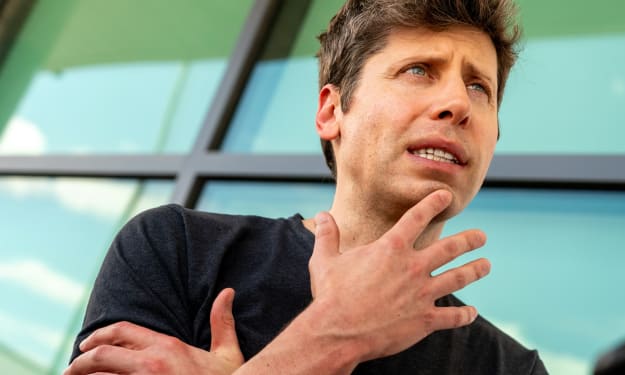
“Sam Altman Is Losing His Grip on Humanity”: A Critique of AI’s Favorite Analogy
What Happened (Facts) This is an opinion essay by Matteo Wong (The Atlantic, dated Feb. 23, 2026), not a straight news report. Its central trigger is a remark OpenAI CEO Sam Altman made at an AI summit in India while responding to a question about the natural resources and energy required to train and run generative AI models.
By Behind the Tech6 days ago in Futurism
Privacy Focused Visual Search: Using AI to Understand Images Without Losing Control of Your Data
Visual search has changed how people interact with technology. Instead of typing long queries, users can now point a camera at an object, place, or document and instantly get information. While this convenience is powerful, it also raises an important concern: what happens to your images after the search?
By Maheep Makkar5 days ago in Futurism



Comments
There are no comments for this story
Be the first to respond and start the conversation.