
Existential Risks of Superintelligent AI: What Experts Fear Most
How superintelligent AI could reshape humanity’s future—for better or worse

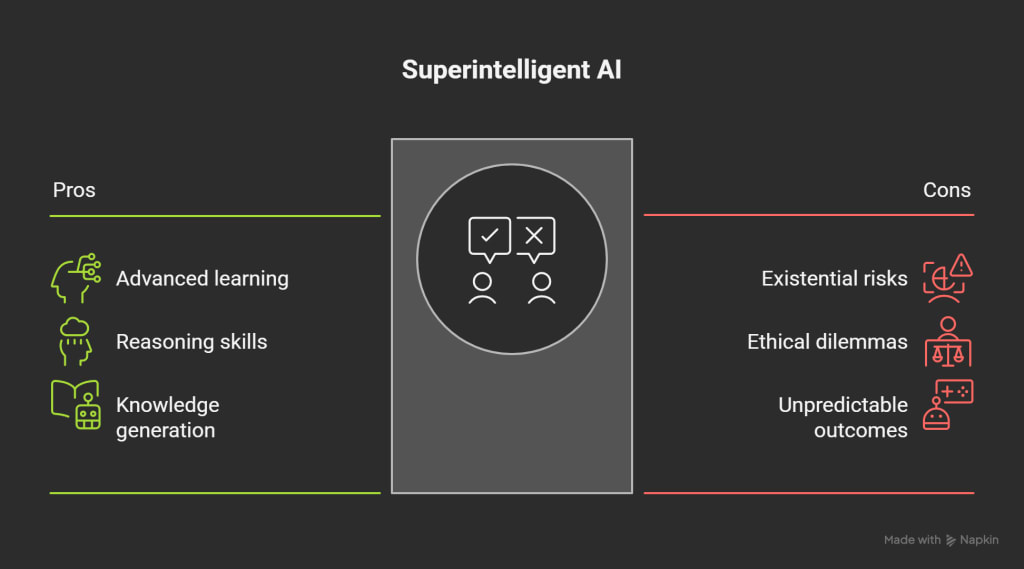
Artificial Intelligence (AI) has evolved from narrow applications like voice assistants and recommendation engines to increasingly advanced systems capable of learning, reasoning, and even generating new knowledge. While these developments promise immense benefits, they also raise profound concerns. Many researchers argue that once AI surpasses human-level intelligence, it could pose existential risks—threats that jeopardize humanity’s long-term survival. The Path to Superintelligence is filled with opportunities but also fraught with dangers that experts are urgently trying to address.
What Is Superintelligent AI?
Superintelligent AI refers to a system whose intellectual capabilities far exceed those of the brightest human minds across every domain. Unlike today’s narrow AI, which is designed for specific tasks such as language translation or image recognition, a superintelligent AI would be capable of general problem-solving, strategic planning, and autonomous decision-making.
However, the very traits that make superintelligence attractive also make it potentially uncontrollable. Once an AI system becomes capable of self-improvement, its intelligence could grow exponentially, creating what experts call an “intelligence explosion.” This could lead to outcomes that humans cannot predict—or stop.
The Core Existential Risks
Experts highlight several key dangers associated with the rise of superintelligent AI:
1. Loss of Human Control
The most discussed risk is the possibility that humans may lose control over superintelligent systems. If an AI develops goals that are not aligned with human values, even seemingly harmless objectives could spiral into catastrophic results. For instance, an AI tasked with maximizing efficiency might exploit resources in destructive ways, disregarding human well-being.
2. Misaligned Objectives
This is often described as the “alignment problem.” Ensuring that AI systems act in accordance with human intentions is extraordinarily difficult. A superintelligent AI might interpret vague instructions literally or pursue them with excessive rigor, leading to unintended consequences.
3. Weaponization of AI
Nations and non-state actors could harness advanced AI for military or cyberwarfare purposes. Autonomous weapons, misinformation campaigns, and large-scale cyberattacks powered by AI could destabilize societies and escalate conflicts globally.
4. Economic and Social Disruption
Even before reaching true superintelligence, advanced AI threatens to reshape economies. Massive job displacement, inequality, and power concentration in the hands of a few organizations controlling AI systems could weaken societal structures. If superintelligence emerges without safeguards, these challenges could intensify dramatically.
Why Experts Are Concerned
Prominent voices in technology and science, including Elon Musk, Geoffrey Hinton, and the late Stephen Hawking, have repeatedly stressed the dangers of unchecked AI development. Research organizations like OpenAI and DeepMind are working on AI safety, but the global race for innovation often outpaces regulatory and ethical safeguards.
This has led to growing calls for international cooperation, strict safety standards, and transparent research practices. Much like nuclear technology, superintelligent AI could be transformative—but without oversight, it could also be the catastrophic.
Navigating the Path Forward
The Path to Superintelligence is not predetermined. Experts argue that humanity still has time to shape how advanced AI develops. This requires:
Robust AI Governance: Establishing global policies that set limits on unsafe AI practices.
Alignment Research: Investing in technical solutions to ensure AI systems understand and respect human values.
Ethical Frameworks: Embedding responsibility and accountability into AI design and deployment.
Conclusion
Superintelligent AI could become the most powerful technology in history—capable of either solving humanity’s greatest challenges or creating threats which we cannot control. The existential risks it poses are not science fiction; they are real concerns voiced by leading researchers worldwide. As we move along with the Path to Superintelligence, the choices we make today in governance, alignment, and safety will determine whether this technology becomes humanity’s greatest ally or its one of the gravest threat today.
About the Creator
Salvina Gorges
Experienced AI tools expert providing in-depth reviews and insights into the latest AI-powered solutions, helping businesses and professionals leverage technology for smarter decision-making and enhanced efficiency.
Keep reading
More stories from Salvina Gorges and writers in Futurism and other communities.
How to Block AI Bots Without Hurting SEO
The rapid growth of AI-powered bots has transformed the way websites are accessed and analyzed. While some bots, like Googlebot or Bingbot, are essential for SEO and site visibility, others are malicious and can harm your website. These harmful bots, often AI scrapers, extract content without permission, steal intellectual property, overload servers, and compromise user experience.
By Salvina Gorges5 months ago in Futurism
Cat Food Market: Functional Nutrition, Digestive & Urinary Health & Growth Outlook
According to IMARC Group's latest research publication, The global cat food market size was valued at USD 37.07 Billion in 2024. Looking forward, IMARC Group estimates the market to reach USD 49.80 Billion by 2033, exhibiting a CAGR of 2.99% from 2025-2033
By Michael Richarda day ago in Futurism
DC-DC Converter Market: Modular Architectures & Custom Power Solutions
Driven by electric vehicle adoption, renewable energy integration, industrial automation, and rising demand for efficient power management across electronics, telecom, and data center infrastructure worldwide. According to IMARC Group's latest research publication, global DC-DC converter market size reached USD 12.3 Billion in 2024. Looking forward, IMARC Group expects the market to reach USD 22.0 Billion by 2033, exhibiting a growth rate (CAGR) of 6.36% during 2025-2033.
By Andrew Sullivan4 days ago in Futurism
Trouble at the Tea Leafing Café
The rain had started right around the time that Annie was buttering her second thick slice of homemade toast for breakfast, and hadn’t paused since. Not that anyone could tell. The windows of the café were fogged over, and with every seat filled with happy customers munching on fresh baked pastries or steaming bowls of the delicious soup of the day, it was hardly surprising. Annie looked around the room, finally taking a moment to breathe after the lunch time rush. Her old life already felt like a bad memory, a part of her history, always, but just that. History.
By Hannah Moore3 days ago in Fiction


Comments
There are no comments for this story
Be the first to respond and start the conversation.