
Europe In Vitro Diagnostics: ROI Analysis for Healthcare Investors (2026 Edition)
Point-of-Care testing is rapidly expanding, moving diagnostics from the central lab to the patient's bedside and home.

In a global economy defined by volatility, the European healthcare sector remains a fortress of stability for institutional and private investors. As capital markets navigate the uncertainties of 2026, the Europe in vitro diagnostics market has emerged as a critical "defensive growth" asset class. It offers a unique blend of technological innovation and recession-proof demand.
While biotechnology stocks often fluctuate on binary trial results, diagnostics provide the steady cash flow of a utility combined with the upside of tech adoption. Studies show that 70% of clinical decision-making relies on diagnostic tests, yet these tests account for less than 5% of total hospital costs. For the savvy investor, this asymmetry represents value. This article provides a detailed ROI analysis, leveraging verified market data to identify where the "smart money" is flowing in the European landscape.
What Is the Current Valuation of the European IVD Market?
According to the latest data sourced from the IMARC Group, the market reached a valuation of US$ 28.69 billion in 2025.
This valuation establishes Europe as the second-largest IVD market globally, trailing only North America. However, the raw number of US$ 28.69 billion tells only half the story. Investors should view this figure as the sector's "Total Addressable Market" (TAM) base. Unlike speculative pre-revenue biotech, this market is mature, liquid, and generates consistent revenue through the "razor-and-blade" model - selling diagnostic instruments (capital equipment) once, and high-margin reagents (consumables) continuously.
Industry experts recommend analyzing this valuation against the backdrop of Europe's post-pandemic recovery. The 2025 figure reflects a normalized market where COVID-19 testing revenue has been successfully replaced by routine screening for chronic diseases. Consequently, this effectively "resets" the baseline for sustainable growth.
What Growth Can Investors Expect Through 2034?
The market is projected to reach US$ 44.12 Billion by 2034, exhibiting a Compound Annual Growth Rate (CAGR) of 4.90% during the forecast period (2026-2034).
A CAGR of 4.90% might appear modest compared to high-risk tech sectors. However, in the context of healthcare infrastructure, it represents robust, compounded expansion. This growth draws from three non-discretionary macro trends:
- The "Silver Tsunami": Europe faces an unparalleled demographic shift. By 2030, over 20% of the EU population will be over 65. An aging population correlates directly with increased testing volume for cardiac markers, diabetes (HbA1c), and cancer biomarkers.
- Preventive Healthcare Shift: European governments are actively shifting budget allocations from "treatment" to "early detection." Every Euro spent on diagnostics saves the system multiple Euros in late-stage therapy costs, ensuring government reimbursement streams remain stable.
- Chronic Disease Management: The rise of lifestyle diseases requires lifelong monitoring. This guarantees recurring revenue for diagnostic providers.
Which Market Segments Offer the Highest ROI?
While Reagents and Consumables hold the dominant revenue share, Molecular Diagnostics and Oncology applications offer the steepest growth trajectory.
For an investor seeking "Alpha" (returns above the market average), understanding the IMARC Group segmentation is crucial.
- The "Cash Cow" (Reagents): This segment accounts for the bulk of the current revenue. It is a volume play. Investors look here for dividend safety and balance sheet strength.
- The "Growth Star" (Molecular Diagnostics): This is where the venture capital flows. Technologies like Next-Generation Sequencing (NGS) are moving from research labs to clinical reality.
- Oncology: Cancer diagnostics is the fastest-growing application. Liquid biopsy (detecting cancer via blood draw) disrupts traditional tissue biopsy methods. Companies dominating this niche currently command higher valuation multiples.
How Is the IVDR Regulation Reshaping the Competitive Landscape?
The In Vitro Diagnostic Regulation (IVDR) creates high barriers to entry, favoring large-cap incumbents with the capital to fund compliance.
The transition from the old IVDD directive to the new IVDR (Regulation (EU) 2017/746) has fundamentally altered the investment risk profile. As of May 2026, the mandatory usage of the EUDAMED database adds another layer of scrutiny.
This regulatory environment acts as an "economic moat" for established players. Small, fragmented competitors often lack the capital to finance the rigorous clinical evidence now required for CE marking. Consequently, we witness a wave of consolidation. Large-cap companies acquire innovative but cash-strapped smaller firms to integrate their technology. They know they can navigate the regulatory hurdles that the smaller firms cannot. For investors, this signals a "buy" on the consolidators.
Who Are the Blue-Chip Players Leading the Sector?
F. Hoffmann-La Roche (Switzerland), Siemens Healthineers (Germany), and bioMérieux (France) dominate the landscape.
These entities are not just participants; they are the market makers. Their diverse portfolios allow them to cross-subsidize R&D in high-growth areas using profits from mature segments.
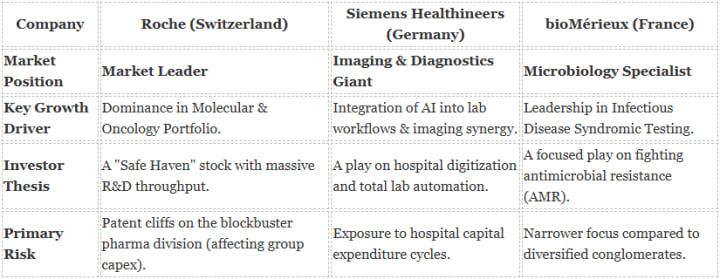
Comparison: European IVD Investment Targets (2026)
The following table breaks down the strategic positioning of the "Big Three" to help you evaluate portfolio allocation.
Why Is Germany the Critical Hub for IVD Investment?
Germany commands approximately 30% of the European market share, driven by robust reimbursement policies and a dense network of research hospitals.
When allocating capital in Europe, Germany serves as the engine room. The IMARC Group data indicates it holds the largest regional share. This dominance draws from the country's decentralized yet highly efficient hospital network. Furthermore, the "Statutory Health Insurance" system provides reliable reimbursement for approved tests.
Unlike the UK, which is still navigating post-Brexit regulatory alignment, or France’s centralized procurement models, Germany offers a balanced market of public and private laboratories. For investors, German-based IVD companies (or multinationals with significant German operations) offer the highest degree of revenue predictability.
What is the Role of Point-of-Care (POC) Testing?
Point-of-Care testing is rapidly expanding, moving diagnostics from the central lab to the patient's bedside and home.
The "Decentralization" of healthcare stands as a key investment theme for the next decade. While central labs handle high-volume routine tests, POC devices capture value in urgent care and home settings. The ROI here lies in speed. Technologies that can deliver a PCR-quality result in 15 minutes (rather than 24 hours) command premium pricing. Investors should watch for companies developing connectivity solutions that link these remote devices directly to electronic health records (EHR).
Conclusion
With a forecast to hit US$ 44.12 billion, the European IVD market offers a stable, compounding return profile for the long-term investor.
The data is clear: The European in vitro diagnostics market is transitioning from a high-growth pandemic phase to a stable, value-driven era. The 4.90% CAGR hides pockets of double-digit growth in oncology and molecular segments.
For the healthcare investor, the strategy for 2026 is one of selectivity. The "Smart Money" moves away from general index exposure. Instead, it targets companies that have successfully navigated the IVDR transition and are pivoting toward personalized medicine. In a world of uncertainty, the biological necessity of diagnosis remains a guaranteed constant.
About the Creator
Joey Moore
I'm Joey Moore, a seasoned Research Analyst with 5+ years of experience in market research. Expert in data analysis, strategic planning, and industry insights. Proven track record in delivering actionable reports.
Keep reading
More stories from Joey Moore and writers in Futurism and other communities.
Latin America Cyber Security Market Analysis: Growth, Trends, and Forecast (2026-2034)
The digital landscape in Latin America is evolving at breakneck speed, but this rapid technological expansion has a dark side. Recent studies indicate that organizations in the region now face an average of 2,716 cyber attacks per week, a figure that stands 39% higher than the global average. As businesses scramble to protect their digital assets, the Latin America cybersecurity market has become a critical focal point for investors, governments, and enterprise leaders alike.
By Joey Moore2 days ago in Futurism
About Binding Prometheus
I want to start actively advocating on behalf of my own work, and the most valuable part of my canon is, without a doubt, Binding Prometheus, the play I have been working on since 2019 and only finished in 2023 as part of my MA. The play itself is an amalgamation of a million different inspirations. On one end, it evokes the Ancient Greek myth-play, deriving its own title from the earliest extant work of Western drama we have, Aeschylus’s Prometheus Bound. On the other end, it borrows significantly from the sci-fi bulwarks from over the years, namely Mary Shelley’s Frankenstein and Karel Capek’s Rossum’s Universal Robots. The play could be an episode of Black Mirror, I fear. I don’t know. I’ve only ever seen one episode of Black Mirror.
By Steven Christopher McKnightabout a month ago in Futurism
Signal Generator Market: Software-Defined Instruments, Test Automation & Growth Outlook
According to IMARC Group's latest research publication, the global signal generator market size reached USD 1.52 Billion in 2024. Looking forward, IMARC Group expects the market to reach USD 2.52 Billion by 2033, exhibiting a growth rate (CAGR) of 5.72% during 2025-2033.
By sujeet. imarcgroup2 days ago in Futurism



Comments
There are no comments for this story
Be the first to respond and start the conversation.