
Empowering Your Solar Storage: Demystifying Inverter for Smarter Energy Use
A Comprehensive Guide to Key Inverter Parameters and Selection Strategies in Modern Solar Energy Systems

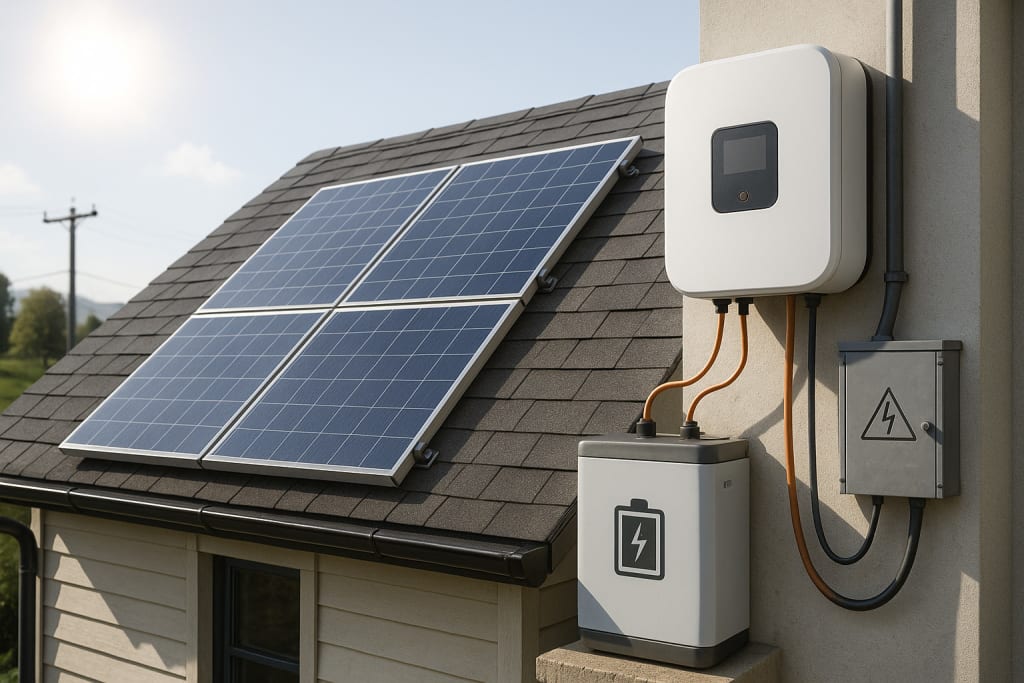
Selecting the right inverter is one of the most critical decisions when designing a solar-plus-storage system. Spec sheets are often packed with technical data, but not all specifications are equally important for residential or small commercial applications. This article highlights the most relevant and impactful inverter parameters—filtering out unnecessary complexity—while offering clear explanations of what each feature means in practice. Rather than a simple checklist, the content is presented as a cohesive guide to help readers understand how each component fits into the broader energy system. Real-world examples and references to trusted LiFePO4 battery solutions, demonstrate how the right energy storage pairing can significantly boost system reliability, efficiency, and longevity. The tone is informative and user-friendly, making technical topics more accessible for a wide audience interested in sustainable energy solutions.
Core Inverter Parameters: Meaning and Practical Impact
1. Continuous & Surge Power
Meaning & Impact: Continuous output power (e.g., 10 kW) defines how much AC load the inverter can sustain indefinitely. Surge (peak) power (e.g., 20 kW) covers brief inrush currents when motors or compressors start.
Transition Note: Once you know power needs, you determine output configuration and scalability.
Practical Tip: List key devices’ running and start-up wattages. Ensure the inverter’s continuous rating exceeds total running load and its surge capacity covers the highest single start-up demand.
2. Output Configuration & Scalability
Meaning & Impact: In U.S. homes, split-phase output provides two 120 V legs delivering 240 V for heavy appliances; single-phase delivers 120 V only. Parallel expansion lets multiple identical inverters work together to increase capacity.
Transition Note: After defining output, next consider solar input and MPPT compatibility.
Practical Tip: Confirm split-phase support. If future expansion is likely, choose an inverter series supporting parallel operation and check synchronization/communication requirements.
3. Solar Input & MPPT Matching
Meaning & Impact: MPPT (Maximum Power Point Tracking) ensures maximum PV harvest under varying sunlight. Key specs include DC voltage range (e.g., 125–425 Vdc), maximum open-circuit voltage (e.g., 500 Vdc), and max PV input power (e.g., 11 kW). Dual MPPT allows independent tracking of two arrays, useful for different roof orientations or partial shading.
Transition Note: Once PV input matches MPPT, the next focus is battery compatibility and operating modes.
Practical Tip: Calculate string voltages at lowest temperatures to avoid exceeding VOC limits and at high temperatures to ensure MPPT startup. For varied roof sections, choose dual-MPPT models.
4. Battery Compatibility & Operating Modes
Meaning & Impact: Most residential hybrid inverters use a 48 Vdc battery bank and must support various chemistries (lead-acid, lithium-ion, LiFePO4). They offer charging modes (PV-priority, grid-priority, hybrid) and output priorities (reserve battery vs. use solar first), balancing self-consumption, cost optimization, and backup readiness.
Transition Note: After matching battery and modes, consider efficiency and response to ensure smooth energy flow.
Practical Tip: If using LiFePO4, verify inverter supports correct charge/discharge voltages and BMS communication. Configure operating modes to meet goals: maximize self-use, maintain reserve for outages, or optimize costs.
5. Efficiency, Control & Safety
Meaning & Impact: High conversion efficiency (typically >95%) reduces losses. DSP-driven control ensures fast response to changing sunlight, load shifts, or grid outages, enabling seamless switching (millisecond-level) and generator synchronization. Protection features (overload, short-circuit, anti-islanding) and communication interfaces (CAN, RS485, Wi-Fi/Ethernet) guarantee safety, reliability, and remote monitoring.
Practical Tip: Choose a highly efficient inverter with fast UPS-like transfer. Ensure protection meets local codes (anti-islanding, IP rating, UL/IEC certifications). Confirm communication compatibility for monitoring. Plan installation for adequate ventilation and accessibility.
How to Choose the Right Inverter
1. Clarify Loads & System Role
Action: List essential loads with running and start-up power; identify those needing uninterrupted power. Decide system type: off-grid, grid-tied with storage, or PV-plus-grid now with storage added later.
Why: This aligns with continuous/surge power and output configuration.
2. Design PV Array & Battery Plan
Action: Size PV strings so voltages match MPPT range across temperatures; use dual MPPT if roof orientations or shading vary. Choose battery chemistry and capacity; for LiFePO4, pick a compatible inverter and consider RICHYE’s quality batteries for reliability.
Why: This covers solar input and battery compatibility.
3. Confirm Performance & Operating Modes
Action: Prioritize high-efficiency models; check fast transfer and generator sync. Configure charging/output priorities (self-consumption vs. reserve). If time-of-use cost savings matter, ensure scheduling or energy management integration for peak shaving.
Why: This ensures efficiency, response, and cost-optimization.
4. Evaluate Expandability, Monitoring & Support
Action: If future expansion is expected, ensure the inverter supports parallel operation. Verify communication interfaces for remote monitoring. Confirm protection features and certifications meet local regulations. Choose reputable manufacturers and coordinate with RICHYE or other battery suppliers for cohesive support.
Why: This addresses long-term reliability, maintainability, and scalability.
Conclusion
By focusing on five essential parameters—continuous and surge power, output configuration and scalability, MPPT voltage matching, battery compatibility and operating modes, and overall inverter efficiency and safety control—you can cut through the noise and make a confident, informed choice when selecting a solar inverter. These aren’t just technical specs; they directly influence how your solar-plus-storage system performs day to day, especially under real-world conditions like changing sunlight, power outages, or peak usage periods.
A well-matched inverter maximizes the energy you generate and store, reduces waste, ensures fast and stable power delivery, and protects your investment for the long term. When paired with a high-quality lithium battery—such as RICHYE’s trusted LiFePO4 solutions—you gain a system that’s not only efficient but also safe, durable, and ready for expansion. RICHYE is a professional lithium battery manufacturer known for producing batteries with outstanding performance, quality, safety, and cost-effectiveness, making them a reliable partner for any residential or off-grid energy setup.
Whether you're building a new solar storage system or upgrading an existing one, following this streamlined approach allows you to design a solution that fits your current needs while remaining flexible for the future. With the right inverter and battery combination, your solar energy system becomes more than just a backup—it becomes a smart, resilient, and cost-saving energy strategy for years to come.
About the Creator
Richye Power
Discover RICHYE Battery, a leading lithium battery manufacturer renowned for excellence in performance and quality. Experience superior reliability and innovative solutions tailored to meet your specific needs.
Keep reading
More stories from Richye Power and writers in Futurism and other communities.
Powering Heights: Unlocking Peak Performance with the Right Aerial Work Platform Battery
In industries that rely on aerial work platforms (AWPs) — from construction and facility maintenance to film production and warehousing — the battery is the linchpin that determines uptime, safety, and cost-effectiveness. Despite the widespread adoption of electric-powered AWPs, many operators still struggle with unexpected battery failures, shortened runtime, and escalating maintenance costs. This article will delve into the crucial role of the Aerial Work Platform Battery, unpack common challenges faced by fleet managers and technicians, and provide actionable solutions to optimize performance, extend battery life, and minimize downtime.
By Richye Power8 months ago in Journal
About Binding Prometheus
I want to start actively advocating on behalf of my own work, and the most valuable part of my canon is, without a doubt, Binding Prometheus, the play I have been working on since 2019 and only finished in 2023 as part of my MA. The play itself is an amalgamation of a million different inspirations. On one end, it evokes the Ancient Greek myth-play, deriving its own title from the earliest extant work of Western drama we have, Aeschylus’s Prometheus Bound. On the other end, it borrows significantly from the sci-fi bulwarks from over the years, namely Mary Shelley’s Frankenstein and Karel Capek’s Rossum’s Universal Robots. The play could be an episode of Black Mirror, I fear. I don’t know. I’ve only ever seen one episode of Black Mirror.
By Steven Christopher McKnight19 days ago in Futurism
Asia Pacific Logistics Market Accelerates on Automotive Growth and Tech Collaboration
The Asia Pacific Logistics Market reached a size of USD 2.22 Trillion in 2024 and is forecast to grow to USD 3.62 Trillion by 2033. The market is expected to expand at a CAGR of 5.32% during the forecast period 2025-2033. Growth is driven by the rapid expansion of e-commerce, growing urbanization, enhanced infrastructure development, and heightened cross-border trade activities. Technological advances including automation, artificial intelligence, and the Internet of Things (IoT) are making operations highly efficient and improving delivery speeds across the region.
By Abhishek Dixit7 days ago in Futurism




Comments (1)
Selecting the right inverter is crucial. List your appliances' wattages to match continuous and surge power. Check output config and scalability too.