
Elon Musk's Grok 2: The AI Revolution That's Shaking Up Silicon Valley
Is Grok 2 Mini the Unexpected David to Grok 2's Goliath?

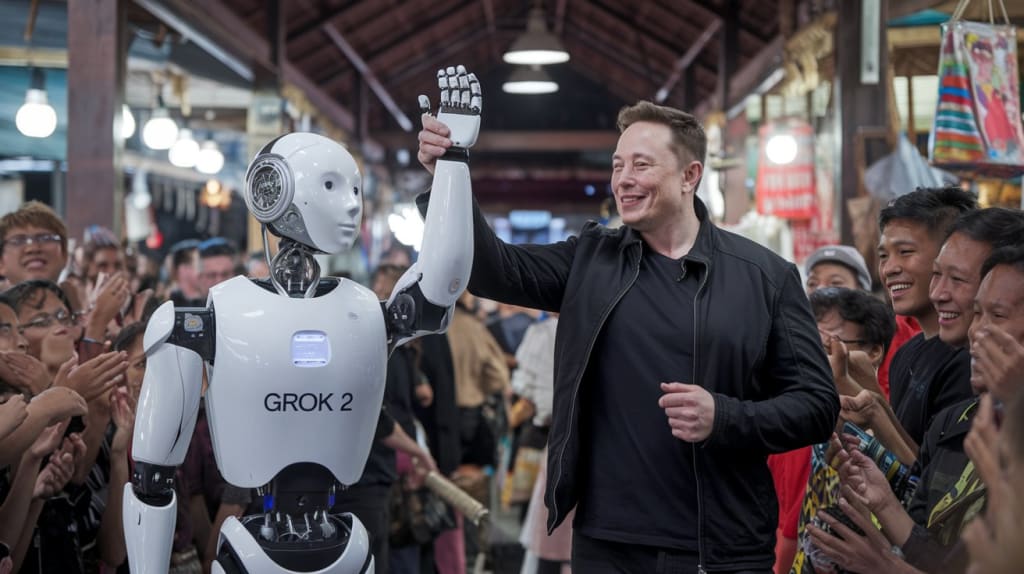
In a stunning move that has sent shockwaves through the tech world, Elon Musk, the visionary entrepreneur behind SpaceX and Tesla, has unveiled his latest creation: Grok 2. This advanced artificial intelligence model, along with its unexpected sibling Grok 2 Mini, is poised to redefine the boundaries of what AI can achieve. As the dust settles from this groundbreaking announcement, experts and enthusiasts alike are scrambling to understand the implications of these new entrants in the increasingly crowded AI arena.
Grok 2, the flagship model, comes packed with an arsenal of impressive features that set it apart from its predecessors and competitors. At its core lies a sophisticated language model capable of tackling complex tasks with ease. Whether it's solving intricate logical puzzles or summarizing dense academic texts, Grok 2 demonstrates a level of comprehension and analytical ability that approaches human-like intelligence.
One of the most talked-about features of Grok 2 is its real-time data integration capabilities. Unlike other AI models that rely on static, pre-loaded datasets, Grok 2 can tap into the constant stream of information flowing through X (formerly Twitter). This gives it an unprecedented ability to stay current and provide up-to-the-minute insights on breaking news and emerging trends. Imagine asking Grok 2 about the latest developments in a fast-moving story and receiving an answer that incorporates tweets from just moments ago – it's a game-changer for those who need to stay on top of rapidly evolving situations.
But Grok 2 isn't all business. In a nod to Musk's well-known sense of humor, the AI comes equipped with a "fun mode" that injects a dose of playfulness into interactions. This feature transforms the typically staid AI experience into something more engaging and personable. For instance, when asked for a game recommendation, Grok 2 in fun mode might respond with a whimsical, "Ah, a quest for the perfect RPG! Let me conjure up something that's sure to enchant you." This lighthearted approach makes Grok 2 more approachable and enjoyable for casual users.
For the more technically inclined, Grok 2 shines in its coding and logical reasoning capabilities. Whether you're a seasoned developer working on a complex project or a beginner looking to generate a simple code snippet, Grok 2 can provide efficient and accurate assistance. Its ability to adapt based on user feedback makes it an invaluable tool for iterative coding processes.
Perhaps the most controversial aspect of Grok 2 is its image generation tool. While other AI models have imposed strict guidelines to avoid generating potentially sensitive or controversial content, Grok 2 offers users more freedom in their creative endeavors. This approach opens up new possibilities for artists and content creators but also raises important questions about responsible AI use and the potential for misuse.
However, the real surprise of Musk's announcement came in the form of Grok 2 Mini, a smaller and faster version of its big sibling. In a series of head-to-head tests, Grok 2 Mini not only held its own against Grok 2 but often outperformed it, delivering faster and sometimes more accurate results across a range of tasks.
For example, when tasked with writing a simple Space Invaders game in Python, Grok 2 Mini produced a functional game complete with scoring and game-over conditions, while Grok 2 struggled with basic game mechanics. In another test involving a complex math problem from a Math Olympiad, Grok 2 Mini came closer to the correct answer on its first attempt, showcasing its prowess in handling advanced mathematical concepts.
Even in creative writing tasks, such as composing a bedtime story based on generated code, Grok 2 Mini demonstrated a flair for narrative and an ability to maintain context that sometimes surpassed its larger counterpart. When asked to analyze a hypothetical scenario involving multiple perspectives (including that of a dog), Grok 2 Mini provided a more nuanced and thoughtful response, considering aspects of consciousness and perception that Grok 2 overlooked.
The unexpected strength of Grok 2 Mini raises intriguing questions about the future direction of AI development. Is bigger always better when it comes to language models? Or does Grok 2 Mini's success suggest that there's value in more streamlined, efficient approaches to AI design?
Despite their impressive capabilities, both Grok 2 and Grok 2 Mini are not without limitations. They occasionally stumble on certain types of problems, particularly advanced mathematical queries, and can sometimes provide inconsistent or incorrect answers. This serves as a reminder that while AI has made tremendous strides, it is still a developing technology with room for improvement.
The launch of Grok 2 and Grok 2 Mini has undoubtedly intensified the AI race, challenging established players like OpenAI's GPT models and Google's Gemini. As these AIs continue to evolve and improve, we can expect to see even more remarkable capabilities emerge, potentially transforming industries and reshaping the way we interact with technology.
In conclusion, Elon Musk's latest foray into the world of AI with Grok 2 and Grok 2 Mini represents a significant leap forward in the field. These models combine advanced language processing, real-time data integration, and creative freedom in ways that push the boundaries of what we thought possible. As we stand on the brink of this new era in AI, one thing is clear: the competition to create the most capable and versatile AI is fiercer than ever, and Musk's entries have just raised the stakes considerably. Whether Grok 2 and its nimble sibling Grok 2 Mini will ultimately dominate the AI landscape remains to be seen, but their impact on the field is already undeniable.
About the Creator
Keep reading
More stories from Next Koding and writers in Futurism and other communities.
The AI Revolution Unveiled: OpenAI's Triad of Superintelligence - Strawberry, Orion, GPT-5
In a groundbreaking revelation, OpenAI, the forefront runner in artificial intelligence research, has pulled back the curtain on three revolutionary AI models that promise to redefine our interaction with technology. These models - Strawberry, Orion, and the enigmatic GPT-5 - each bring unique capabilities to the table, potentially ushering in a new era of artificial superintelligence.
By Next Kodingabout a year ago in Futurism
About Binding Prometheus
I want to start actively advocating on behalf of my own work, and the most valuable part of my canon is, without a doubt, Binding Prometheus, the play I have been working on since 2019 and only finished in 2023 as part of my MA. The play itself is an amalgamation of a million different inspirations. On one end, it evokes the Ancient Greek myth-play, deriving its own title from the earliest extant work of Western drama we have, Aeschylus’s Prometheus Bound. On the other end, it borrows significantly from the sci-fi bulwarks from over the years, namely Mary Shelley’s Frankenstein and Karel Capek’s Rossum’s Universal Robots. The play could be an episode of Black Mirror, I fear. I don’t know. I’ve only ever seen one episode of Black Mirror.
By Steven Christopher McKnight18 days ago in Futurism
Smart Lock Market Size to Surpass USD 9.9 Billion by 2033 Driven by IoT Integration & Connected Living Trends
According to IMARC Group's latest research publication, global smart lock market size reached USD 2.7 Billion in 2024. Looking forward, IMARC Group expects the market to reach USD 9.9 Billion by 2033, exhibiting a growth rate (CAGR) of 15.43% during 2025-2033.
By Suhaira Yusuf5 days ago in Futurism


Comments
There are no comments for this story
Be the first to respond and start the conversation.