
Elon Musk’s Bold Plan: Tesla’s Optimus Robots Could Build a Martian Colony by 2026
SpaceX and Tesla Unite to Send AI-Powered Humanoid Robots to Mars, Laying the Groundwork for Future Human Colonization

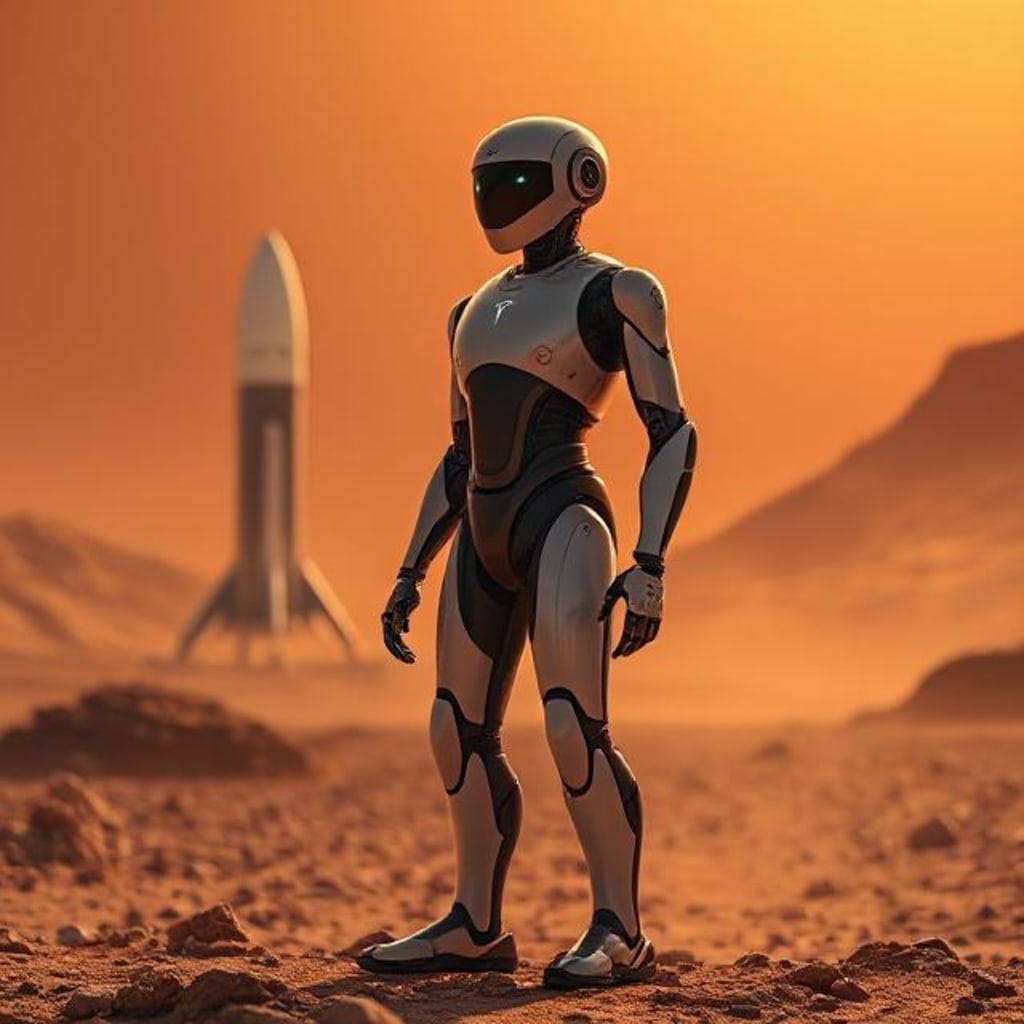
Elon Musk, the visionary entrepreneur behind Tesla and SpaceX, has unveiled one of his most ambitious projects yet: sending Tesla’s humanoid robots, Optimus, to Mars by the end of 2026. This mission could redefine the way humanity approaches interplanetary exploration, shifting the focus from human astronauts to AI-driven robotic pioneers.
Optimus, also called the Tesla Bot, was first announced in 2021 as part of Tesla’s AI initiatives. Standing around 5 feet 8 inches tall and weighing approximately 125 pounds, Optimus is designed to handle repetitive, dangerous, and labor-intensive tasks, which humans would otherwise perform. Leveraging Tesla’s neural network and AI technology—the same system behind Tesla’s self-driving cars—Optimus can walk, lift, and manipulate objects with near-human dexterity.
The second generation of Optimus, unveiled in December 2023, showcased significant upgrades in motion control, hand grip, and energy efficiency, making it more suitable for industrial applications—and now, interplanetary missions.
---
Why Robots Are Key to Mars Colonization
Sending humans to Mars without preparation is extremely risky due to harsh environmental conditions: extreme temperatures, high radiation, and a thin atmosphere. Optimus robots, however, can operate in these environments without life support, making them perfect for early exploration and habitat construction.
If successful, Optimus robots could:
Assemble habitats and research stations
Set up solar panels and energy infrastructure
Conduct geological and atmospheric surveys
Prepare the groundwork for future human explorers
By handling these tasks, Optimus robots could significantly reduce risk, cost, and preparation time, giving humans a better chance of surviving and thriving on the Red Planet.
---
Starship: The Vehicle to Mars
The mission relies on SpaceX’s Starship, the next-generation spacecraft designed for long-duration space travel. Starship is fully reusable and intended to be the most powerful rocket ever built. It is key to Musk’s vision of making humanity multi-planetary.
Although Starship has undergone several test flights, it is still in development. For the 2026 Mars mission to succeed, Starship must demonstrate reliability in launch, landing, and cargo transport. SpaceX engineers are rapidly iterating on design improvements at their Texas facility, with each test flight bringing them closer to this unprecedented goal.
---
Challenges for Optimus on Mars
While the vision is thrilling, significant hurdles remain. Optimus must:
Operate autonomously due to the communication delay between Earth and Mars
Endure dust storms, extreme temperatures, and low gravity
Adapt to unpredictable terrain and unexpected equipment failures
Autonomy is especially critical. Optimus cannot rely on human instructions in real time, so its AI must make complex decisions independently. Its success will determine whether humanoid robots can handle the initial stages of Mars colonization.
---
Why This Mission Matters
Elon Musk’s plan goes beyond simple automation—it represents a new paradigm in space exploration. By using AI-powered robots to construct the first Martian infrastructure, Musk envisions a world where humans and machines collaborate across planets.
If successful, this mission could:
Open doors for robotic exploration of the Moon, asteroids, and outer planets
Set a standard for AI-assisted colonization in the 21st century
Inspire other nations and private companies to rethink space exploration strategies
This approach also allows humans to focus on science, research, and innovation, while robots handle the dangerous groundwork—a concept that could transform the future of interplanetary travel.
---
The Broader Impact
The deployment of Optimus robots has implications beyond Mars:
1. Industrial robotics – Lessons learned in space can enhance automation on Earth, improving efficiency and safety in factories.
2. AI advancement – Optimus’ autonomous decision-making could accelerate AI development across industries.
3. Global competition – With China, the EU, and other countries advancing in robotics, Musk’s plan may set the tone for international space leadership.
While ambitious, the project highlights a critical shift: AI and humanoid robots are becoming integral to human progress, not just on Earth, but across the cosmos.
---
Final Thoughts
Sending Optimus robots to Mars is not just a bold experiment—it is a statement about the future. Musk is redefining the relationship between humans and machines, showing that AI can extend our capabilities into environments too hostile for human life.
If all goes according to plan, by 2026, the first humanoid robots could lay the foundation for a permanent human presence on Mars. This vision is no longer science fiction; it is the beginning of a new era where AI, robotics, and human ambition converge to push the boundaries of possibility.
---
SEO Keywords:
Elon Musk Mars mission, Optimus robot, Tesla Optimus Mars, SpaceX Starship 2026, Robots on Mars, AI robots by Tesla, SpaceX Mars 2026, Elon Musk robot plan, Tesla humanoid robot, Starship Mars launch, Elon Musk sends Optimus robots to Mars, Tesla AI robot mission to Mars, Mars colonization plan by Elon Musk, Optimus robot tasks on Mars
About the Creator
Muhammad Riaz
- Writer. Thinker. Storyteller. I’m Muhammad Riaz, sharing honest stories that inspire, reflect, and connect. Writing about life, society, and ideas that matter. Let’s grow through words.
Keep reading
More stories from Muhammad Riaz and writers in Futurism and other communities.
AI-Powered Cities: How Artificial Intelligence Could Run Entire Nations by 2035
The Future of Civilization Is Changing It’s no longer a question of if artificial intelligence will reshape society—it’s how fast. According to leading researchers, by 2035, AI won’t just assist us with work, shopping, or entertainment. It could become the invisible backbone of entire cities, nations, and even global systems.
By Muhammad Riaz5 months ago in Futurism
About Binding Prometheus
I want to start actively advocating on behalf of my own work, and the most valuable part of my canon is, without a doubt, Binding Prometheus, the play I have been working on since 2019 and only finished in 2023 as part of my MA. The play itself is an amalgamation of a million different inspirations. On one end, it evokes the Ancient Greek myth-play, deriving its own title from the earliest extant work of Western drama we have, Aeschylus’s Prometheus Bound. On the other end, it borrows significantly from the sci-fi bulwarks from over the years, namely Mary Shelley’s Frankenstein and Karel Capek’s Rossum’s Universal Robots. The play could be an episode of Black Mirror, I fear. I don’t know. I’ve only ever seen one episode of Black Mirror.
By Steven Christopher McKnight18 days ago in Futurism
Egypt Hospitality Market: Leisure Tourism Boom, Service Innovation & Forecast
According to IMARC Group's latest research publication, Egypt hospitality market size reached USD 6,101.5 Million in 2024. The market is projected to reach USD 8,820.6 Million by 2033, exhibiting a growth rate of 4.18% during 2025-2033.
By Abhay Rajput3 days ago in Futurism




Comments
There are no comments for this story
Be the first to respond and start the conversation.