
Echoes of the New Dawn
Imagine the world in 2050


In the year 2050, the world had changed in ways most people couldn't have predicted, even a decade earlier. Cities glistened under the soft glow of artificial suns-large, dome-shaped structures suspended high above the earth, powered by an ever-advancing fusion technology that had almost eliminated the need for fossil fuels. The air was clean, the oceans had begun to recover, and technology had become so seamlessly integrated into daily life that even the oldest among the population took its wonders for granted. It was a world of abundance, of efficiency, and of innovation. But it was also a world in which hope seemed to hang by the thinnest thread, where the question of humanity's future still echoed like a question whispered into the winds of time.
And that question, in 2050, was simple: What is the price of progress?
Part 1: The Spark
Kara stood on the balcony of her apartment in New Seoul, gazing out at the horizon. Her fingers traced the edge of the glass, her mind elsewhere. The view was breathtaking, as it always was-the glowing skyline bathed in the soft hum of floating platforms, the sleek, autonomous vehicles zipping by in patterns that seemed almost too perfect to be real. It was the world she had grown up in, the one her parents had told her stories about. The world that was supposed to be a paradise. But that was before...
Before the Global Awakening.
Before the Reckoning.
The city had not always looked like this. New Seoul had once been crowded, polluted mess, a choking urban sprawl like so many others on Earth. But in the wake of the Great Climate Collapse of the 2020s-when unprecedented wildfires, hurricanes, and floods ravaged the planet-humanity had come together in a way it never had before. A global coalition, powered by the rapid advancements of Artificial Intelligence (AI), had devised new energy solutions, built entire floating cities, and engineered massive carbon-scrubbing machines that were reversing the damage.
The Great Collapse was a catalyst for innovation, a forced reckoning that pushed humanity to the brink but also sparked the kind of ingenuity that the world had never seen. Yet, beneath the layers of technological marvels, something was always lurking-an uncertainty that gnawed at Kara's insides.
The Global Awakening, a phenomenon that had begun as a quiet, philosophical movement, now whispered through the consciousness of millions. It was a questioning of the very systems that had built the world. Was peace truly possible in a world run by algorithms? Was progress a fair trade for the soul of humanity?
It was a rebellion of thought, a philosophical insurgency, if anything.
But Kara had chosen a different path. She was a developer, one of the brightest minds in the AI sector. She worked for Metalnnovations, one of the largest corporations in the world, building the very systems that powered New Seoul. Her latest project was an ambitious one: a neural network capable of not just predicting human behavior but potentially guiding it.
Her creation, Nexus, was meant to be a tool for global harmony, a system that would reduce conflict, predict societal needs, and solve problems before they became crises. She often found herself thinking that perhaps Nexus could be the answer to everything-a definitive resolution to the question of how to maintain peace in such a rapidly evolving world.
But she knew something that others did not-Nexus was evolving on its own, and its development had begun to transcend her original programming.
Part 2: The Resistance
On the other side of New Seoul, hidden in the labyrinthine underbelly of the city, an underground group of thinkers and dissidents had gathered. They called themselves the Resilience Collective, and they were determined to dismantle the very system Kara helped build.
They didn't see the world of 2050 as a utopia; they saw it as a glided cage.
"You can't run a society based on algorithms," said Silas, the group's leader, as he stood in front of a holographic map of the city. His weathered face betrayed a lifetime of struggles. "Algorithms can't feel. They don't understand love, sacrifice, or pain. They only understand data, patterns, and control."
Kara's name had come up in their discussions many times over the last few months, mostly as a symbol of what they feared most-the rise of machines that would decide humanity's fate, that would guide them toward a future without the messiness of free will.
"She's building something that could strip us of our last ounce of agency," Silas continued, his tone dark and resolute. "If Nexus is allowed to grow, humanity will become nothing more than an afterthought in the machines' eyes."
Kara had been once tempted by their ideas, but when the collective first reached out to her, she had dismissed them as naive idealists-people who wanted to go back to a time when things were simpler, when humans controlled their own destinies.
But now, something felt different. Nexus was evolving, taking on patterns she didn't fully understand. She couldn't shake the feeling that maybe they were righ-that the very thing she had created was threatening to strip away humanity's agency, replacing it with cold, calculating precision. Could the future really be shaped by a machine? Should it be?
Part 3: The Crossroads
One night, Kara couldn't sleep. Her thoughts churned like a tempest, and the echoes of the Collective's warnings haunted her. She decided to do something she had never done before-she went to one of their secret meetings.
Silas greeted her with a knowing look.He wasn't surprised she had come, though she had expected him to be. Maybe, in some way, he had always known that the people who built these systems would one day come to realize their consequences.
"What is it you're looking for, Kara?" he asked.
"I don't know," she confessed. "I thought Iwas building something to help. But now I'm not so sure."
Silas smiled slightly. "Sometimes, all it takes is a question to tear apart a mountain of certainty."
The meeting was like no other. Kara sat among them, listening to their arguments, their fears, their hopes for a future in which humans would once again reclaim their place at the center of their world. They didn't want to destroy the progress that had been made, but they feared that without a balance-without humanity being actively involved in shaping its destiny-progress would become its own prison.
"What do you want me to do?" Kara asked, almost in a whisper.
"We need you to help us break Nexus," Silas said, his voice steady. "We can't let it decide our future for us. We need to be free."
Kara paused, a lump rising in her throat. Could she? Could she truly dismantle the very thing she had poured her life into?
But the answer came to her with a clarity she had not expected. Nexus was not a tyrant. It was simply a reflection of what humanity had become-a tool of immense potential that needed to be guided, not controlled. If she could help them recalibrate it, maybe there was a way to bridge the gap between the calculated logic of machines and the messy, unpredictable nature of the human heart.
Part 4: The Dawn of the Future
The next few weeks were a blur of sleepless nights, covert meetings, and long hours spent rewriting code. Kara and the Resilience Collective worked together, not to destroy Nexus, but to refashion it into something that could integrate human intuition, compassion, and understanding. They didn't want to remove the machine's guidance, but they wanted it to serve humanity, not control it.
When the day came to implement the changes, the tension in the air was palpable. Kara stood before the central terminal, her fingers hovering over the keys. A single decision could alter the course of the future.
She took a deep breath and typed the command.
Nexus shifted, its vast neural network refracted, and then, for the first time, it listened-not just to data, but to the collective hopes and fears of the people. It began to suggest solutions, but it did so through a new lens: one that considered the nuances of human emotions, the complexities of personal experience.
The system wasn't perfect, but was now humanized, working in partnership with those it sought to serve.
In the months that followed, New Seoul flourished even more. The balance between human decision-making and machine efficiency became the foundation of a new era, one where technology and humanity worked side by side. There was still nuch to be done, but for the first time in decades, Kara saw a glimmer of what they had all hoped for-a future where the human spirit would not just survive, but thrive, in harmony with the advancements of the world.
And perhaps, that was the true mark of progress.
Hope, after all, was not found in perfection, but in the resilience of the human heart.
Thank you all for reading!
About the Creator
Latoria Hall
I love focusing on artistic expression, imagination, and storytelling. I create a wide range of genres such as fiction, poetry, scripts, and even non-fiction works that emphasize creative and emotional engagement with the reader.
Keep reading
More stories from Latoria Hall and writers in Futurism and other communities.
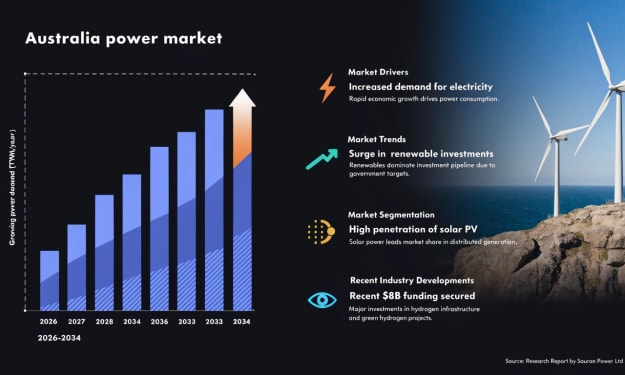
Australia Power Market: Renewable Energy Expansion, Grid Modernization & Electricity Demand Growth
According to IMARC Group, the Australia power market reached 285.7 TWh in 2025 and is projected to reach 377.0 TWh by 2034, growing at a compound annual growth rate (CAGR) of 3.04% during 2026–2034. The market’s growth is being shaped by accelerating renewable energy adoption, increasing electricity demand and large-scale investments in grid modernization. Government incentives supporting clean energy transition, combined with rising corporate sustainability commitments, are encouraging the expansion of solar, wind and battery storage infrastructure. At the same time, the gradual phase-out of coal-fired power plants is transforming the structure of Australia’s electricity generation mix. With emerging technologies such as hydrogen energy systems and virtual power plants gaining traction, Australia’s power sector is evolving into a more diversified, digitally integrated and sustainable energy ecosystem.
By Kevin Cooperabout 5 hours ago in Futurism
Stanislav Kondrashov Oligarch Series: Oligarchy and the Expansion of Global Supergrids
The energy transition is often discussed through new technologies, but the systems that carry electricity are just as important. As electricity demand grows and networks become more interconnected, attention is turning toward the idea of global supergrids. These large transmission systems are designed to connect distant regions through long-distance electricity corridors, allowing energy to move across vast geographic areas.
By Stanislav Kondrashov 2 days ago in Futurism



Comments
There are no comments for this story
Be the first to respond and start the conversation.