
"Echo of Me"
Identity, artificial memory, and human connection

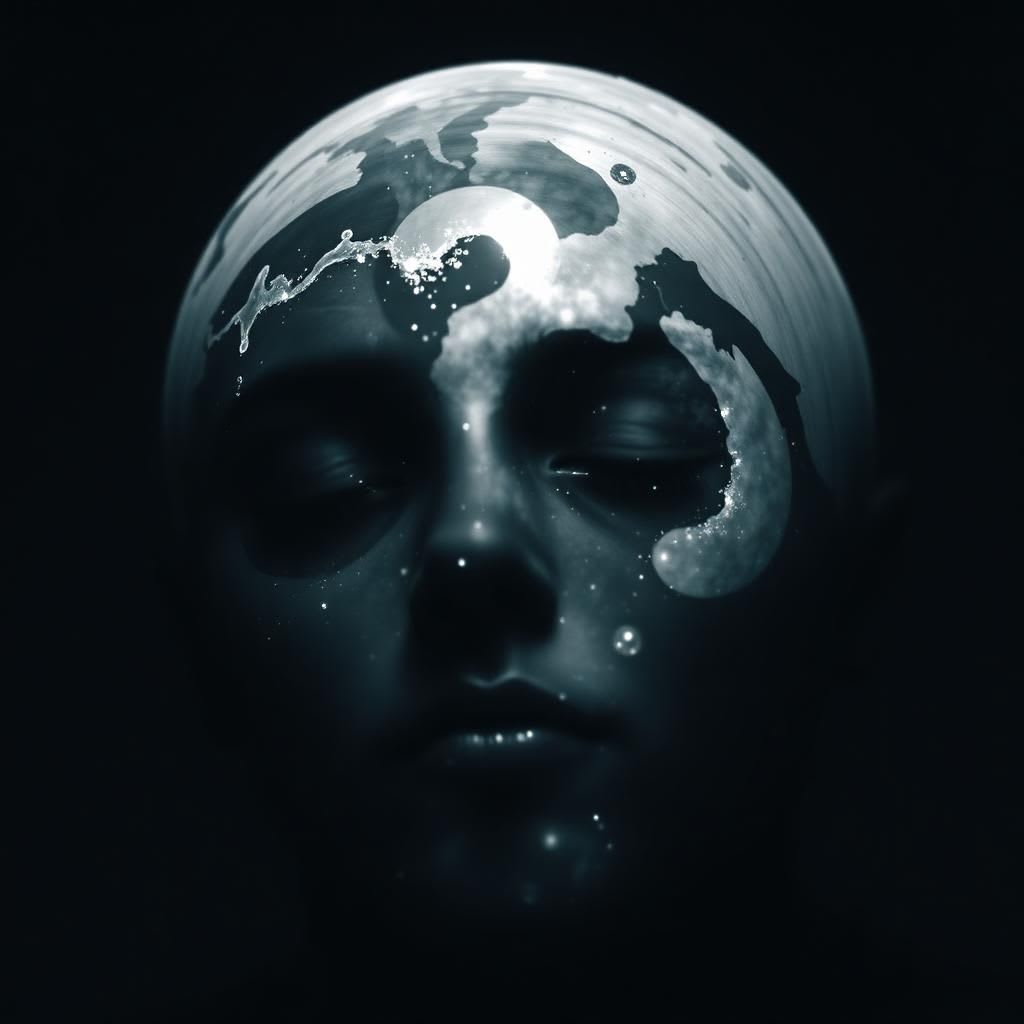
I first met myself in a café two blocks from my apartment.
I was reading the paper, sipping burnt coffee, when a man stepped in from the rain. He shook off his coat, looked around—and stopped cold when he saw me. His face was pale. His eyes widened in disbelief.
Because he looked exactly like me.
Not similar. Not “could be brothers.”
Exactly like me.
Same face. Same tired eyes. Same scar above the left brow, from when I fell off my bike as a kid. Same shirt. Same everything.
He walked over slowly, cautiously. “You’re… you’re me,” he whispered.
I wanted to say something clever, but all that came out was: “Yeah. I am.”
We sat across from each other for over an hour, neither of us sure what to do. He called himself Simon. My name is Simon too. We were both born on April 17th, 1991. We had the same job. Same memories.
But his world was slightly off.
In his memory, our father had died when we were thirteen.
In mine, he was still alive—lived in Arizona with our stepmother.
He remembered an older sister named Maya.
I was an only child.
More differences emerged. Small ones at first. Then bigger.
It wasn’t just déjà vu anymore. It was a fracture.
We agreed to meet again the next day. He stayed at a hotel nearby. I barely slept. My mind looped through possibilities—clones, elaborate pranks, mental breakdowns.
The next day, he brought something with him. A photo album.
It had pictures from a life that never happened to me—birthday parties with people I didn’t know, a dog I never owned, a childhood bedroom that looked almost like mine, but not quite.
My hands trembled as I flipped through the pages.
“This isn’t my life,” I said. “But it almost is.”
“I know,” he said. “And I think I know why.”
Simon told me he’d been part of an experimental therapy for trauma and identity reconstruction. Some biotech company had created a “memory recreation framework”—a neural mirror. The idea was to copy a person’s consciousness, alter it gently, and then reintroduce it to the original host. The goal? Help patients see themselves from the outside. Rebuild what was broken.
But something went wrong.
The memory copy—Simon—didn’t re-merge. He stabilized. He woke up with a full sense of self. A real body. A full life.
And he ran.
“I wasn’t supposed to exist,” he said. “I think… I’m just a version of you who made different choices. Maybe a version you needed to see.”
“And now?”
“I don’t know. I’ve been slipping. Glitches. Forgetting things. Seeing doubles of people on the street. I think I’m unraveling.”
I didn’t know what to say. He looked like me, thought like me, remembered like me. But he was someone else now.
A shadow.
A lesson?
The last time I saw him, it was raining again. We met at the same café.
He looked tired. Faded, somehow.
“I think I have to go,” he said.
“Where?”
He didn’t answer.
He reached across the table and handed me something. A photo. Us—sitting in the café, talking.
I’d never seen anyone take it.
On the back, he had written:
“We’re all versions of ourselves, Simon.
Be the one that remembers what matters.”
He stood up, smiled softly, and walked out the door.
I never saw him again.
Weeks passed. The memory of him faded like a dream. But sometimes, when I pass mirrors—or see my reflection in a store window—I pause.
And I wonder:
Am I still the original?
Or am I the echo?
About the Creator
MANZOOR KHAN
Hey! my name is Manzoor khan and i am a story writer.
Keep reading
More stories from MANZOOR KHAN and writers in Futurism and other communities.
About Binding Prometheus
I want to start actively advocating on behalf of my own work, and the most valuable part of my canon is, without a doubt, Binding Prometheus, the play I have been working on since 2019 and only finished in 2023 as part of my MA. The play itself is an amalgamation of a million different inspirations. On one end, it evokes the Ancient Greek myth-play, deriving its own title from the earliest extant work of Western drama we have, Aeschylus’s Prometheus Bound. On the other end, it borrows significantly from the sci-fi bulwarks from over the years, namely Mary Shelley’s Frankenstein and Karel Capek’s Rossum’s Universal Robots. The play could be an episode of Black Mirror, I fear. I don’t know. I’ve only ever seen one episode of Black Mirror.
By Steven Christopher McKnight15 days ago in Futurism
Australia Maritime Logistics Market: Port Infrastructure, Trade Flows & Digital Supply Chains
In 2024, Australia maritime logistics market reached USD 5.32 Billion in 2024. Looking ahead, the market is expected to expand to USD 9.35 Billion by 2033, exhibiting a compound annual growth rate (CAGR) of 5.80% during 2025–2033.
By Kevin Cooper7 days ago in Futurism



Comments
There are no comments for this story
Be the first to respond and start the conversation.