
Driving the Future: Hyperloop, Flying Cars, and the Evolution of Transportation
A Journey Beyond Boundaries: Pioneering the Next Era in Mobility

In an era marked by rapid technological advancements, the landscape of transportation is undergoing a revolutionary transformation. From the ambitious concept of a Hyperloop to the development of flying cars, the future of transportation is set to redefine the way we move from point A to point B.
The Hyperloop Revolution: Breaking the Speed Barrier
Imagine commuting between cities at speeds exceeding 700 miles per hour—this is the promise of the Hyperloop. Conceived by Elon Musk in 2013, the Hyperloop is a high-speed transportation system that uses pressurized capsules within low-pressure tubes to achieve unparalleled speeds. This concept has sparked a global race among companies striving to turn this vision into reality.
Virgin Hyperloop, a company dedicated to developing the Hyperloop, successfully conducted its first passenger test in 2023, marking a significant milestone in the quest for ultra-fast, sustainable transportation.
Flying Cars: Taking Commuting to New Heights
While flying cars have long been a staple of futuristic fantasies, recent breakthroughs suggest that they may soon become a reality. Companies like Terrafugia and AeroMobil are at the forefront of this airborne revolution, working on prototypes that promise to liberate us from congested roads.
PAL-V, a Dutch company, unveiled the PAL-V Liberty, a flying car that combines the convenience of driving with the freedom of flying. With successful test flights and regulatory advancements, flying cars are inching closer to mainstream adoption.
The Rise of Electric Vehicles: Beyond Conventional Transportation
Electric vehicles (EVs) have already made a significant impact on the automotive industry, with companies like Tesla leading the charge. However, the evolution of EVs goes beyond personal cars. Electric planes, buses, and even bikes are becoming viable alternatives, contributing to a more sustainable and eco-friendly future.
Joby Aviation, an electric air mobility company, is working on developing electric vertical takeoff and landing (eVTOL) aircraft. Their vision is to create an aerial ridesharing service, revolutionizing urban transportation.
Challenges and Opportunities: Paving the Way for Tomorrow's Transport
Despite the promising advancements, challenges remain on the path to the future of transportation. Regulatory hurdles, infrastructure development, and public acceptance are crucial factors that need to be addressed. However, these challenges also present opportunities for innovation, collaboration, and societal transformation.
As we stand at the intersection of science fiction and reality, the evolving landscape of transportation invites us to dream beyond conventional boundaries. The integration of Hyperloop technology, flying cars, and electric vehicles into our daily lives holds the potential to reduce commute times, alleviate traffic congestion, and minimize the environmental impact of transportation.
Embracing the Future Today
In the face of these transformative developments, the future of transportation inspires us to reimagine the way we connect with the world. As technology continues to break barriers, the possibilities are limitless, and the journey towards a smarter, more efficient, and sustainable transportation system is well underway.
In conclusion, the Hyperloop, flying cars, and the evolution of transportation represent not just modes of getting from one place to another but a glimpse into a future where the boundaries of mobility are pushed beyond what we once thought possible.
Buckle up as we navigate the exciting road ahead—one that might just take us off the ground and into the skies. The dreams of yesterday are becoming the reality of tomorrow, and the evolution of transportation is a testament to humanity's relentless pursuit of progress and innovation. The road ahead is not just about reaching our destinations; it's about embracing a future where the journey is as extraordinary as the destination itself.
About the Creator
Keep reading
More stories from Yeswanth Vadlamudi and writers in Futurism and other communities.
The Future of Wearable Tech: From Health Monitoring to Augmented Reality
In the dynamic landscape of technology, wearables have emerged as more than just gadgets; they are transformative companions that seamlessly integrate into our daily lives, enhancing our well-being and connectivity. From fitness trackers to augmented reality glasses, this article explores the inspiring evolution of wearable tech, its real-world applications, and the exciting potential it holds for the future.
By Yeswanth Vadlamudi2 years ago in Futurism
AI in Procurement Market to Surpass USD 22.6 Billion by 2033
AI in Procurement Market Overview The global AI in Procurement Market is projected to reach USD 22.6 Billion by 2033, rising from USD 1.9 Billion in 2023, which reflects a strong compound annual growth rate of 28.1% during the forecast period from 2024 to 2033. In 2023, North America maintained a leading position in the market with more than 38% share, generating approximately USD 0.7 Billion in revenue. The strong adoption of advanced analytics, automation platforms, and digital procurement systems has supported the growth of this market across large enterprises and government institutions.
By Roberto Crum6 days ago in Futurism
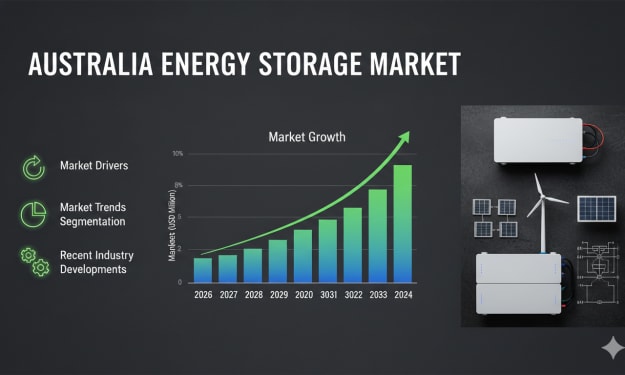
Australia Energy Storage Market: Renewable Integration, Battery Deployment & Grid Stability
According to IMARC Group, the Australia energy storage market reached 4.72 GW in 2025 and is projected to expand significantly to 19.81 GW by 2034, exhibiting a compound annual growth rate (CAGR) of 17.28% during 2026–2034. The rapid growth of the sector reflects the country’s accelerating transition toward renewable energy and the increasing need for reliable electricity systems across Australia. As solar and wind power generation expands, energy storage technologies such as battery energy storage systems (BESS) are becoming essential for maintaining grid reliability and balancing electricity supply and demand. Government policies supporting clean energy adoption, declining battery costs, and investments in grid modernization are significantly strengthening Australia energy storage market share while enabling the integration of renewable power into the national electricity network.
By Shrestha Roy6 days ago in Futurism
Guard Your Battery
Why are some people so attractive just by standing there? It’s not because they are "likable," but because they don’t need everyone to like them. I realized later that truly charismatic people allow themselves to be criticized, but they never criticize themselves. They never try to please the world; instead, the world stops to watch them.
By Emily Chan - Life and love sharing7 days ago in Poets


Comments
There are no comments for this story
Be the first to respond and start the conversation.