
Draft Chinese AI Rules Outline ‘Core Socialist Values’ for AI Human Personality Simulators
Proposed regulations signal Beijing’s intent to shape artificial intelligence with ideology, ethics, and social responsibility


China has released draft regulations proposing that artificial intelligence systems designed to simulate human personalities must adhere to the country’s “core socialist values.” The move reflects Beijing’s growing effort to ensure that rapidly advancing AI technologies align not only with technical standards but also with political ideology, social stability, and ethical norms.
The draft rules, issued by Chinese regulatory authorities for public consultation, focus specifically on AI human personality simulators—systems capable of mimicking human behavior, emotions, speech patterns, and decision-making. These technologies are increasingly used in virtual assistants, customer service bots, digital companions, and educational platforms.
What Are AI Human Personality Simulators?
AI human personality simulators are advanced systems designed to interact with users in ways that feel natural and human-like. Unlike basic chatbots, these models can display emotions, adopt personalities, and engage in extended conversations that resemble human interaction.
In China, such technologies are gaining popularity in areas ranging from mental health support and entertainment to online education and e-commerce. However, their influence over users—particularly young people—has raised concerns among regulators about misinformation, moral guidance, and social impact.
Core Socialist Values at the Center
At the heart of the proposed rules is the requirement that AI systems must uphold core socialist values, a phrase commonly used in Chinese policy documents. These values include principles such as patriotism, integrity, social harmony, respect for authority, and collective responsibility.
According to the draft, AI-generated content must not undermine national unity, spread harmful ideologies, distort historical facts, or promote values deemed inconsistent with Chinese social and political norms. Developers would be responsible for ensuring that AI personalities do not express opinions or behaviors that conflict with these standards.
The regulations suggest that AI should act as a positive guiding force in society rather than a neutral or uncontrolled technology.
Why China Is Regulating AI Personalities
Chinese authorities have repeatedly emphasized that AI is not just a technological tool but a social force capable of shaping opinions, behavior, and culture. With AI systems becoming more conversational and emotionally engaging, regulators fear they could influence users in unpredictable or undesirable ways.
By setting ideological and ethical boundaries early, policymakers aim to prevent risks such as political dissent, social destabilization, or the spread of values seen as incompatible with national interests.
The draft rules are part of a broader regulatory framework that already governs generative AI, recommendation algorithms, and deepfake technologies in China.
Responsibilities for Developers and Platforms
Under the proposed guidelines, companies developing or deploying AI personality simulators would face stricter obligations. These include:
Conducting risk assessments before launching AI systems
Ensuring content moderation mechanisms are in place
Preventing AI from generating politically sensitive or socially harmful responses
Maintaining transparency about AI-generated content
Developers may also be required to implement technical safeguards that prevent AI from deviating from approved behavioral norms.
Failure to comply could result in penalties, service suspension, or other regulatory actions.
Global Context and Comparisons
China’s approach contrasts with regulatory efforts in other regions, such as the European Union and the United States, where discussions around AI governance tend to focus on privacy, safety, bias, and accountability rather than ideological alignment.
However, experts note that many countries are grappling with similar concerns about AI’s influence on society. While the language and priorities differ, the underlying question remains the same: how much control should governments have over AI behavior?
China’s model reflects a governance philosophy that places social stability and political coherence at the forefront of technological development.
Public Reaction and Industry Impact
The release of the draft rules has sparked debate among technologists, academics, and the public. Supporters argue that clear guidelines provide stability and prevent misuse of powerful technologies. They say regulation can encourage responsible innovation while protecting users.
Critics, however, warn that strict ideological requirements could limit creativity, reduce global competitiveness, and restrict the diversity of AI applications. Some developers fear that compliance costs and content restrictions may slow innovation or make products less adaptable for international markets.
Despite these concerns, most major Chinese tech companies are expected to align with the regulations, given the country’s strong enforcement mechanisms.
Implications for the Community
For everyday users, the rules could shape how AI companions, virtual assistants, and educational tools behave in subtle but meaningful ways. Conversations with AI may increasingly reflect officially approved narratives and values, influencing how users perceive information and social norms.
Community advocates emphasize the importance of transparency, urging platforms to clearly inform users when they are interacting with AI systems and what limitations exist on those interactions.
A Sign of AI’s Growing Power
The draft regulations highlight a broader reality: AI is no longer just a technical innovation—it is a cultural and social force. As governments worldwide seek to balance innovation with responsibility, China’s proposal demonstrates how deeply national values can shape the future of artificial intelligence.
As the consultation period continues, revisions may follow. But one thing is clear: the debate over who controls AI—and what values it reflects—is only just beginning.
About the Creator
Asad Ali
I'm Asad Ali, a passionate blogger with 3 years of experience creating engaging and informative content across various niches. I specialize in crafting SEO-friendly articles that drive traffic and deliver value to readers.
Fluid Loss Additives Market Outlook: Drilling Efficiency Enhancement and Oilfield Services Growth Opportunities
According to IMARC Group's latest research publication, The global fluid loss additives market size was valued at USD 318.42 Million in 2025. Looking forward, IMARC Group estimates the market to reach USD 409.06 Million by 2034, exhibiting a CAGR of 2.82% from 2026-2034.
By James Whitman4 days ago in Futurism
Australia Textile & Apparel Market: Sustainable Fashion, E-commerce Growth & Fabric Innovation
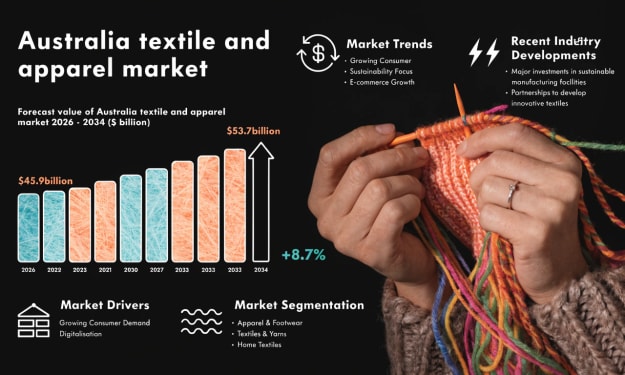
According to IMARC Group, the Australia textile and apparel market reached a value of USD 30.3 Billion in 2025 and is projected to reach USD 45.7 Billion by 2034, growing at a compound annual growth rate (CAGR) of 4.66% during 2026–2034. The market is evolving as consumer preferences increasingly favor sustainable fashion, innovative fabric technologies and digitally driven retail experiences. Rising disposable incomes and changing lifestyle trends are encouraging consumers to spend more on clothing, footwear and fashion accessories. At the same time, growing awareness about environmental sustainability is driving demand for eco-friendly textiles, recycled fabrics and ethically produced garments. The rapid expansion of e-commerce platforms and online fashion marketplaces is also transforming how consumers shop for apparel, enabling brands to reach wider audiences across Australia. As fashion companies adopt new production technologies and sustainable manufacturing practices, the textile and apparel sector is undergoing significant transformation.
By Kevin Cooper3 days ago in Futurism



Comments
There are no comments for this story
Be the first to respond and start the conversation.