
DOGE ETF Deep Dive: How the Structure Works and Why It Matters
Business

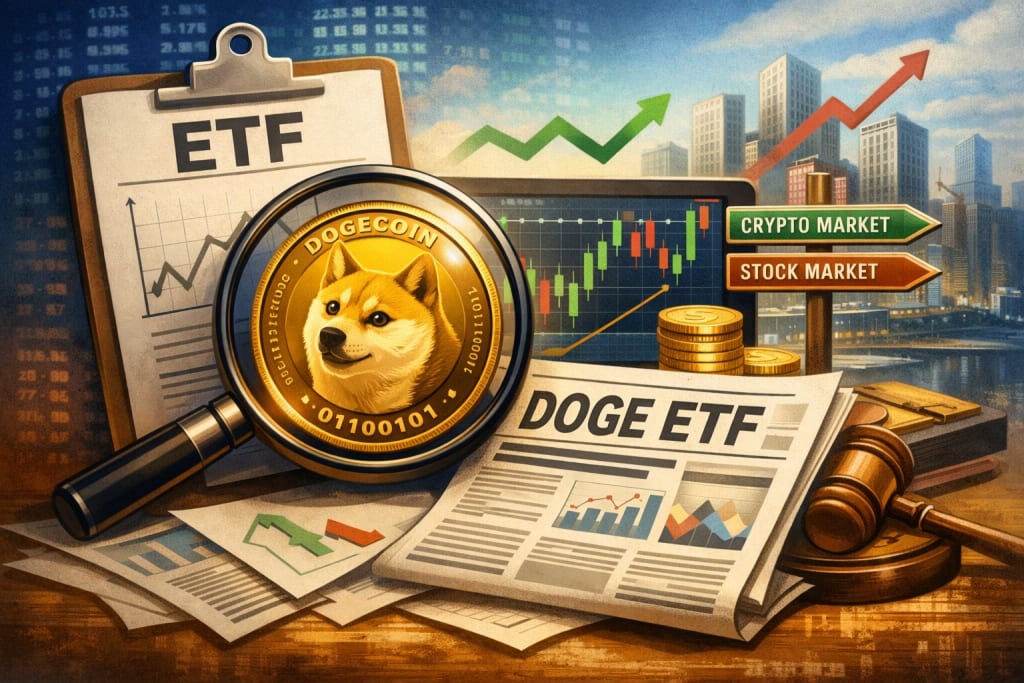
The idea of a Dogecoin-focused ETF has shifted from online speculation to a more serious structural discussion. The question is no longer whether Dogecoin exists as a cultural phenomenon, but what happens when exposure to it is placed inside a traditional, exchange-traded framework.
An ETF is not just a mirror of an asset. It introduces a new layer of market mechanics—exchange trading hours, brokerage access, market makers, settlement rules, and regulatory disclosures. These factors can shape how price movements are experienced by investors, especially when the underlying asset trades continuously and reacts quickly to sentiment.
This article offers an educational look at how a DOGE-linked ETF could be structured, where it might behave differently from the spot market, and why those differences matter. Rather than focusing on predictions or opinions, the goal is to separate the behavior of Dogecoin itself from the mechanics of an ETF wrapper.
This content is informational and not financial advice.
What an ETF Actually Represents
An exchange-traded fund (ETF) is a listed security that trades on stock exchanges much like a share. The fund aims to provide exposure to an underlying asset or reference value, typically measured against its net asset value (NAV). NAV represents the value of the fund’s holdings after accounting for fees and expenses.
To keep ETF prices aligned with NAV, most funds rely on a creation and redemption process. Large institutional participants can create new shares when demand pushes prices above NAV, or redeem shares when prices fall below it. Under normal market conditions, this process helps keep ETF prices close to their underlying value.
When applied to Dogecoin, the key issue becomes structural: how does the ETF gain exposure to DOGE? That decision has a direct impact on tracking accuracy, risk, and performance behavior.
Possible Structures for a DOGE-Linked ETF
Direct custody model
In a straightforward setup, the fund would hold Dogecoin directly through a qualified custodian. ETF shares would represent fractional exposure to those holdings, minus operating costs. This approach most closely follows the spot price, though it still introduces ETF-specific frictions such as fees, trading hours, and temporary price deviations.
For comparison, holding DOGE directly often involves managing a doge wallet, which gives users direct control over the asset. An ETF, by contrast, replaces self-custody with institutional infrastructure and intermediaries.
Derivatives-based exposure
Some ETFs use futures or swaps rather than holding the asset itself. While this can simplify custody, it introduces additional factors such as contract roll costs, collateral management, and counterparty exposure. During volatile periods, these elements can cause performance to diverge noticeably from the spot token.
Hybrid or blended models
In some cases, funds combine exposure tools with cash or short-term securities to manage liquidity and operations. While this may improve stability, it can further distance ETF performance from pure token price movements.
Why ETF Prices Can Diverge From Spot Dogecoin
Even in calm markets, an ETF tied to DOGE will not behave exactly like the token itself. Several factors explain why:
- Fees and expenses slowly reduce returns relative to spot holdings.
- Premiums or discounts to NAV can emerge when trading demand outpaces arbitrage.
- Liquidity constraints may widen bid-ask spreads during fast price moves.
- Pricing methodologies vary based on reference markets and calculation timing.
- Trading-hour differences matter, since Dogecoin trades 24/7 while ETFs trade only during market sessions.
This last point is especially important. If DOGE experiences a sharp move overnight or over a weekend, an ETF may open with a visible gap and then adjust throughout the trading day as liquidity providers rebalance their positions.
It’s also worth clearing up a common misconception: Dogecoin is not a stock. An ETF share is a regulated security that tracks exposure through a fund structure, carrying its own operational and market risks.
Dogecoin, Sentiment, and Market Behavior
Dogecoin operates in a market where attention and narrative often play an outsized role. Social momentum, online visibility, and participation cycles can influence price action just as much as broader market conditions.
This doesn’t make Dogecoin unique, but it does make its movements less linear. Price changes can happen in steps rather than smooth trends, particularly when leverage and derivatives amplify flows. When interest rises quickly, liquidity can follow. When interest fades, liquidity can disappear just as fast.
An ETF wrapper doesn’t remove these dynamics—it translates them into a different trading environment. That translation can magnify certain effects, especially when traditional market hours interact with continuous crypto trading.
What an ETF Wrapper Changes—and What It Doesn’t
A DOGE-linked ETF doesn’t change the Dogecoin network or its underlying mechanics. What it changes is how exposure is accessed and expressed.
Access: ETFs allow participation through standard brokerage accounts, using familiar tools.
Infrastructure: They integrate with reporting, compliance, and portfolio systems common in traditional finance.
Market mechanics: Market makers, hedging, and arbitrage influence price behavior differently than in crypto-native venues.
For many people, learning how to buy dogecoin directly is part of understanding the crypto ecosystem. An ETF represents a parallel path—one that prioritizes convenience and familiarity over direct ownership.
Framing Risk Without Making Predictions
Rather than forecasts, it’s useful to think in conditional terms:
- If ETF participation grows, flows may increasingly move through fund shares rather than spot markets.
- If volatility increases, NAV alignment may weaken temporarily.
- If product details or regulatory conditions change, sentiment can shift before trading behavior does.
- If market interest declines, liquidity conditions can tighten rapidly in both spot and ETF markets.
These outcomes are structural possibilities, not guarantees.
Conclusion
A DOGE ETF would not simply be “Dogecoin in another format.” It would be exposure filtered through ETF infrastructure—custody, pricing models, market-making dynamics, fees, and trading-hour constraints.
Understanding that distinction helps avoid confusion when price behavior doesn’t match expectations. By separating the token from the wrapper, readers can better interpret market moves, evaluate headlines more critically, and understand what kind of exposure they’re actually getting.
Clarity comes from structure, not hype—and in complex markets, structure matters.
About the Creator
Artificial Intelligence (AI) Market Set to Surpass USD 10,173.05 Billion by 2034
The global Artificial Intelligence (AI) Market is projected to expand from USD 638.2 billion in 2024 to approximately USD 3,680.5 billion by 2033, registering a robust CAGR of 19.1% during the forecast period. Growth is being driven by rapid enterprise digital transformation, rising demand for automation, large-scale adoption of generative AI, and strong government investments in AI infrastructure. North America currently leads the market, supported by advanced cloud ecosystems and high enterprise AI spending.
By Roberto Crum5 days ago in Futurism
Australia Steel Market: Infrastructure Development, Mining Demand & Manufacturing Growth
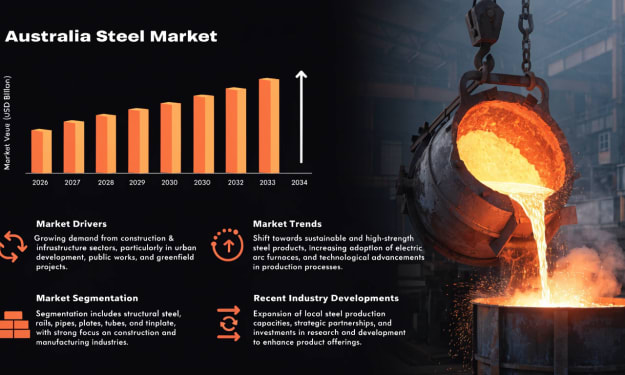
According to IMARC Group, the Australia steel market reached USD 20.1 Billion in 2025 and is projected to grow to USD 26.2 Billion by 2034, exhibiting a compound annual growth rate (CAGR) of 2.91% during 2026–2034. Steel remains one of the most essential materials supporting economic development in Australia. Its widespread applications across construction, mining, transportation, and manufacturing sectors make it a critical component of the country’s industrial ecosystem. Large-scale infrastructure development, expansion in mining operations, and rising domestic manufacturing activity are strengthening Australia steel market share. Additionally, government investments in renewable energy infrastructure and transport modernization projects are further increasing demand for advanced steel products.
By Kevin Cooper3 days ago in Futurism
From ad men to mad men
It's after 2am in the morning when a local police patrol vehicle in Northern New Jersey spots a figure costumed as Quasimodo, The Hunchback of Notre Dame, proceeding southbound on the sidewalk along Lydecker Street. Though the hunchback’s costume stuffing offers added insulation, it's January, and friggin’ freezing. Carefully, the officers slow down, gently question the subject, and offer him a ride home.
By David W. Maury3 days ago in Humor



Comments
There are no comments for this story
Be the first to respond and start the conversation.