
Discrete Semiconductor Market Trends: Power Efficiency, Miniaturization & Demand Outlook to 2033
How miniaturization trends, compact power modules, and higher voltage requirements are influencing design optimization and manufacturing priorities in discrete semiconductor production.

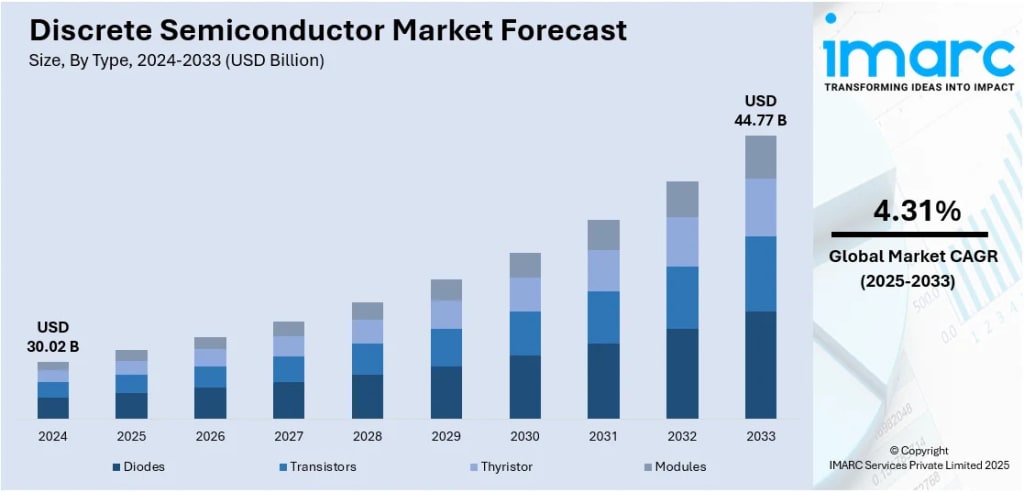
The global discrete semiconductor market is witnessing substantial momentum, driven by energy-efficient electronics demand, electric vehicle proliferation, and accelerating industrial automation adoption. According to IMARC Group's latest market intelligence, the market was valued at USD 30.02 Billion in 2024. The market is projected to reach USD 44.77 Billion by 2033, exhibiting steady growth during 2025-2033.
Discrete semiconductors serve as fundamental building blocks in modern electronics, performing essential functions including power conversion, signal amplification, switching operations, and voltage regulation. These components prove indispensable across consumer electronics, automotive systems, industrial machinery, telecommunications infrastructure, and renewable energy installations. The market benefits from converging trends: smartphones and wearables require advanced power management; electric vehicles demand robust power electronics for battery systems and motor control; industrial automation depends on reliable semiconductors for precision operations; and renewable energy systems need efficient power conversion components.
Download the Free “Discrete Semiconductor Market” Sample & Key Highlights
Discrete Semiconductor Market Growth Drivers:
- Growth in the Automotive Industry
Global automotive production continues expanding robustly, creating substantial semiconductor demand. India recorded combined production of 1,921,268 units across passenger vehicles, two-wheelers, three-wheelers, and quadricycles in December 2024 alone. Modern vehicles integrate extensive electronics for engine control units, advanced driver-assistance systems, infotainment platforms, and transmission management. Discrete semiconductors ensure optimal energy efficiency, voltage regulation, and signal amplification across these critical applications. Even traditional internal combustion engine vehicles increasingly rely on automation and digitalization, intensifying component requirements.
- Increasing Adoption of Electric Vehicles
Electric vehicle adoption is surging worldwide approximately 14 million new electric cars sold globally in 2023, representing 35% annual growth and bringing total electric vehicles on roads to 40 million. EV systems require substantial discrete components including IGBTs, MOSFETs, and rectifiers for battery charging, traction inverters, and onboard power supplies. These semiconductors convert DC battery power to AC for electric motors while regulating power flow across subsystems with minimal energy loss. Fast-charging infrastructure particularly demands discrete devices supporting high voltage and current operations efficiently. Government incentives, carbon neutrality mandates, and battery technology improvements continue boosting EV growth trajectories, directly expanding discrete semiconductor demand across electrification value chains.
- Increased Adoption of Consumer Electronics
Consumer electronics proliferation drives substantial discrete semiconductor consumption across tablets, computers, kitchen appliances, and portable devices. India's home appliances and consumer electronics market was forecasted to grow by USD 2.3 billion during 2022-2027. Manufacturers pursuing slimmer, faster, multifunctional products require high-density, thermally stable, cost-effective discrete components. Features like fast charging, high-resolution displays, and 5G connectivity demand robust power management enabled by advanced discrete devices. Smart home ecosystems and Internet of Things integration further intensify demand for discrete semiconductors offering high reliability in compact packages.
Discrete Semiconductor Market Trends:
- Silicon Carbide and Gallium Nitride Adoption
Wide bandgap semiconductors like silicon carbide and gallium nitride are transforming power electronics through superior efficiency and thermal performance compared to traditional silicon devices. These materials enable smaller, lighter power systems operating at higher voltages and temperatures while reducing energy losses. SiC MOSFETs particularly benefit electric vehicle powertrains, industrial motor drives, and renewable energy inverters requiring high-efficiency power conversion. GaN devices excel in fast-charging applications and high-frequency power supplies. As manufacturing costs decline and production capacity expands, SiC and GaN adoption accelerates across applications where performance advantages justify premium pricing, gradually displacing conventional silicon in demanding power electronics roles.
- Miniaturization and Integration
Discrete semiconductor packaging continues evolving toward smaller form factors supporting compact device designs without sacrificing performance. Advanced packaging technologies enable higher power densities while improving thermal management and electromagnetic compatibility. Manufacturers develop increasingly miniaturized components for space-constrained applications like wearables, smartphones, and automotive electronics. Surface-mount packages dominate new designs, facilitating automated assembly while reducing board space requirements. Despite integration pressures from system-on-chip solutions, discrete components retain advantages in flexibility, repairability, and performance optimization for power-critical applications. This trend toward smaller, more capable discrete devices enables product innovation across electronics categories while maintaining the fundamental benefits of discrete component architectures.
- Smart Grid and Energy Storage Applications
Smart grid modernization and energy storage deployment create expanding markets for discrete semiconductors in power distribution infrastructure. These systems require components managing bidirectional power flow, voltage regulation, and grid synchronization as renewable generation and battery storage integrate into electrical networks. The United States maintained the highest number of data centers globally with 5,426 facilities as of March 2025, each requiring substantial power management infrastructure. Energy storage systems from residential batteries to utility-scale installations depend on discrete semiconductors for charge controllers and inverters. As electrical grids worldwide modernize to accommodate distributed generation and electrification demands, discrete component requirements for grid infrastructure and energy storage systems expand significantly.
Recent News and Developments in Discrete Semiconductor Market
- March 2025: Nexperia released industrial-grade 1200V silicon carbide MOSFETs featuring exceptional temperature stability in X.PAK top-side cooled surface-mount packaging. This launch addresses growing demand for discrete SiC MOSFETs leveraging top-side cooling for superior thermal efficiency across industrial applications.
- March 2025: Vishay Intertechnology showcased its MaxSiC™ Series SiC MOSFETs at the Applied Power Electronics Conference 2025. The company exhibited its extensive passive and semiconductor portfolio focusing on energy harvesting, electric vehicle powertrains, advanced battery technologies, and efficient data center power conversion.
- January 2025: Wolfspeed introduced Generation 4 MOSFET technology platform delivering breakthrough performance for high-power applications. Designed to simplify switching behaviors and address design challenges in high-power systems, Gen 4 defines Wolfspeed's long-term product strategy across discrete components in 750V, 1200V, and 2300V classes.
Note: If you require specific details, data, or insights that are not currently included in the scope of this report, we are happy to accommodate your request. As part of our customization service, we will gather and provide the additional information you need, tailored to your specific requirements. Please let us know your exact needs, and we will ensure the report is updated accordingly to meet your expectations.
About the Creator
Andrew Sullivan
Hello, I’m Andrew Sullivan. I have over 9+ years of experience as a market research specialist.
Keep reading
More stories from Andrew Sullivan and writers in Futurism and other communities.
Heavy Construction Equipment Market Analysis: Urbanization, Mining Activity & Forecast to 2033
Infrastructure expansion, urbanization, and technological advancements in automation and electrification are driving heavy construction equipment demand, supported by government investments, sustainability initiatives, and expanding rental services across diverse construction and industrial applications. According to IMARC Group's latest data, The global heavy construction equipment market size was valued at USD 144.7 Billion in 2024. Looking forward, IMARC Group estimates the market to reach USD 214.5 Billion by 2033, exhibiting a CAGR of 4.25% from 2025-2033.
By Andrew Sullivan2 days ago in Futurism
Travel Accommodation Market Outlook: Tourism Trends and Growth Opportunities
Rising global travel demand, increasing disposable income, and growth of domestic and international tourism are driving expansion of the travel accommodation market. Rapid development of online booking platforms and mobile apps improves accessibility and convenience According to IMARC Group's latest research publication, The global travel accommodation market size was valued at USD 961.6 Billion in 2025. Looking forward, IMARC Group estimates the market to reach USD 2,187.5 Billion by 2034, exhibiting a CAGR of 9.56% from 2026-2034.
By James Whitman6 days ago in Futurism
Cables and Connectors Market: Automotive Electrification, EV Integration & Growth Outlook
According to IMARC Group's latest research publication, global cables and connectors market size reached USD 108.0 Billion in 2024. Looking forward, IMARC Group expects the market to reach USD 157.4 Billion by 2033, exhibiting a growth rate (CAGR) of 3.84% during 2025-2033.
By sujeet. imarcgroup5 days ago in Futurism
Writing About Writing: The Rainbow Trap
The good thing about living in modern times is that LGBTQ representation in media is increasing. Not just in niche and Independant media, either, but also in mainstream media. Books, movies, TV shows, comics... they're finally catching on that LGBTQ+ people form a significant part of their audience, and deserve to see themselves on screen and in fiction, not just as victims in documentaries and true crime shows.
By Natasja Rose3 days ago in Writers




Comments
There are no comments for this story
Be the first to respond and start the conversation.