


DARK MATTER
Dark matter is a hypothetical form of matter that is thought to make up approximately 85% of the matter in the universe. Despite its name, dark matter does not emit, absorb, or reflect any electromagnetic radiation, making it invisible to telescopes. Instead, its presence is inferred through its gravitational effects on visible matter.
One of the first indications of the existence of dark matter came from observations of galaxy rotation curves. In the 1930s, Swiss astronomer Fritz Zwicky observed that the outer regions of galaxy clusters were rotating much faster than would be expected if the visible matter in the galaxies was providing all of the gravitational force. Similar observations have been made in individual galaxies, including our own Milky Way.
The idea of dark matter was further supported by the observation of gravitational lensing, which occurs when the gravity of a massive object bends and amplifies the light from a more distant object behind it. The amount of lensing observed is much greater than would be expected if the lensing object was made up of only visible matter.
Another piece of evidence for dark matter comes from the study of the cosmic microwave background radiation, the afterglow of the Big Bang. The temperature fluctuations in this radiation are thought to be the seeds that eventually grew into the large-scale structure of the universe we see today. Computer simulations of the universe, which include the effects of dark matter, have been able to reproduce the observed temperature fluctuations, while simulations without dark matter do not.
The most widely accepted theory for the nature of dark matter is that it is composed of weakly interacting massive particles (WIMPs). These particles would not interact with electromagnetic radiation, but would interact through the weak nuclear force and gravity. WIMPs are a popular candidate for dark matter because they would naturally arise in many theories beyond the standard model of particle physics.
There are several ongoing experimental efforts to detect WIMPs directly. These include experiments that look for the tiny amounts of energy that a WIMP would transfer to a detector when it collides with a nucleus, as well as experiments that look for the gamma rays that would be produced when two WIMPs annihilate each other. So far, no direct detection of WIMPs has been made, but many experiments are currently under way and will continue to search for WIMPs in the future.
Another possible explanation for dark matter is that it is composed of much lighter particles, such as axions or sterile neutrinos. These particles would not be expected to be detected directly, but their effects on the cosmic microwave background radiation could be observed.
In summary, dark matter is a hypothetical form of matter that is thought to make up most of the matter in the universe. Its existence is inferred through its gravitational effects on visible matter, such as galaxy rotation curves and gravitational lensing. The leading theory for the nature of dark matter is that it is composed of weakly interacting massive particles (WIMPs), which are being searched for in ongoing experiments. Other possibilities include lighter particles such as axions or sterile neutrinos. Despite many efforts to detect dark matter, it has not yet been directly observed.
DARK ENERGY
Dark energy is a mysterious and unexplained form of energy that is thought to make up approximately 68% of the universe's total energy density. It is believed to be responsible for the acceleration of the expansion of the universe, as it acts as a repulsive force that counteracts the force of gravity.
One of the main pieces of evidence for the existence of dark energy is the observation of Type Ia supernovae, which are extremely bright explosions that occur when a white dwarf star accretes matter from a companion star. Scientists have observed that these supernovae are dimmer than expected, which suggests that the expansion of the universe is accelerating.
The current leading theory for dark energy is the cosmological constant, first proposed by Einstein. This theory suggests that dark energy is a form of energy that is evenly distributed throughout the universe and is inherent to the fabric of space-time itself.
Another theory for dark energy is the concept of "quintessence," which suggests that dark energy is a dynamic field that changes over time.
The study of dark energy is still in its early stages and scientists are actively working to understand its properties and behavior. The Planck satellite and Euclid space telescope are currently collecting data to help scientists better understand dark energy and its role in the universe.
About the Creator
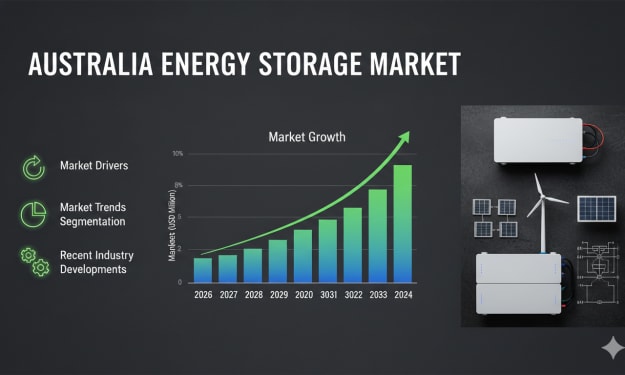
Australia Energy Storage Market: Renewable Integration, Battery Deployment & Grid Stability
According to IMARC Group, the Australia energy storage market reached 4.72 GW in 2025 and is projected to expand significantly to 19.81 GW by 2034, exhibiting a compound annual growth rate (CAGR) of 17.28% during 2026–2034. The rapid growth of the sector reflects the country’s accelerating transition toward renewable energy and the increasing need for reliable electricity systems across Australia. As solar and wind power generation expands, energy storage technologies such as battery energy storage systems (BESS) are becoming essential for maintaining grid reliability and balancing electricity supply and demand. Government policies supporting clean energy adoption, declining battery costs, and investments in grid modernization are significantly strengthening Australia energy storage market share while enabling the integration of renewable power into the national electricity network.
By Shrestha Royabout 3 hours ago in Futurism
Cooking Oil Market: AI-Driven Innovation Transforming Global Edible Oil Demand
AI Overview of the Cooking Oil Market The cooking oil market includes a wide range of edible oils derived from plant and seed sources such as soybean, palm, sunflower, olive, coconut, and canola. These oils are essential ingredients in households, restaurants, food processing industries, and the HoReCa (Hotel, Restaurant, and Catering) sector.
By James Smith2 days ago in Futurism
Review of 'Man on the Run'
My wife and I saw Man on the Run, a nearly 2-hour documentary on Amazon Prime, about Wings, Paul McCartney's group that flew around the world from shortly after The Beatles broke up in early 1970 to shortly after John Lennon was murdered at the end of 1980, making a Beatles reunion forever impossible.
By Paul Levinson5 days ago in Beat


Comments (1)
Very excited about this article