
Could the Universe Be Closed Rather Than Infinite?
Space

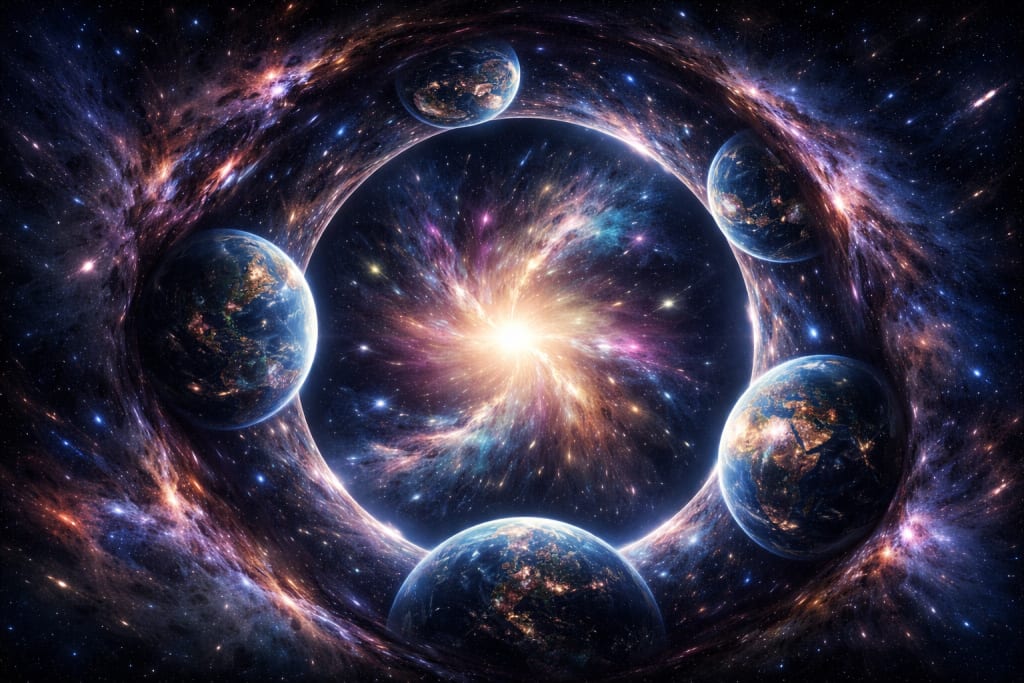
For most people, the idea of the Universe is inseparable from infinity. We imagine space stretching endlessly in every direction, with no limits, no edge, and no final destination. Infinity feels natural, almost inevitable. Yet modern cosmology poses a far more unsettling and fascinating question: what if the Universe is not infinite at all? What if it is closed—finite in size, but without any boundaries?
At first glance, this sounds like a contradiction. How can something be finite and still have no edge? Surprisingly, this concept is not only mathematically consistent but also deeply rooted in Einstein’s theory of relativity and modern observations of the cosmos.
Finite Does Not Mean Bounded
One of the biggest obstacles to understanding a closed Universe is our everyday intuition. In daily life, finite objects always have borders: a room has walls, a field has fences, a planet has a surface. But in geometry, this does not always apply.
A classic analogy is the surface of the Earth. The Earth is finite in area, yet it has no edge. If you start walking in a straight line and never change direction, you will not fall off the planet or reach a boundary—you will eventually return to your starting point. For a two-dimensional being living on Earth’s surface, the world would be closed but unbounded.
Cosmologists suggest that our three-dimensional space could work in a similar way. The Universe might be “wrapped” onto itself in higher-dimensional geometry. In such a cosmos, you could theoretically travel in one direction for an unimaginably long time and still end up where you began—without ever crossing an edge or leaving space itself.
The Geometry of the Cosmos
According to general relativity, the shape of the Universe is determined by its total energy content, including matter, radiation, and dark energy. From a geometric standpoint, there are three main possibilities.
First, there is a closed Universe with positive curvature, similar to the surface of a sphere but in three dimensions. In this case, space is finite in volume. Parallel lines eventually meet, and the rules of Euclidean geometry no longer strictly apply.
Second, there is a flat Universe, where space follows the familiar geometry we learn in school. Parallel lines never meet, and triangles have angles that add up to 180 degrees. A flat Universe can be infinite—but it does not have to be. Certain flat geometries can still be closed if space has a complex topology, such as being shaped like a three-dimensional torus.
Third, there is an open Universe with negative curvature, often compared to a saddle shape. This type of Universe is almost certainly infinite.
For many years, scientists believed that only a positively curved Universe could be closed. Today, however, we know that topology—the global structure of space—matters just as much as local curvature. This opens the door to closed Universes that appear flat on large scales.
What Observations Tell Us
The strongest evidence about the shape of the Universe comes from observations of the cosmic microwave background (CMB), the faint afterglow of the Big Bang that fills all of space. Measurements from satellites such as WMAP and Planck show that the Universe is extremely close to being flat.
At first glance, this seems to support an infinite cosmos. But “nearly flat” does not rule out a closed Universe. It simply means that if the Universe is closed, its overall size must be far larger than the portion we can observe.
Scientists have even searched for telltale signs of a closed topology. If space wraps around itself, light could travel multiple paths to reach us. In theory, we might see the same galaxy or pattern in the CMB appearing in different directions, like repeated reflections in a cosmic hall of mirrors. So far, no conclusive evidence of such repetitions has been found—but the absence of evidence may simply mean that the Universe is too large for these effects to be detectable with current technology.
The Question of “Outside”
One of the most common questions people ask is: if the Universe is closed, what is outside it? From a scientific perspective, this question is misleading. Space itself defines all physical locations. If the Universe is the totality of space, then “outside” has no meaning.
This is similar to asking what lies beyond the North Pole. Once you reach it, the question loses its sense—there is no “north” beyond the North Pole. In the same way, a closed Universe does not sit inside a larger empty container. It simply exists as a self-contained structure.
Philosophical Implications
The difference between an infinite and a closed Universe is not merely technical—it carries deep philosophical consequences. In an infinite cosmos, many physicists argue that every possible arrangement of matter must occur somewhere, no matter how unlikely. This leads to the unsettling idea of exact duplicates of Earth, of you, and of every moment in history, repeated endlessly across space.
In a closed Universe, such conclusions are no longer guaranteed. With a finite volume, the number of possible physical configurations may be limited. Reality could be more unique, less repetitive, and perhaps more meaningful than an infinite model would suggest.
Where Science Stands Today
At present, cosmology cannot definitively answer whether the Universe is infinite or closed. Both possibilities are consistent with existing theories and observations. The observable Universe may simply be too small a window to reveal the true global structure of space.
Ironically, one of the most profound discoveries of modern science may be a recognition of its own limits. Even as we map galaxies billions of light-years away and probe the earliest moments after the Big Bang, the ultimate shape of the cosmos may remain forever beyond our reach.
And perhaps that is fitting. Whether infinite or closed, the Universe continues to challenge our intuition—reminding us that reality is often far stranger, and far more beautiful, than our imagination expects.
About the Creator
Keep reading
More stories from Holianyk Ihor and writers in Futurism and other communities.
Why the Universe Looks Too Smooth to Be Born by Chance
When we imagine the birth of the Universe, we often picture something violent and chaotic: a sudden explosion of energy, matter flying in all directions, randomness ruling everything. Intuitively, such a beginning should leave behind a messy, uneven cosmos. Yet when astronomers observe the Universe on the largest possible scales, they see something very different. The Universe looks remarkably smooth, balanced, and orderly — almost too orderly for a purely random origin.
By Holianyk Ihorabout 4 hours ago in Futurism
About Binding Prometheus
I want to start actively advocating on behalf of my own work, and the most valuable part of my canon is, without a doubt, Binding Prometheus, the play I have been working on since 2019 and only finished in 2023 as part of my MA. The play itself is an amalgamation of a million different inspirations. On one end, it evokes the Ancient Greek myth-play, deriving its own title from the earliest extant work of Western drama we have, Aeschylus’s Prometheus Bound. On the other end, it borrows significantly from the sci-fi bulwarks from over the years, namely Mary Shelley’s Frankenstein and Karel Capek’s Rossum’s Universal Robots. The play could be an episode of Black Mirror, I fear. I don’t know. I’ve only ever seen one episode of Black Mirror.
By Steven Christopher McKnight26 days ago in Futurism
Saudi Arabia Dried Fruits and Nuts Market Analysis: Key Players and Market Forecast
According to IMARC Group's latest research publication, the Saudi Arabia dried fruits and nuts market size reached USD 590.61 Million in 2024. The market is projected to reach USD 1,059.61 Million by 2033, exhibiting a growth rate of 6.71% during 2025-2033.
By Abhay Rajput6 days ago in Futurism



Comments
There are no comments for this story
Be the first to respond and start the conversation.