
Code Wars: The Battle for AI Dominance
Shaping the Future of Global Power
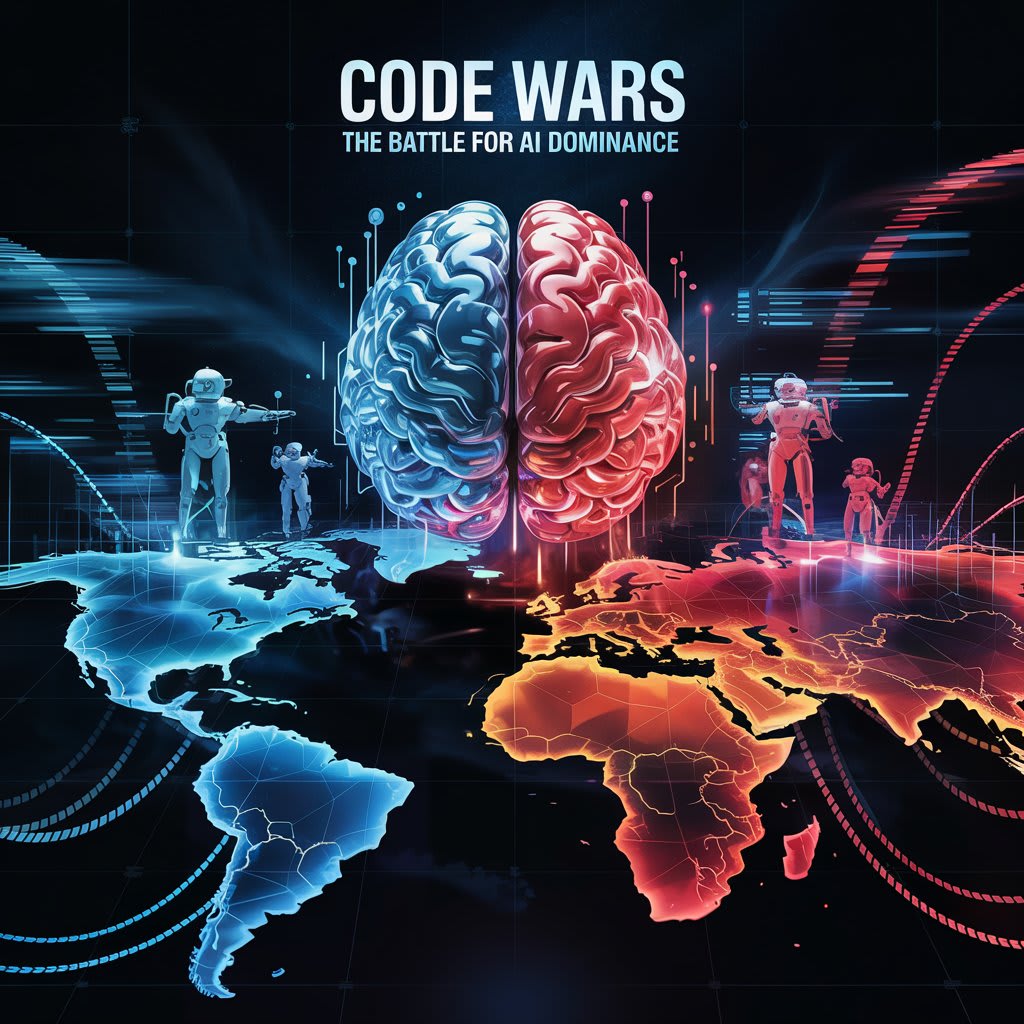
The world stood at the precipice of a new era—one where lines of code, vast datasets, and machine learning algorithms would determine the balance of power. Nations raced to harness artificial intelligence, knowing that whoever led this revolution would shape economies, security, and global influence for decades to come.
This was not a war fought with bullets or bombs, but with research labs, supercomputers, and brilliant minds pushing the boundaries of what machines could do. The stakes were high, and the competition was fierce—but the ultimate goal was progress, not destruction.
The Rise of the AI Titans
In the United States, Silicon Valley remained the beating heart of AI innovation. Tech giants like Google, OpenAI, and NVIDIA poured billions into developing cutting-edge models that could write, create, and reason like humans. The U.S. government, recognizing AI’s strategic importance, partnered with universities and private firms to maintain its lead.
Across the Pacific, China moved with precision. The government’s "Next Generation Artificial Intelligence Development Plan" aimed to make the country the world leader in AI by 2030. Companies like Baidu, Alibaba, and Tencent worked closely with state-backed research institutes, leveraging vast amounts of data to train algorithms that could predict market trends, optimize supply chains, and even influence social governance.
Europe, meanwhile, took a different approach. Rather than racing for sheer dominance, the EU focused on ethical AI—regulating its use to protect privacy and human rights. While this slowed some advancements, it positioned Europe as a leader in responsible innovation, setting global standards for how AI should be governed.
Smaller nations, too, found their niches. Israel became a hub for cybersecurity AI, while Singapore invested heavily in smart city technologies. Even countries with fewer resources joined the race, using open-source tools and international collaborations to compete.
The Battlefields of AI
The competition played out across multiple fronts.
1. Economic Power
AI was reshaping industries at an unprecedented pace. Automated factories, AI-driven financial markets, and personalized medicine were just the beginning. The country that mastered these technologies first would reap enormous economic rewards, leaving others struggling to catch up.
2. National Security
AI-powered surveillance, autonomous drones, and cyber-defense systems became critical tools for governments. Nations sought to protect their infrastructure while ensuring their adversaries couldn’t gain an edge. The balance between security and privacy became a delicate dance.
3. Scientific Breakthroughs
From drug discovery to climate modeling, AI accelerated research in ways previously unimaginable. The first nation to achieve artificial general intelligence (AGI)—a machine capable of human-like reasoning—could unlock solutions to humanity’s greatest challenges.
Collaboration Amid Competition
Despite the rivalry, there were moments of cooperation. International AI summits brought scientists together to discuss ethics, safety, and shared challenges. Open-source platforms allowed researchers worldwide to build on each other’s work. Even competing nations recognized that some problems—like AI alignment and existential risks—required global solutions.
Yet, the race continued. Each breakthrough by one country spurred others to push harder. The question was no longer if AI would transform the world, but who would lead that transformation—and what kind of future they would create.
The Future Unfolds
As the years passed, the landscape evolved. Some nations surged ahead in specific sectors while others specialized in different areas. The true winners were those who balanced innovation with responsibility, ensuring that AI served humanity rather than controlling it.
The battle for AI dominance was far from over. But one thing was certain: the world would never be the same.
The Code Wars had begun—and the future of global power was being written, one algorithm at a time.
About the Creator
About Binding Prometheus
I want to start actively advocating on behalf of my own work, and the most valuable part of my canon is, without a doubt, Binding Prometheus, the play I have been working on since 2019 and only finished in 2023 as part of my MA. The play itself is an amalgamation of a million different inspirations. On one end, it evokes the Ancient Greek myth-play, deriving its own title from the earliest extant work of Western drama we have, Aeschylus’s Prometheus Bound. On the other end, it borrows significantly from the sci-fi bulwarks from over the years, namely Mary Shelley’s Frankenstein and Karel Capek’s Rossum’s Universal Robots. The play could be an episode of Black Mirror, I fear. I don’t know. I’ve only ever seen one episode of Black Mirror.
By Steven Christopher McKnight24 days ago in Futurism
Athletic Footwear Market: Performance Innovation, Brand Strategies & Growth Outlook
According to IMARC Group's latest research publication, global athletic footwear market size reached USD 125.98 Billion in 2025. Looking forward, IMARC Group expects the market to reach USD 176.23 Billion by 2034, exhibiting a growth rate (CAGR) of 3.76% during 2026-2034.
By Andrew Sullivan5 days ago in Futurism



Comments
There are no comments for this story
Be the first to respond and start the conversation.