
Cloud Computing Market Share, Trends & Forecast 2025–2033 | Renub Research
How Digital Transformation, AI, SaaS, and Hybrid Cloud Adoption Are Powering the Next Era of Global Cloud Growth

Introduction: Cloud Computing at the Core of the Digital Economy
Cloud computing has evolved from a cost-saving IT alternative into the backbone of the global digital economy. From startups to multinational enterprises, organizations across sectors are increasingly relying on cloud platforms to run applications, manage data, enable collaboration, and deploy advanced technologies such as artificial intelligence (AI) and big data analytics.
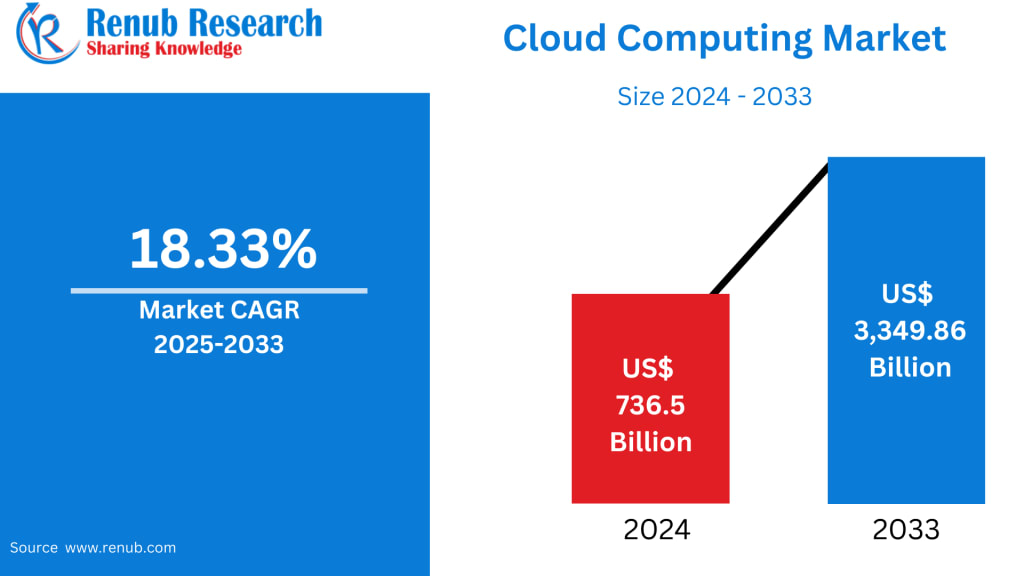
According to Renub Research, the global Cloud Computing Market was valued at US$ 736.5 billion in 2024 and is projected to reach an impressive US$ 3,349.86 billion by 2033, expanding at a robust CAGR of 18.33% from 2025 to 2033. This remarkable growth reflects the accelerating pace of digital transformation, the rise of remote work, increasing demand for scalable IT infrastructure, and the rapid adoption of SaaS and hybrid cloud models worldwide.
Global Cloud Computing Market Overview
Cloud computing refers to the delivery of computing services—including servers, storage, databases, networking, software, and analytics—over the internet. Instead of investing heavily in physical infrastructure, businesses can access these resources on demand, paying only for what they use.
The three primary service models shaping the cloud ecosystem include:
Software as a Service (SaaS): Delivers ready-to-use applications over the internet
Infrastructure as a Service (IaaS): Provides virtualized computing resources
Platform as a Service (PaaS): Enables developers to build, test, and deploy applications
By offering flexibility, scalability, speed, and cost efficiency, cloud computing has become indispensable for modern enterprises. It enables real-time collaboration, seamless data access, faster innovation cycles, and enhanced business continuity across industries.
Key Growth Drivers Fueling the Cloud Computing Market
1. Accelerating Digital Transformation Across Industries
Digital transformation remains the most influential driver of cloud computing adoption. Organizations are replacing legacy IT systems with cloud-based solutions to improve agility, reduce operational costs, and enhance customer experiences.
Cloud-first strategies allow enterprises to modernize applications, integrate AI and analytics, and respond quickly to changing market demands. Industries such as BFSI, healthcare, retail, manufacturing, and government are increasingly migrating mission-critical workloads to the cloud.
A notable milestone came in June 2024, when Oracle and Google Cloud announced a strategic partnership. The collaboration enables seamless interoperability between Oracle Cloud Infrastructure (OCI) and Google Cloud, allowing customers to deploy workloads without cross-cloud data transfer fees. The launch of Oracle Database@Google Cloud further strengthens cloud modernization efforts worldwide.
2. Expanding Adoption of Software as a Service (SaaS)
The rapid expansion of SaaS continues to dominate the cloud computing landscape. SaaS solutions offer businesses immediate access to applications without the burden of installation, maintenance, or infrastructure management.
From CRM, ERP, and HR platforms to collaboration and productivity tools, SaaS applications support remote work, real-time data access, and automatic updates. The subscription-based pricing model appeals to both large enterprises and SMEs by ensuring predictable IT expenses.
As organizations increasingly favor cloud-native and subscription-based software, SaaS remains the largest contributor to overall cloud market revenue.
3. AI, Big Data Analytics, and Edge Computing Integration
The convergence of cloud computing with AI and big data analytics is reshaping enterprise decision-making. Massive volumes of data generated daily require scalable infrastructure for processing, storage, and real-time analysis—capabilities uniquely enabled by cloud platforms.
In February 2024, Akamai Technologies announced its Generalized Edge Compute (Gecko) initiative, expanding cloud capabilities at the network edge. By bringing compute resources closer to end users and data sources, edge computing enhances performance, reduces latency, and supports AI-driven applications.
This growing reliance on AI-powered services across finance, healthcare, media, and manufacturing continues to fuel cloud market growth.
4. Rise of Remote and Hybrid Work Models
The global shift toward remote and hybrid work environments has permanently increased demand for cloud-based collaboration and productivity tools. Cloud platforms enable employees to securely access applications and data from anywhere, ensuring business continuity and workforce flexibility.
Organizations now prioritize cloud investments that support virtual collaboration, cybersecurity, and scalable digital workplaces, reinforcing long-term market expansion.
Challenges Facing the Cloud Computing Market
Data Privacy, Security, and Downtime Risks
Despite its advantages, cloud computing faces challenges related to data privacy, cybersecurity threats, and service outages. High-profile disruptions can affect productivity, revenue, and customer trust, even for major cloud providers.
Although service level agreements (SLAs) offer performance guarantees, businesses must adopt multi-cloud strategies, redundancy, and fault-tolerant architectures to minimize risks and ensure operational resilience.
Integration with Legacy Systems
Many enterprises still rely on outdated on-premise infrastructure that was not designed for cloud environments. Migrating and integrating legacy systems into modern cloud platforms can be complex, costly, and time-consuming.
Issues such as compatibility constraints, data migration risks, and lack of standardized APIs often slow down cloud adoption. To overcome this, organizations are increasingly adopting hybrid cloud strategies that balance modernization with operational stability.
Regional Market Insights
United States Cloud Computing Market
The United States remains a global leader in cloud computing adoption, driven by strong digital transformation initiatives across industries. Sectors such as BFSI, healthcare, retail, and government are leveraging cloud platforms to deploy AI-driven services and improve operational efficiency.
In June 2023, Google Cloud partnered with EPAM Systems, Inc. to expand AI-first solutions using tools like Vertex AI and Generative AI App Builder. This collaboration highlights the growing importance of cloud-AI integration in driving innovation across the U.S. market.
India Cloud Computing Market
India’s cloud computing market is witnessing rapid growth, fueled by government digital initiatives, rising internet penetration, and expanding technology adoption across enterprises.
In January 2024, Microsoft announced a US$ 3 billion investment in India to strengthen cloud and AI infrastructure. The initiative also includes training 10 million people in AI skills by 2030, reinforcing India’s position as a global digital and cloud innovation hub.
United Kingdom Cloud Computing Market
The UK cloud market is expanding steadily, supported by a vibrant technology ecosystem and strong demand for secure, scalable cloud services.
In 2024, Amazon Web Services (AWS) revealed plans to invest £8 billion over the next decade to expand data centers and cloud infrastructure in the UK. This investment is expected to accelerate digital transformation and strengthen the nation’s cloud economy.
Saudi Arabia Cloud Computing Market
Saudi Arabia is emerging as a key cloud market in the Middle East, driven by Vision 2030 and government-led digital transformation policies. Initiatives such as the Cloud First Policy encourage public and private organizations to migrate workloads to the cloud.
Major global providers, including AWS, Microsoft, Google, and Oracle, are expanding their presence in the Kingdom, positioning Saudi Arabia as a regional cloud hub.
Cloud Computing Market Segmentation
By Service:
Software as a Service (SaaS)
Infrastructure as a Service (IaaS)
Platform as a Service (PaaS)
By Enterprise Size:
Large Enterprises
Small & Medium Enterprises (SMEs)
By Industry:
BFSI
IT & Telecom
Retail & Consumer Goods
Media & Entertainment
Manufacturing
Energy & Utilities
Healthcare
Government & Public Sector
Others
By Country (25-Nation Coverage):
North America, Europe, Asia Pacific, Latin America, Middle East & Africa
Competitive Landscape and Key Players
The cloud computing market is highly competitive, with global technology giants investing heavily in infrastructure, innovation, and strategic partnerships.
Key Players Analyzed:
Amazon.com Inc. (AWS)
Google LLC
Microsoft Corporation
Alibaba Cloud
Salesforce Inc.
Adobe Group
Oracle Corporation
IBM Corporation
Each company is evaluated across:
Company Overview
Key Leadership
Recent Developments & Strategies
Sales Analysis
Final Thoughts
The global cloud computing market is entering a decisive growth phase, fueled by digital transformation, AI integration, SaaS dominance, and rising demand for scalable IT infrastructure. With the market projected to surpass US$ 3.34 trillion by 2033, cloud computing is no longer optional—it is essential for innovation, resilience, and competitiveness.
As enterprises continue to modernize operations and governments invest in digital ecosystems, cloud technologies will remain at the heart of economic growth and technological advancement worldwide.
About the Creator
jaiklin Fanandish
Jaiklin Fanandish, a passionate storyteller with 10 years of experience, crafts engaging narratives that blend creativity, emotion, and imagination to inspire and connect with readers worldwide.
Keep reading
More stories from jaiklin Fanandish and writers in Futurism and other communities.
Formulation Development Outsourcing Market Size and Forecast 2025–2033
Introduction The global pharmaceutical industry is undergoing a profound transformation, driven by rising research and development (R&D) costs, increasing regulatory scrutiny, and the growing complexity of drug formulations. Against this backdrop, formulation development outsourcing has emerged as a critical strategy for pharmaceutical and biopharmaceutical companies aiming to remain competitive, innovative, and cost-efficient.
By jaiklin Fanandishabout a month ago in Futurism
About Binding Prometheus
I want to start actively advocating on behalf of my own work, and the most valuable part of my canon is, without a doubt, Binding Prometheus, the play I have been working on since 2019 and only finished in 2023 as part of my MA. The play itself is an amalgamation of a million different inspirations. On one end, it evokes the Ancient Greek myth-play, deriving its own title from the earliest extant work of Western drama we have, Aeschylus’s Prometheus Bound. On the other end, it borrows significantly from the sci-fi bulwarks from over the years, namely Mary Shelley’s Frankenstein and Karel Capek’s Rossum’s Universal Robots. The play could be an episode of Black Mirror, I fear. I don’t know. I’ve only ever seen one episode of Black Mirror.
By Steven Christopher McKnight17 days ago in Futurism
CC Geographic Information System (GIS) Market: Analytics Advancement & Growth Drivers
According to IMARC Group's latest research publication, GCC Geographic Information System (GIS) Market size reached USD 770.0 Million in 2024. Looking forward, IMARC Group expects the market to reach USD 2,296.0 Million by 2033, exhibiting a growth rate (CAGR) of 12.26% during 2025-2033.
By Abhay Rajput6 days ago in Futurism



Comments
There are no comments for this story
Be the first to respond and start the conversation.