
Climate Engineering: The Bold Solution or Dangerous Gamble?
Climate engineering is a double-edged sword. While it offers innovative solutions to mitigate climate change, it poses significant risks that require careful consideration.

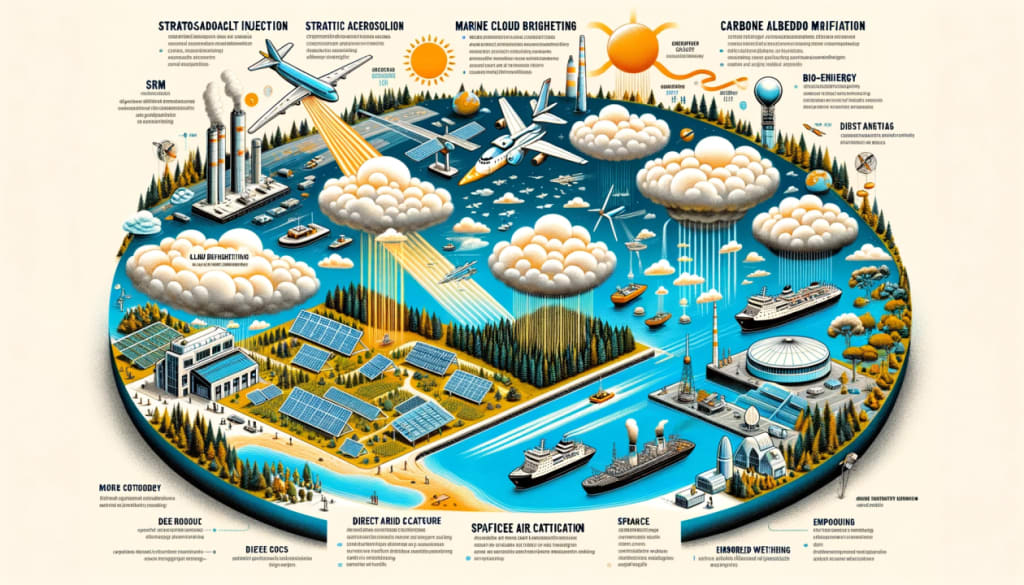
Climate change is one of the most pressing challenges of our time. As traditional methods to reduce greenhouse gas emissions struggle to keep pace with global warming, climate engineering, also known as geoengineering, has emerged as a potential solution. By deliberately manipulating Earth's climate systems, climate engineering aims to mitigate the effects of climate change. However, this approach comes with risks that must be understood and addressed. This comprehensive article explores the risks of climate engineering and presents potential solutions to ensure its responsible use.

What is Climate Engineering?
Climate engineering involves technologies designed to counteract climate change by directly altering the environment. Two primary approaches are:
- Solar Radiation Management (SRM): Techniques to reflect sunlight back into space, such as injecting aerosols into the stratosphere or deploying reflective materials on Earth's surface.
- Carbon Dioxide Removal (CDR): Methods to remove CO₂ from the atmosphere, including direct air capture, afforestation, and ocean fertilization.
While promising in theory, these techniques could have unforeseen consequences, making careful evaluation critical.
Risks Associated with Climate Engineering
1. Unintended Side Effects
- Altered Weather Patterns: Changes in precipitation could lead to droughts in some areas and floods in others, destabilizing ecosystems and food supplies.
- Ecological Disruption: Techniques like ocean fertilization may harm marine biodiversity, creating dead zones in oceans.
2. Moral Hazard
- Climate engineering could reduce the urgency for emission reductions. If stakeholders view it as a "quick fix," it may delay necessary efforts to transition to renewable energy and sustainable practices.
3. Technological Failures
- Unpredictability: Geoengineering systems might fail or produce unintended outcomes, exacerbating climate problems rather than solving them.
- Difficulty in Reversal: Some techniques, such as ocean-based methods, may cause irreversible damage.
4. Global Inequities
- Certain regions may benefit while others bear the brunt of negative effects, leading to geopolitical tensions.
- Decision-making power concentrated in a few countries or organizations could marginalize vulnerable populations.
5. Environmental Degradation
- Stratospheric aerosol injection could damage the ozone layer, increasing harmful ultraviolet radiation.
- Large-scale afforestation projects might compete with agricultural land, impacting food security.
Solutions to Mitigate Climate Engineering Risks
1. Thorough Research and Testing
- Controlled Experiments: Conduct small-scale, controlled tests to study potential consequences before large-scale deployment.
- Advanced Modeling: Use computer simulations to predict long-term impacts under various scenarios.
2. Global Governance and Cooperation
- International Frameworks: Develop treaties to regulate the development and deployment of geoengineering technologies.
- Equitable Decision-Making: Involve all nations, especially those most vulnerable to climate change, in discussions and planning.
3. Public Awareness and Engagement
- Transparency: Share findings from research and testing openly with the public.
- Educational Campaigns: Explain the benefits, risks, and ethical considerations of climate engineering to build informed consensus.
4. Focus on Mitigation and Adaptation
- Combine climate engineering with efforts to reduce emissions and adapt to climate impacts.
- Support renewable energy, energy efficiency, and conservation initiatives as foundational solutions.
5. Develop Reversible and Flexible Techniques
- Design systems that can be adjusted, paused, or reversed if adverse effects arise.
- Prioritize approaches with minimal environmental footprint, such as natural carbon sequestration.
Geoengineering: A Horrible Idea We Might Have to Do
Balancing Climate Engineering with Sustainable Practices
Integration with Renewable Energy
Climate engineering should complement renewable energy efforts rather than replace them. Solar, wind, and hydroelectric power remain vital to reducing emissions sustainably.
Enhancing Natural Climate Solutions
- Protect and restore forests, wetlands, and mangroves as natural carbon sinks.
- Support soil regeneration and sustainable agricultural practices to capture carbon naturally.
Ethical Oversight and Monitoring
- Involve ethicists, environmentalists, and communities in decision-making.
- Implement robust monitoring systems to track the environmental and societal impacts of climate engineering projects.
Conclusion
Climate engineering is a double-edged sword. While it offers innovative solutions to mitigate climate change, it poses significant risks that require careful consideration. By prioritizing research, global cooperation, and sustainable practices, we can explore geoengineering responsibly and ethically. Combining these efforts with emission reductions and natural climate solutions will help create a balanced approach to tackling climate change.
About the Creator
Keep reading
More stories from Marveline Merab and writers in Futurism and other communities.
Biohacking Human Augmentation: Unlocking New Frontiers of Innovation
Biohacking and human augmentation represent a paradigm shift in the way humans interact with technology and biology. From improving physical performance to enhancing cognitive capabilities, these practices push the boundaries of what is possible. But with great potential comes ethical, societal, and medical questions about how far we should go in redefining human limits.
By Marveline Merababout a year ago in Futurism
About Binding Prometheus
I want to start actively advocating on behalf of my own work, and the most valuable part of my canon is, without a doubt, Binding Prometheus, the play I have been working on since 2019 and only finished in 2023 as part of my MA. The play itself is an amalgamation of a million different inspirations. On one end, it evokes the Ancient Greek myth-play, deriving its own title from the earliest extant work of Western drama we have, Aeschylus’s Prometheus Bound. On the other end, it borrows significantly from the sci-fi bulwarks from over the years, namely Mary Shelley’s Frankenstein and Karel Capek’s Rossum’s Universal Robots. The play could be an episode of Black Mirror, I fear. I don’t know. I’ve only ever seen one episode of Black Mirror.
By Steven Christopher McKnight16 days ago in Futurism
Saudi Arabia Pneumatic Equipment Market Expanding Industrial Applications and Manufacturing Demand
According to IMARC Group's latest research publication, Saudi Arabia pneumatic equipment market size reached USD 298.12 Million in 2024. The market is projected to reach USD 543.94 Million by 2033, exhibiting a growth rate (CAGR) of 6.91% during 2025-2033.
By Suhaira Yusufa day ago in Futurism




Comments
There are no comments for this story
Be the first to respond and start the conversation.