
Classic Movie Review: '2001 A Space Odyssey'
Watching one of the all time classics again just for the experience.

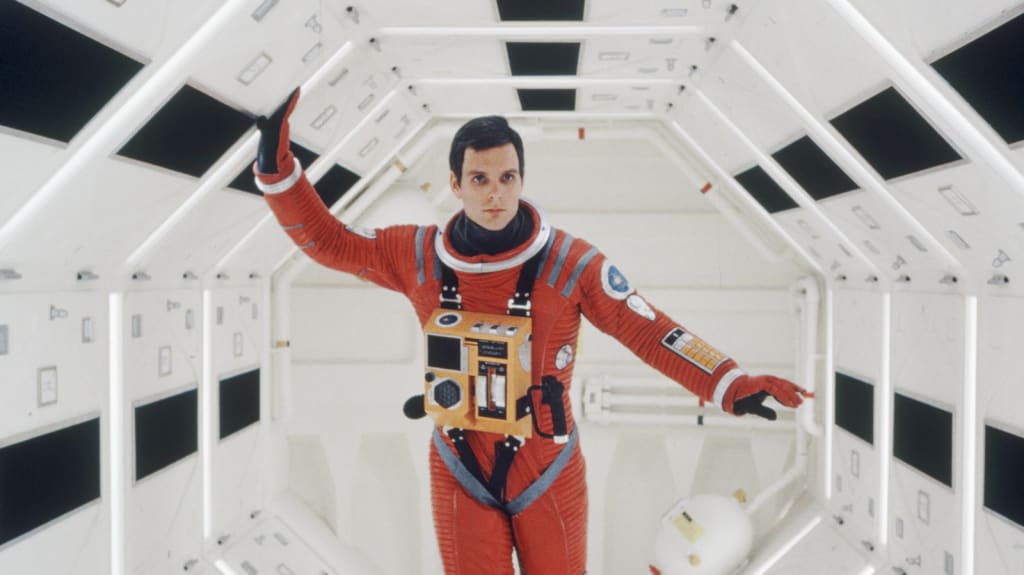
I have no excuse to write a full length review of 2001 A Space Odyssey in 2021. It's not celebrating an Anniversary, it's not new to 4K or the Criterion Collection. I have nothing remotely to tie this movie to other than my desire to sit and experience it again on my 50+ inch flat screen television, the one great indulgence of my life, more expensive than my car. (That's only a slight exaggeration.)
2001 A Space Odyssey is an experience as much as it is a movie. You watch 2001 as much as you are engulfed by it. Stanley Kubrick’s 1968 masterpiece remains mind-blowingly brilliant more 50 years after it was released in theaters. And I didn’t even need the kinds of psychotropic drugs that people had in the late 1960’s to enjoy it. Thanks to director Christopher Nolan, helped rehabilitate the movie for it's 50th Anniversary in 2018, Stanley Kubrick’s visionary work is available to the world as it was back in ‘68.
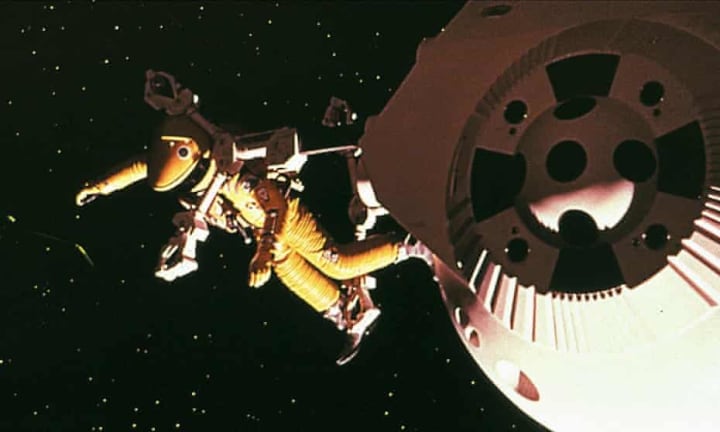
There is only a modest amount of a plot in 2001 A Space Odyssey and it doesn’t kick in until we are over an hour into the movie. The film happens in a series of set pieces seemingly intended to demonstrate the evolution of man. The film begins by observing apes, thousands of years in the past. After a group of apes is chased away from their watering hole they are visited by a large black monolith. After touching the massive edifice inspiration strikes.
One of the apes picks up a bone and begins to pound it on other sets of bones and enjoys seeing them crack and fly into the air. Eventually, this ape gets the idea that this bone could be used to pound on other animals. He uses it on a pig and enjoys a meal of raw meat. He spreads it around and soon they are all eating well. Then, it’s time to take back the watering hole. With bones in hand, the apes approach the watering hole and take it back by force.
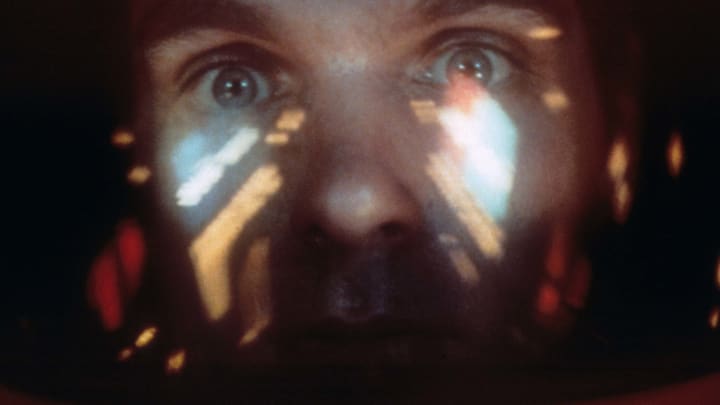
The scene ends in iconic fashion with the soaring Thus Spoke Zarathustra on the soundtrack, as an ape throws his bone in the air and the scene shifts to outer space. This is man’s next great evolutionary leap. We’ve conquered space to the point that there is a spaceport and a Hilton branded hotel. Space travel in this future world is mundane to the point that no one is in awe. When we meet Dr. Heywood Floyd (William Syvester) he’s trying to sleep on a space shuttle, not enraptured by being in space, rather he's just staring out a window in mild wonder. He’s been here before and thus, so have we.
Dr. Floyd is headed to the Moon where a large, black monolith has landed near an American base. Floyd is part of the team tasked with keeping the discovery a secret from the worldwide space community. We know, in the audience, that this monolith is related to, if not the same, as the monolith that inspired the evolutionary leap forward of the apes toward man and it’s fascinating still to find out where we are to leap next.
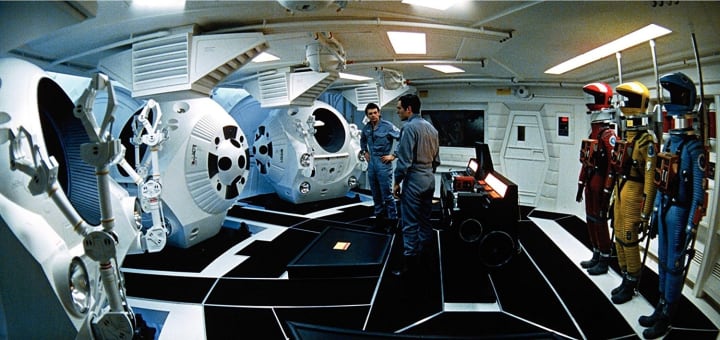
That’s a thumbnail sketch of the first hour of 2001 A Space Odyssey but it doesn’t do justice to the small and brilliant details that Stanley Kubrick brings to the film. The little touches, the top details and the superior style of 2001 A Space Odyssey can barely be described in a movie review unless you’re prepared to write a book length appreciation of it. I probably could write a book about 2001, I find it that enthralling.
It’s at this point that we are finally introduced to the star of 2001 A Space Odyssey and no, I am not talking about actor Keir Dullea. The HAL 9000 computer is inarguably the star of 2001. No single item in film history has ever been as iconic as HAL. Voice actor Douglas Rain crafts the perfect, soothing and intelligent voice to go with HAL, which is essentially, a single, unblinking, red-eye. HAL sees all and it takes everything Dullea’s Dr. David Bowman can think of in order to get past HAL and complete his mission.
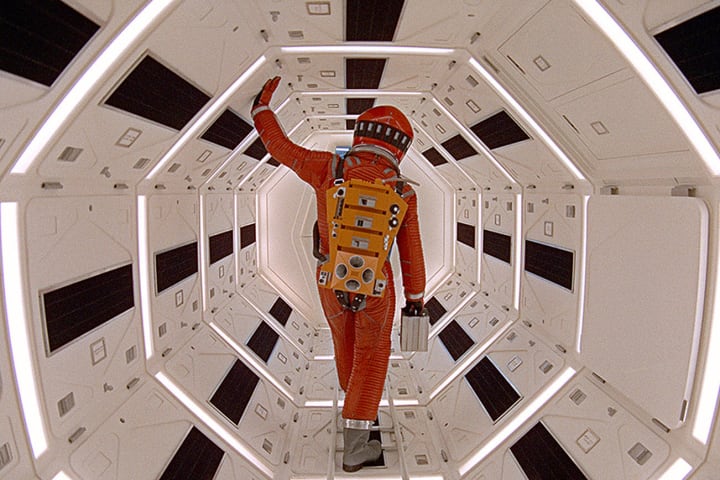
You will need to see for yourself where it goes from there as I am not going to spoil the magic of a true film classic. The soothing, ever calm voice of HAL becomes slightly alarmed later in the movie and it is fascinating to consider just what it means for HAL to feel things like emotions, especially when HAL believes that Dave and fellow astronaut Frank Poole are conspiring against him/it.
The ending is a trip unlike any other. Again, no spoilers. I will only say that I can only imagine what it is like to be high on some drug during the final half hour of 2001 A Space Odyssey but it can’t be far off from the sober experience. It feels like a trip, it feels as if you are loose from your senses in the moments until we’ve reached our final dinner reservation, so to speak. The iconic closing shot of the movie never fails to leave me stunned, not just at how sweeping and epic it feels but because it is all there in the text of 2001 A Space Odyssey, how we got here.
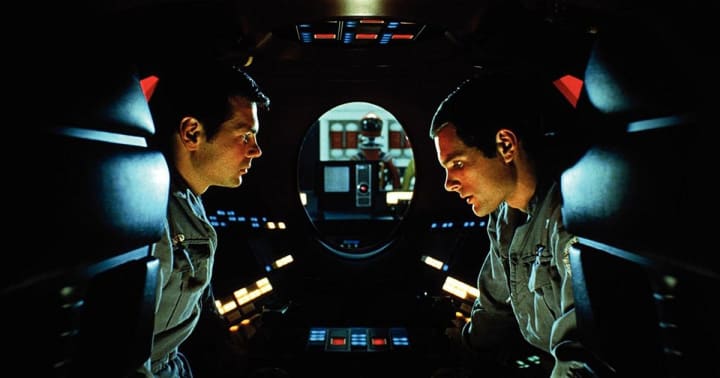
The film earns this unusual mind bending ending by layering the plot in such a way that no other ending would make as much sense. The trippiness throws you for a loop, unmoors you from the plot and draws you deeper into the movie. You are an active participant in the last wordless scenes of 2001 A Space Odyssey. You are invited to ponder the infinite and your place within it and what it all means all while the birth of new life is ready to descend on the next evolution of man.
About the Creator
Sean Patrick
Hello, my name is Sean Patrick He/Him, and I am a film critic and podcast host for the I Hate Critics Movie Review Podcast I am a voting member of the Critics Choice Association, the group behind the annual Critics Choice Awards.
Keep reading
More stories from Sean Patrick and writers in Futurism and other communities.
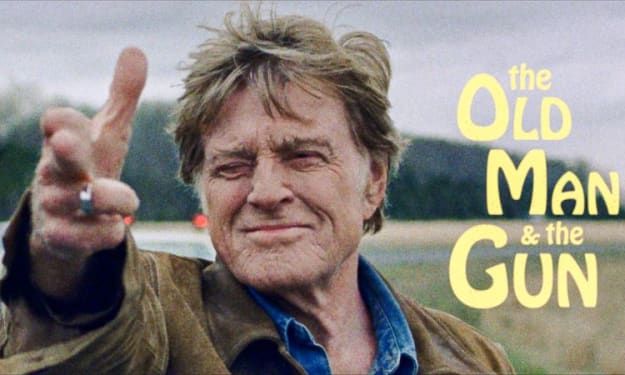
Movie Review: 'Old Man and the Gun' Starring Robert Redford
Robert Redford announced his retirement from acting in 2019. That means that his final performance is his role in the David Lowery helmed Old Man & the Gun. If that is indeed the case, that Mr. Redford is truly retired, he goes out on a pretty great note, playing a character that suits him. The consummate charmer, Redford plays bank robber Forrest Tucker with the kind of half-smile and glint in his eye which marked his all time greatest performances.
By Sean PatrickExclusive • 4 years ago
About Binding Prometheus
I want to start actively advocating on behalf of my own work, and the most valuable part of my canon is, without a doubt, Binding Prometheus, the play I have been working on since 2019 and only finished in 2023 as part of my MA. The play itself is an amalgamation of a million different inspirations. On one end, it evokes the Ancient Greek myth-play, deriving its own title from the earliest extant work of Western drama we have, Aeschylus’s Prometheus Bound. On the other end, it borrows significantly from the sci-fi bulwarks from over the years, namely Mary Shelley’s Frankenstein and Karel Capek’s Rossum’s Universal Robots. The play could be an episode of Black Mirror, I fear. I don’t know. I’ve only ever seen one episode of Black Mirror.
By Steven Christopher McKnight20 days ago in Futurism
Fiber Laser Market: Industrial IoT Integration, Smart Factories & Growth Prospects
Driven by rising demand for precision manufacturing, automotive and electronics production, energy-efficient laser systems, and increasing adoption in cutting, welding, and additive manufacturing applications worldwide. According to IMARC Group's latest research publication, the global fiber laser market size reached USD 3.0 Billion in 2024. Looking forward, IMARC Group expects the market to reach USD 6.1 Billion by 2033, exhibiting a growth rate (CAGR) of 7.8% during 2025-2033.
By Andrew Sullivanabout 15 hours ago in Futurism
How to Succeed at the Benson Directory®
Congratulations and welcome to the Benson Directory® employee #22391! As our newest call handler, you will have the privilege of speaking with dozens of unique and interesting people on a daily basis as well as the opportunity to earn bonuses for high performance. Contained within this handbook you will find a set of ease to follow instructions designed to help you settle in to your new role and begin paving the way to success.
By S. A. Crawford4 days ago in Fiction



Comments
There are no comments for this story
Be the first to respond and start the conversation.