

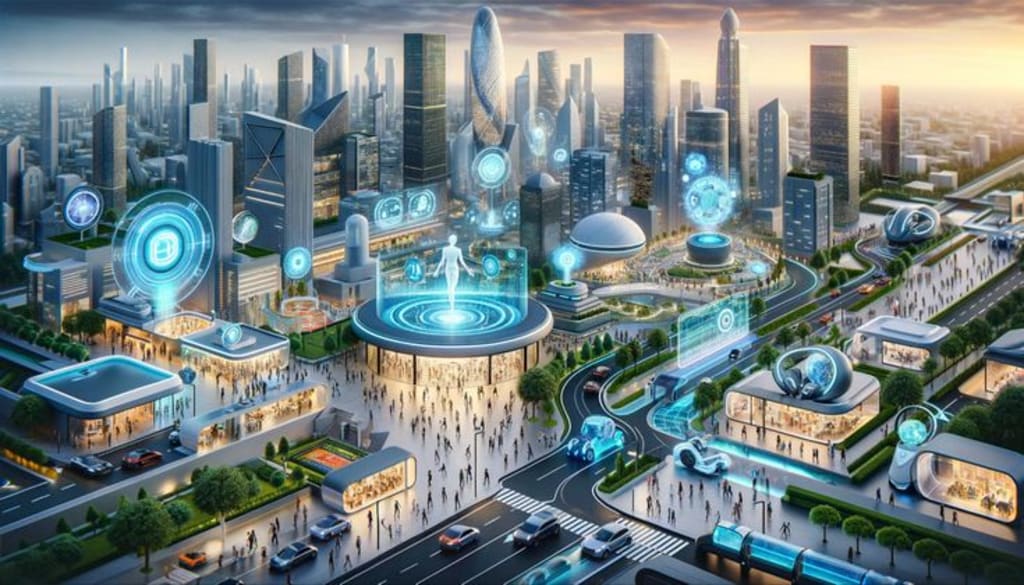
In the year 2050, the city of NeoLume was like nothing anyone had ever imagined. Towering skyscrapers stretched into the clouds, covered with glowing digital panels that changed colors with the time of day. Autonomous cars zipped through the streets silently, and drones floated above, delivering packages and monitoring traffic. For twenty-year-old Aria, this was home, but she often wondered if living in such a high-tech world came with a cost.
Aria worked at the city’s Central Tech Hub, where innovations were tested before being released to the public. She loved technology and had dreamed of building robots and AI programs since she was a child. Yet, sometimes she felt disconnected. People relied on machines for everything—from cooking and cleaning to learning and making decisions. Face-to-face conversations were rare, and parks were almost empty, as everyone preferred virtual experiences.
One day, Aria was assigned to a special project: designing a new AI companion for elderly citizens, intended to provide company and assistance. She studied hundreds of reports and watched videos of people interacting with older AI models. Most elderly users seemed happy, but some grew frustrated. Aria realized that the key to success was not just programming intelligence, but understanding emotions and human connection.
Aria spent weeks experimenting, coding, and testing different behaviors. She gave the AI subtle expressions, voice tones, and gestures that could mimic empathy. She even taught it to remember personal stories and favorite activities of each user. It wasn’t just a machine—it was a friend.
Finally, the day came to test her creation with Mr. Lee, an eighty-year-old man who lived alone in NeoLume. Aria brought the AI to his apartment, nervous but excited. The robot introduced itself politely, asking about his day and suggesting a cup of tea. Mr. Lee’s eyes lit up, and for the first time in years, he laughed freely.
Over the next few weeks, Aria watched as Mr. Lee interacted with the AI. He seemed more active, more cheerful, and even started talking to his neighbors again. Aria realized that technology could enhance life, but it could never replace human warmth. Her AI companion worked best when it encouraged connection, not isolation.
Inspired by this success, Aria began imagining other possibilities for the city. What if AI could help children learn in ways that nurtured creativity rather than just memorization? What if robots could assist farmers to grow food efficiently while still respecting nature? What if technology could bring people closer instead of driving them apart?
NeoLume was already a city of the future, full of advanced gadgets, machines, and networks. But Aria believed that the true future depended not on machines alone, but on how humans used them. A city could shine with neon lights, drones, and flying cars, yet feel empty without empathy, understanding, and shared experiences.
One evening, Aria stood on her apartment balcony, looking at the glowing city below. She watched people walking with smart devices, robots moving in sync with traffic, and holograms dancing in the night air. And she smiled, knowing that the future was not only about machines—it was about using them to make life richer, more connected, and more meaningful.
Aria’s work reminded her that every new invention carried responsibility. Futurism wasn’t just science and technology; it was imagination, ethics, and vision. And as she returned to her lab to continue building, she felt hope. The City of Tomorrow was bright, not just because of lights and machines, but because people like her were working to make the future humane, thoughtful, and full of life.
but because people like her were working to make the future humane, thoughtful, and full of life.
About the Creator
Sudais Zakwan
Sudais Zakwan – Storyteller of Emotions
Sudais Zakwan is a passionate story writer known for crafting emotionally rich and thought-provoking stories that resonate with readers of all ages. With a unique voice and creative flair.
Keep reading
More stories from Sudais Zakwan and writers in Futurism and other communities.
The Last Letter from the Stars
In the year 2147, humanity had reached far beyond Earth. Colonies dotted the Moon, Mars, and the distant edges of the asteroid belt. Satellites orbited every known planet, and probes ventured into galaxies that only existed as faint points of light a century ago. Yet, despite all the technology, all the knowledge, and all the exploration, some things remained mysterious—some messages waited patiently, across the vast silence of space, for someone to hear them.
By Sudais Zakwan4 days ago in Futurism
Companion Diagnostics Market Trends: AI-Powered Testing, Data-Driven Decisions & Industry Outlook to 2033
The global companion diagnostics market is experiencing robust growth, fueled by personalized medicine, technological innovation, and the widespread adoption of targeted therapies. According to IMARC Group's recent analysis, the market reached USD 7.6 Billion in 2024. Looking ahead, IMARC Group projects the market will reach USD 22.3 Billion by 2033, demonstrating steady expansion during 2025-2033.
By Andrew Sullivan3 days ago in Futurism
Rachel Reviews: Lunch Tales: Teagan by Lucille Guarino
Well, I did enjoy this! Sometimes, all you need is just great storytelling and this is what Lucille Guarino delivers here. There's no big message to this book; it's just about folks and families, living their lives and coping with everything that's being thrown at them and finding their way. But when it's done well, like it is here, then you have characters to whom you can relate, tension which leaves you rooting for a better outcome, attraction which has your heart racing and an urge, as a reader, to see the characters happy with the people with whom they belong.
By Rachel Deeminga day ago in BookClub


Comments
There are no comments for this story
Be the first to respond and start the conversation.