
"CHINA WILL BUILD A HUGE SOLAR POWER PLANT IN SPACE, 1 KM WIDE, THAT COULD GENERATE MORE ENERGY THAN ALL THE OIL ON EARTH"
Technology

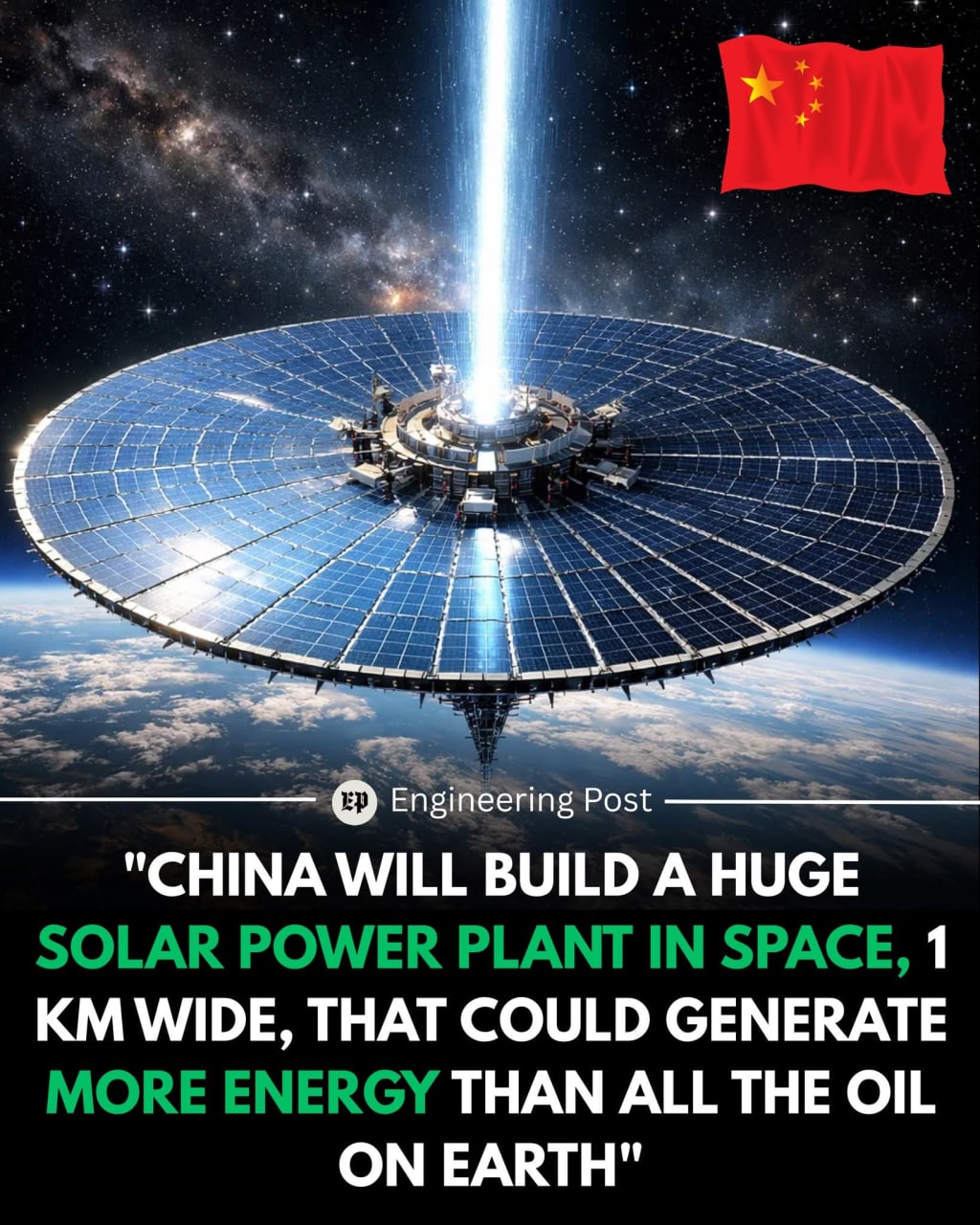
In a move that sounds more like science fiction than science policy, China has revealed plans to build a gigantic solar power station in space, stretching nearly one kilometer wide, capable of generating more energy than all the oil reserves on Earth combined. If realized, this project could redefine the future of global energy and position space as humanity’s next major power source.
Why Build Solar Power in Space?
Traditional solar energy on Earth has one major limitation: intermittency. Solar panels stop producing electricity at night, during cloudy weather, or due to seasonal changes. Space, however, offers a perfect solution. Above Earth’s atmosphere, sunlight is constant, intense, and uninterrupted.
By placing a solar array in geostationary orbit, approximately 36,000 kilometers above the Earth, the station would receive sunlight 24 hours a day, 365 days a year. There would be no clouds, no night cycles, and minimal energy loss. This alone could make space-based solar power several times more efficient than ground-based solar farms.
The Scale: Bigger Than Any Energy Project Before
The proposed station would be around 1 kilometer wide, making it one of the largest structures ever built by humans — not on Earth, but in orbit. Chinese scientists have compared the project’s ambition to the Manhattan Project or the Three Gorges Dam, calling it a “once-in-a-century” energy initiative.
According to researchers, the total energy harvested by this space solar plant in a single year could equal — or even exceed — the total energy obtainable from all the oil reserves on Earth. If this estimate proves accurate, it would mark one of the most dramatic shifts in energy production since the Industrial Revolution.
How Will Energy Come Back to Earth?
The idea of powering Earth from space raises an obvious question: how does the electricity get here?
The answer lies in wireless power transmission. The solar station would convert sunlight into electricity, then transform that energy into microwave or laser beams. These beams would be safely transmitted to receiving stations on Earth, where they would be converted back into usable electrical power and fed into the grid.
Scientists emphasize that the microwave frequencies proposed are non-ionizing and safe, similar to those used in satellite communications and radar systems today.
Massive Engineering Challenges
Despite its promise, the project faces enormous technical hurdles. Launching thousands of tons of materials into space is expensive and complex. Building and assembling a kilometer-wide structure in orbit would require advanced robotics, autonomous construction systems, and reusable heavy-lift rockets.
China plans to approach this gradually. Initial steps include launching smaller experimental platforms to test wireless energy transmission, modular assembly, and long-term durability in space. Full-scale construction is expected to take several decades, with completion likely not before the mid-21st century.
Why This Matters for the World
If successful, space-based solar power could revolutionize how humanity meets its energy needs. Unlike fossil fuels, it produces no carbon emissions, no air pollution, and no climate damage. Unlike Earth-based renewables, it provides continuous baseload power, potentially eliminating the need for coal and gas backup plants.
This technology could power megacities, support electric transportation, desalinate water, and even supply energy to remote regions without traditional infrastructure. It may also play a key role in supporting future space missions, lunar bases, and Mars exploration.
A New Energy Race Has Begun
China’s announcement signals the beginning of a new kind of global competition — not for oil fields or gas pipelines, but for energy dominance in space. Other countries, including the United States, Japan, and members of the European Union, are also researching space solar power, but China currently appears to be moving fastest.
Whether this ambitious vision becomes reality or remains an engineering dream, one thing is clear: the future of energy may not be found underground anymore — it may be orbiting above our heads.
About the Creator
About Binding Prometheus
I want to start actively advocating on behalf of my own work, and the most valuable part of my canon is, without a doubt, Binding Prometheus, the play I have been working on since 2019 and only finished in 2023 as part of my MA. The play itself is an amalgamation of a million different inspirations. On one end, it evokes the Ancient Greek myth-play, deriving its own title from the earliest extant work of Western drama we have, Aeschylus’s Prometheus Bound. On the other end, it borrows significantly from the sci-fi bulwarks from over the years, namely Mary Shelley’s Frankenstein and Karel Capek’s Rossum’s Universal Robots. The play could be an episode of Black Mirror, I fear. I don’t know. I’ve only ever seen one episode of Black Mirror.
By Steven Christopher McKnight24 days ago in Futurism
Saudi Arabia Dried Fruits and Nuts Market Analysis: Key Players and Market Forecast
According to IMARC Group's latest research publication, the Saudi Arabia dried fruits and nuts market size reached USD 590.61 Million in 2024. The market is projected to reach USD 1,059.61 Million by 2033, exhibiting a growth rate of 6.71% during 2025-2033.
By Abhay Rajput4 days ago in Futurism



Comments
There are no comments for this story
Be the first to respond and start the conversation.