
CHINA SUCCESSFULLY GREW PLANTS ON THE MOON, MAKING SPACE FARMING A REALITY.
Moon astrology


For decades, growing food beyond Earth was the stuff of science fiction. From futuristic movies showing astronauts harvesting crops on distant planets to novels imagining self-sustaining colonies in space, space farming always felt like a distant dream. But in a historic scientific breakthrough, China has taken a major step toward turning that dream into reality by successfully growing plants on the Moon.
This milestone was achieved during China’s Chang’e-4 lunar mission, which made history in 2019 by becoming the first spacecraft to land on the far side of the Moon. Along with geological instruments and communication systems, the mission carried a unique biological experiment — a miniature, sealed ecosystem designed to test whether life could begin and grow beyond Earth.
The First Green Life on the Lunar Surface
Inside the experimental container were cotton seeds, potato seeds, rapeseed, arabidopsis plants, yeast, and fruit fly eggs. The goal was simple yet revolutionary: observe whether seeds could germinate and survive under lunar gravity. Shortly after landing, images sent back to Earth confirmed astonishing news — cotton seeds had sprouted, marking the first time plants had ever grown on the Moon.
Although the plants were protected inside a controlled biosphere, the achievement itself was extraordinary. It proved that basic biological processes like germination could occur in lunar gravity, a crucial factor for long-term space exploration.
Why Growing Plants on the Moon Matters
Space farming is not just about growing food — it’s about survival. If humans are to establish long-term bases on the Moon or travel to Mars, they cannot rely entirely on supplies from Earth. Transporting food, oxygen, and water across space is extremely expensive and logistically challenging.
Plants offer a solution. They can:
Provide fresh food for astronauts
Produce oxygen through photosynthesis
Recycle carbon dioxide
Help purify water
Improve mental well-being in isolated environments
By proving that plants can grow on the Moon, China’s experiment laid the foundation for self-sustaining life-support systems beyond Earth.
Challenges That Still Remain
Despite the success, space farming is far from easy. The Moon presents one of the harshest environments imaginable. Temperatures can swing from extreme heat during the day to freezing cold at night, and the surface is exposed to intense radiation due to the lack of an atmosphere.
In fact, the plants grown during the Chang’e-4 mission did not survive long-term once the lunar night set in. However, scientists emphasize that the goal was never permanent survival — it was to gather data. And the data collected is invaluable.
Each experiment teaches researchers how plants respond to low gravity, radiation, and limited resources — knowledge that will shape future designs for lunar greenhouses and space habitats.
China’s Expanding Vision for Space
This lunar plant experiment is part of China’s broader ambition to become a global leader in space exploration. The country has announced plans for an International Lunar Research Station, potentially operational in the 2030s. Future missions aim to test larger biological systems, utilize lunar soil, and even explore 3D-printed structures made from Moon dust.
With each mission, China is moving closer to a future where astronauts could live and work on the Moon for extended periods — not just as visitors, but as settlers.
A Giant Leap Toward a Multi-Planetary Future
While humans are still years away from farming openly on the lunar surface, this experiment marks a powerful beginning. It sends a clear message: life can take root beyond Earth.
As nations race toward the Moon and Mars, the ability to grow food in space may define who succeeds in long-term exploration. China’s lunar plants may have been small, but their significance is enormous — symbolizing humanity’s first real steps toward becoming a multi-planetary species.
What once belonged to imagination is now firmly grounded in science. Space farming is no longer a question of if — only when.
About the Creator
About Binding Prometheus
I want to start actively advocating on behalf of my own work, and the most valuable part of my canon is, without a doubt, Binding Prometheus, the play I have been working on since 2019 and only finished in 2023 as part of my MA. The play itself is an amalgamation of a million different inspirations. On one end, it evokes the Ancient Greek myth-play, deriving its own title from the earliest extant work of Western drama we have, Aeschylus’s Prometheus Bound. On the other end, it borrows significantly from the sci-fi bulwarks from over the years, namely Mary Shelley’s Frankenstein and Karel Capek’s Rossum’s Universal Robots. The play could be an episode of Black Mirror, I fear. I don’t know. I’ve only ever seen one episode of Black Mirror.
By Steven Christopher McKnight10 days ago in Futurism
United States Brain Computer Interface Market Size and Forecast 2025–2033
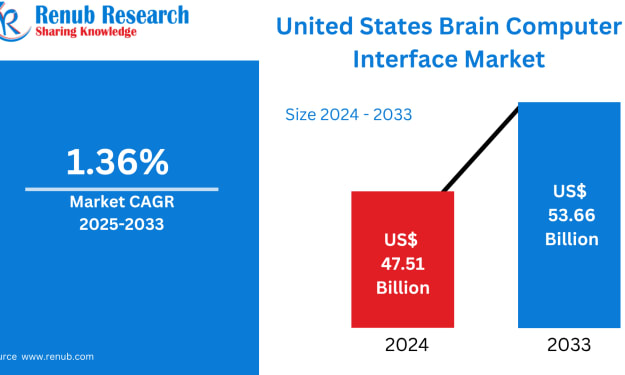
United States Brain Computer Interface Market The United States Brain Computer Interface (BCI) Market is expected to reach US$ 53.66 billion by 2033, up from US$ 47.51 billion in 2024, growing at a CAGR of 1.36% from 2025 to 2033, according to Renub Research. While the growth rate may appear modest compared to other emerging technologies, the strategic importance of BCIs continues to rise as healthcare, defense, rehabilitation, and consumer wellness converge around neurotechnology.
By Janine Root a day ago in Futurism



Comments
There are no comments for this story
Be the first to respond and start the conversation.