
China Shares Moon Samples with the World—But NASA is Left Out
"U.S. Law Keeps NASA from Participating in China's Groundbreaking Lunar Research as Global Scientists Gain Access to Rare Moon Samples"

China Shares Moon Samples with the World—But NASA is Left Out
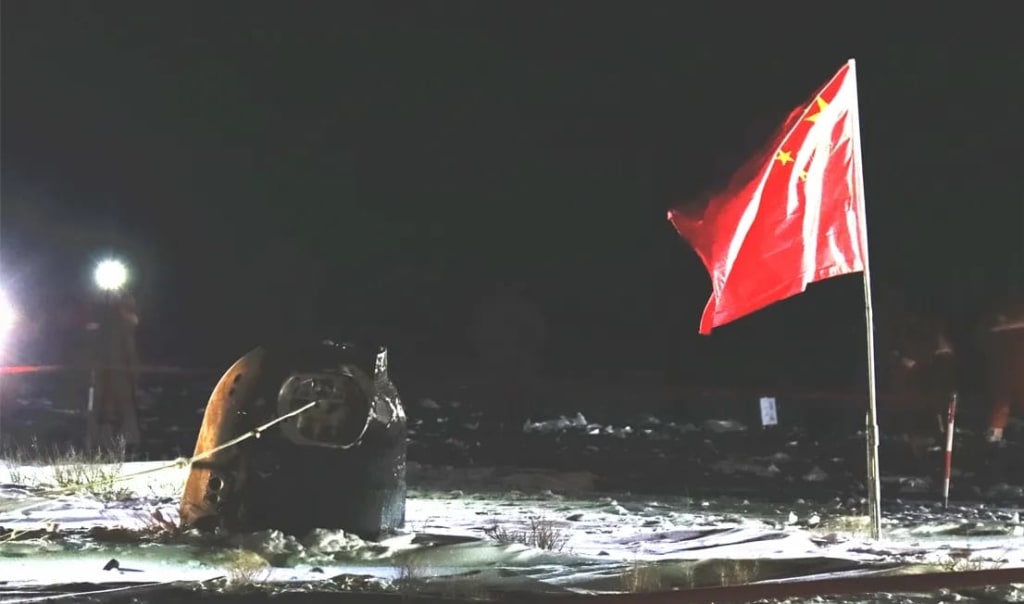
In a groundbreaking move that underscores its growing ambitions in space exploration, China has begun sharing moon rock samples with international researchers. These samples, brought back by China's Chang’e missions, offer rare and valuable insight into the moon’s composition—especially from regions never before explored. However, one major space power remains conspicuously absent from this collaboration: NASA.
This exclusion isn’t due to a lack of scientific interest or capability. Instead, a legal roadblock—the 2011 Wolf Amendment—prevents NASA and its associated scientists from engaging in direct bilateral cooperation with China’s space agency. As a result, while scientists in France, Germany, and even Pakistan gain access to lunar material, NASA is forced to watch from the sidelines.
A Lunar Feat for the History Books
China’s Chang’e-5 mission, launched in 2020, marked a significant milestone. It was the first mission since 1976 to bring back moon samples to Earth, collecting about 1.7 kilograms of lunar soil. The more recent Chang’e-6 mission, launched in 2024, achieved an even more remarkable feat—retrieving samples from the moon’s far side, a region never previously visited by a spacecraft.
These samples are considered a scientific goldmine. They could help unravel the mysteries of the moon’s history, including its volcanic activity, surface evolution, and the presence of water ice—crucial for future lunar bases.
Global Invitations, Except for NASA
In a bold and seemingly diplomatic gesture, China has opened applications for international scientists to study these samples. Countries including France, the United Kingdom, Russia, and Thailand have responded positively. Samples from the Chang’e-5 and Chang’e-6 missions are now being distributed to global research institutions, making China a key player in collaborative lunar science.
However, U.S. researchers affiliated with NASA have largely been excluded from these studies. This isn't due to tensions with China, but rather the Wolf Amendment—a U.S. law that bans NASA from using government funds for direct cooperation with the Chinese government or Chinese-affiliated organizations, unless Congress gives prior approval.
The Wolf Amendment’s Long Shadow
The Wolf Amendment was introduced in 2011 amid growing concerns over national security and technology theft. While the law aims to protect sensitive U.S. technologies, it has also prevented direct scientific collaboration between the world’s two most advanced space programs.
For researchers, this restriction is deeply frustrating. Lunar geology is a global scientific pursuit, and collaboration—especially when analyzing rare samples—is essential for progress. Some scientists at NASA-funded U.S. universities, such as Brown and SUNY Stony Brook, have reportedly been able to apply for access under carefully negotiated arrangements, but NASA itself is still prohibited from official collaboration.
China's Message to the U.S.: Change the Law
Chinese officials have openly criticized the Wolf Amendment, stating that it hampers scientific progress and international goodwill. In a press conference, Chinese space leaders expressed hope that the U.S. would reconsider its stance and embrace a more open approach to scientific exchange.
“Space exploration is for the benefit of all humankind,” said one Chinese space official. “We hope that barriers like the Wolf Amendment can be lifted in the future to allow broader cooperation.”
This sentiment is not unique to China. Many international scientists believe that space exploration should transcend politics and promote unity through shared goals.
The Bigger Picture: A New Space Race?
Beyond the issue of moon rocks, the exclusion of NASA from Chinese-led lunar research is symbolic of the growing competition—and potential tension—between the U.S. and China in space.
While NASA leads the Artemis program, aiming to return astronauts to the moon by the late 2020s, China is advancing its own lunar goals, including plans for a joint base on the moon with Russia by 2036. Each side appears to be building its own space alliances, potentially leading to a divided rather than cooperative future in space.
Conclusion: Politics vs. Progress
China's decision to share its moon samples marks a significant moment in global space science. It reflects not only technological prowess but also a willingness to foster international collaboration. Yet, due to domestic U.S. laws, NASA remains unable to participate, missing a valuable opportunity to engage in a rare scientific dialogue.
The situation raises important questions: Should scientific advancement be stifled by political policies? Can rival nations find common ground in the pursuit of knowledge?
As space exploration enters a new era, the world is watching. Whether nations choose collaboration or competition will shape not only the future of science—but of humanity’s role among the stars.
About the Creator
Adnan Rasheed
Author & Creator | Writing News , Science Fiction, and Worldwide Update| Digital Product Designer | Sharing life-changing strategies for success.
Keep reading
More stories from Adnan Rasheed and writers in Futurism and other communities.
France Overtakes U.S. in War Tech: Battle Robots to Hit the Front Lines by 2027 as America Lags Behind in Military AI Race
France Overtakes U.S. in War Tech: Battle Robots to Hit the Front Lines by 2027 as America Lags Behind in Military AI Race In a bold leap into the future of warfare, France has announced its ambitious plan to deploy combat-ready battle robots to the front lines by 2027 — a move that puts the nation ahead of the United States in the race for military artificial intelligence (AI) supremacy. The announcement, backed by high-level military leadership, signals a transformative shift in defense strategy, where autonomous systems are no longer science fiction but an impending reality.
By Adnan Rasheed8 months ago in Futurism
About Binding Prometheus
I want to start actively advocating on behalf of my own work, and the most valuable part of my canon is, without a doubt, Binding Prometheus, the play I have been working on since 2019 and only finished in 2023 as part of my MA. The play itself is an amalgamation of a million different inspirations. On one end, it evokes the Ancient Greek myth-play, deriving its own title from the earliest extant work of Western drama we have, Aeschylus’s Prometheus Bound. On the other end, it borrows significantly from the sci-fi bulwarks from over the years, namely Mary Shelley’s Frankenstein and Karel Capek’s Rossum’s Universal Robots. The play could be an episode of Black Mirror, I fear. I don’t know. I’ve only ever seen one episode of Black Mirror.
By Steven Christopher McKnight18 days ago in Futurism
Car Sharing Market Size and Forecast 2025–2033
Introduction: A New Era of Mobility The global transportation landscape is undergoing a profound transformation. Once dominated by private vehicle ownership, urban mobility is now being reshaped by digital platforms, sustainability priorities, and changing consumer behavior. At the center of this shift stands the Car Sharing Market, a model that emphasizes access over ownership, flexibility over permanence, and efficiency over excess.
By Aaina Oberoi7 days ago in Futurism



Comments
There are no comments for this story
Be the first to respond and start the conversation.