
China's DeepSeek Shakes the AI World—But Elon Musk Isn't Impressed
"How China's DeepSeek is Challenging Big Tech and Redefining the Global AI Race"
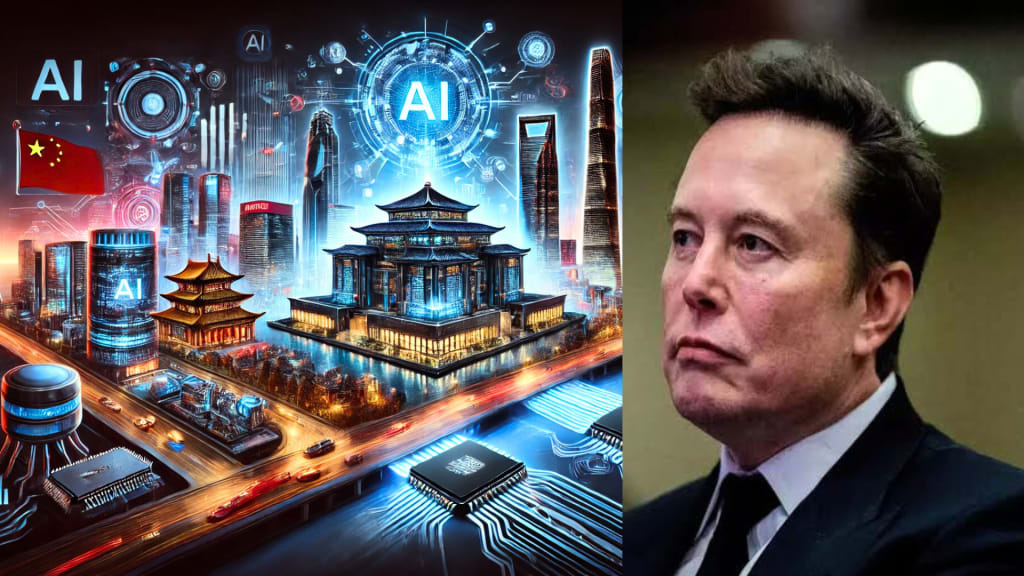
The AI industry just witnessed a game-changer. Chinese startup DeepSeek has skyrocketed to fame by dethroning OpenAI's ChatGPT as the most downloaded free app on Apple’s App Store. This sudden rise has sent shockwaves through the tech industry, rattling both companies and investors. Major players like Nvidia and ASML saw their stocks tumble, with Nvidia plunging 16% and ASML dropping 7% in the morning alone. Panic spread as investors scrambled to make sense of what’s happening.
At the center of it all is DeepSeek’s R1 model, an open-source reasoning engine that is grabbing headlines for two key reasons: its strong performance and its surprisingly low cost of development. Unlike other tech giants that use thousands of expensive GPUs to train their AI models, DeepSeek claims it only needed 2,000 Nvidia chips to create their latest model. This efficiency has raised eyebrows across the tech world.
However, not everyone is convinced. Elon Musk, CEO of Tesla and SpaceX, publicly dismissed the hype. When Salesforce CEO Marc Benioff pointed to DeepSeek’s success as proof that innovation in AI isn’t all about GPUs, Musk responded with a simple, mocking reply: “Lmao no.”
A Rising Threat to U.S. Tech Dominance
DeepSeek’s rapid climb has put a spotlight on the growing competition between the U.S. and China in the AI space. Big Tech is already feeling the pressure. Meta has reportedly set up multiple “war rooms” to analyze how DeepSeek’s rise could impact their business. Microsoft, one of the biggest investors in AI, is doubling down on its AI initiatives to stay ahead in the race.
DeepSeek’s rise has also reignited debates about whether the AI hype has reached its peak. Are we in the middle of an AI bubble that’s bound to pop? Or is this just the beginning of a new phase in AI, where cheaper and more accessible models dominate?
Some experts see DeepSeek as proof that the AI industry is evolving, moving toward a future where innovation isn’t limited to a few companies with deep pockets. Others warn that the race to cut costs and go open-source could lead to oversaturation, making it harder to separate groundbreaking advancements from mediocre ones.
The U.S. Fights Back
The United States isn’t sitting idle. In response to growing competition, President Trump announced a massive $500 billion AI initiative to strengthen domestic AI infrastructure. The plan includes partnerships with major players like OpenAI, Nvidia, and Oracle. The goal is clear: ensure the U.S. stays ahead in the global AI arms race.
But DeepSeek’s success shows that money alone isn’t enough. Speed and execution are becoming just as important as funding. While the U.S. invests heavily in its AI ecosystem, China’s DeepSeek is proving that smaller, focused efforts can also deliver results.
The Bigger Picture
The rise of DeepSeek raises questions about the future of the AI industry. Will the success of low-cost, open-source models like R1 inspire other startups to follow a similar path? If so, this could lead to a new era of AI innovation that’s less about who has the most GPUs and more about creative problem-solving.
On the other hand, there’s the risk that the rapid growth of AI could lead to overhyped expectations and eventually a market crash. Some analysts worry that the industry might be moving too fast, leaving little room to pause and evaluate long-term risks and rewards.
What’s Next?
For now, investors and tech giants are left wondering: is DeepSeek’s rise the start of a seismic shift in the AI world, or just another chapter in the industry’s constant evolution? One thing is certain: the AI landscape is more competitive than ever, and both the U.S. and China are determined to come out on top.
Whether DeepSeek becomes a long-term disruptor or fades into the background, its success sends a clear message: innovation isn’t just about resources; it’s about strategy, speed, and execution. The AI arms race has just gotten a lot more interesting, and the world is watching closely to see what happens next.
About the Creator
About Binding Prometheus
I want to start actively advocating on behalf of my own work, and the most valuable part of my canon is, without a doubt, Binding Prometheus, the play I have been working on since 2019 and only finished in 2023 as part of my MA. The play itself is an amalgamation of a million different inspirations. On one end, it evokes the Ancient Greek myth-play, deriving its own title from the earliest extant work of Western drama we have, Aeschylus’s Prometheus Bound. On the other end, it borrows significantly from the sci-fi bulwarks from over the years, namely Mary Shelley’s Frankenstein and Karel Capek’s Rossum’s Universal Robots. The play could be an episode of Black Mirror, I fear. I don’t know. I’ve only ever seen one episode of Black Mirror.
By Steven Christopher McKnight18 days ago in Futurism
Gaming Peripherals Market Size and Forecast 2025–2033
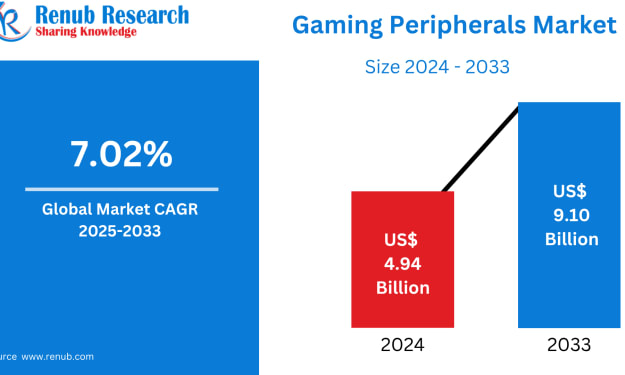
Gaming Peripherals Market: An Industry in Rapid Transformation The global gaming peripherals market is entering a decisive growth phase as gaming continues to evolve from a leisure activity into a mainstream form of digital entertainment and professional competition. According to Renub Research, the Gaming Peripherals Market is expected to grow from US$ 4.94 billion in 2024 to US$ 9.10 billion by 2033, registering a compound annual growth rate (CAGR) of 7.02% from 2025 to 2033. This expansion reflects not only the surging popularity of gaming worldwide but also the rising demand for high-performance devices such as gaming mice, mechanical keyboards, headsets, controllers, and other immersive accessories.
By Aaina Oberoi6 days ago in Futurism



Comments
There are no comments for this story
Be the first to respond and start the conversation.