
China Leads the Nuclear Revolution: World's First Thorium Reactor Ignites a New Energy Era
Is this the beginning of the end for traditional nuclear power?


In a groundbreaking development that could reshape the global energy landscape, China has announced the commissioning of the world's first thorium molten salt reactor. This technological marvel, scheduled to go online by 2029, represents not just one, but two world firsts: the first thorium reactor and the first commercial molten salt reactor. The implications of this achievement are far-reaching, potentially offering a safer, cleaner, and more abundant source of nuclear energy.
The thorium reactor project, shrouded in secrecy until recently, was inadvertently revealed in an environmental assessment report posted by the Shanghai Institute of Applied Physics. According to the report, the reactor facility is set to be commissioned in 2025 and fully operational by 2029, capable of generating heat at a maximum of 60 megawatts. While initially intended for research purposes, the project is part of a larger complex that will include wind and solar power bases, a molten salt-based energy storage station, a hydrogen generation system, and a thermal power plant. This integrated approach demonstrates China's commitment to developing a diverse and sustainable energy portfolio.
What makes thorium such a compelling alternative to traditional uranium-based nuclear fuel? For starters, thorium is estimated to be three to four times more abundant in the Earth's crust than uranium. This abundance could potentially solve one of the key limitations of nuclear power: fuel scarcity. Moreover, thorium produces significantly less radioactive waste and is much harder to weaponize, addressing two of the most pressing concerns associated with conventional nuclear energy.
The use of molten salt as a coolant in these reactors adds another layer of safety. Unlike water-cooled reactors, which operate under high pressure and risk explosive steam releases in case of a breach, molten salt reactors operate at atmospheric pressure and have a much higher boiling point. This inherent safety feature significantly reduces the risk of catastrophic accidents like those seen at Chernobyl or Fukushima.
China's ambitious thorium reactor project is not happening in isolation. Countries around the world are taking notice and ramping up their own research efforts. India, with its substantial thorium reserves, aims to produce 30% of its energy from thorium by 2050. Russia has announced the development of thorium-based nuclear fuels, while the United States and European countries are also exploring this technology.
In the United States, TerraPower, founded by Bill Gates, is collaborating with Oak Ridge National Laboratory to develop sustainable nuclear energy technologies. Their Natrium reactor project in Wyoming, while not thorium-based, incorporates innovative molten salt technology for energy storage. In Europe, a partnership between NAAREA of France and Thorizon of the Netherlands is advancing research on modular molten salt reactors, with plans for both small-scale (40 megawatt) and larger (100 megawatt) thorium reactors.
However, China's head start in this field is significant. The country has already invested heavily in alternative energy sources, as evidenced by its dominance in solar power production. By mid-2024, China's total installed solar capacity reached approximately 700 gigawatts, with 100 gigawatts of new capacity added in just the first half of that year. This track record suggests that China has the political will and industrial capacity to rapidly scale up thorium reactor technology.
The potential impact of this technology extends beyond China's borders. As part of its Belt and Road Initiative, China plans to sell modular thorium reactors to other countries. This move could position China as a global superpower in energy production, potentially reshaping geopolitical dynamics around energy resources.
Despite the promise of thorium reactors, challenges remain. The corrosive nature of molten salts poses material science challenges for reactor components. Additionally, regulatory frameworks and safety protocols for commercial thorium reactors are yet to be fully developed. These hurdles will need to be overcome before widespread adoption can occur.
To illustrate the potential of thorium reactors, let's consider a hypothetical scenario: Imagine a small island nation struggling with energy security and high electricity costs due to its reliance on imported fossil fuels. A modular thorium reactor could provide a stable, long-term energy source without the need for constant fuel imports. The reduced waste and enhanced safety features would make it more palatable to the local population compared to traditional nuclear plants. Furthermore, the high-temperature heat from the reactor could be used not only for electricity generation but also for desalination, addressing water scarcity issues common in many island nations.
As we stand on the brink of this new nuclear age, questions abound. Will thorium reactors live up to their promise of safer, cleaner nuclear energy? Can they be scaled up quickly enough to make a significant impact on global carbon emissions? And how will the geopolitics of energy shift if China becomes the primary supplier of this technology?
The answers to these questions will unfold in the coming decades. What is clear, however, is that China's thorium reactor project represents a pivotal moment in the history of energy production. As the world grapples with the dual challenges of increasing energy demand and the urgent need to reduce carbon emissions, thorium reactors could offer a promising solution. Whether this technology will become the dominant form of nuclear energy or merely one part of a diverse energy mix remains to be seen. But one thing is certain: the nuclear landscape is changing, and China is leading the charge into this new frontier.
About the Creator
Reader insights
Nice work
Very well written. Keep up the good work!
Top insights
Compelling and original writing
Creative use of language & vocab
Easy to read and follow
Well-structured & engaging content
Excellent storytelling
Original narrative & well developed characters
Masterful proofreading
Zero grammar & spelling mistakes
On-point and relevant
Writing reflected the title & theme
Keep reading
More stories from Next Koding and writers in Futurism and other communities.
The Dragon's Defiance: How China's Tech Industry Triumphed Over US Sanctions
In a stunning turn of events that has left Western policymakers and economists baffled, China's technology sector has not only weathered the storm of US sanctions but emerged stronger than ever. This remarkable resilience in the face of what many considered to be crippling economic warfare offers a fascinating case study in national determination, strategic planning, and the unintended consequences of international policy.
By Next Koding2 years ago in Futurism
Sustainable Marine Fuel Market To Reach USD 836.0 Billion by 2034 at 51.5% CAGR
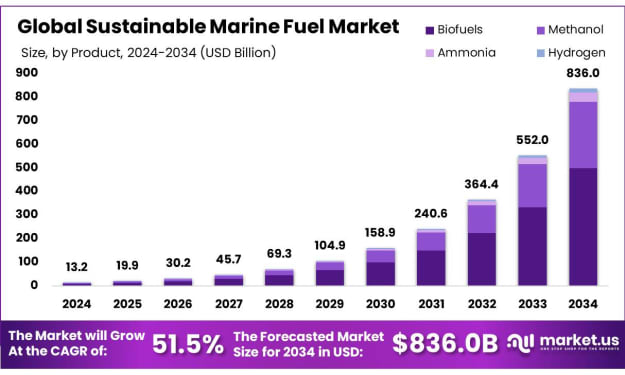
The global Sustainable Marine Fuel Market is projected to grow rapidly, increasing from USD 13.1 billion in 2024 to around USD 836.0 billion by 2034, representing a compound annual growth rate (CAGR) of 51.5% between 2025 and 2034. In 2024, Europe led the market with more than 51.0% of the global share, generating approximately USD 6.7 billion in revenue. This expansion is largely driven by the maritime sector’s urgent need to reduce emissions, as shipping currently accounts for about 2.5% of global greenhouse gas (GHG) emissions, a figure that could rise to nearly 17% by 2050 without effective mitigation measures.
By Hayden Kulas5 days ago in Futurism
Wind Energy Market Trends: Floating Wind Technology, Energy Transition & industry Outlook to 2034
The global wind energy sector is undergoing a transformative shift as nations prioritize energy security and decarbonization. Governments are moving away from simple subsidies toward sophisticated industrial policies, such as India’s USD 890 million Viability Gap Funding for offshore wind and the Netherlands’ €3.9 billion IJmuiden Ver subsidy. This transition is further fueled by the integration of AI-driven grid management and the rapid scaling of 15 MW+ turbines, which can reduce installation costs by up to 20% per gigawatt. According to IMARC Group’s latest data, the global wind energy market size reached USD 102.1 Billion in 2025. Looking forward, IMARC Group estimates the market to reach USD 180.0 Billion by 2034, exhibiting a CAGR of 6.31% from 2026-2034.
By Andrew Sullivanabout 4 hours ago in Futurism



Comments (3)
Wow amazing news
China's advancements are scary. Nice job.
Well done China. Great Asia.