
Can Gravity Help Us Travel Faster Between Galaxies?
Space


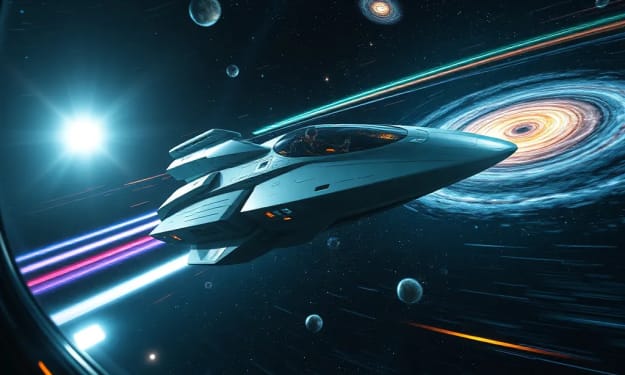
In the vastness of space, distances are measured not in kilometers or miles, but in light-years. Even our nearest galactic neighbor, the Andromeda Galaxy, lies a staggering 2.5 million light-years away. With current technology, such a journey is far beyond our reach. But what if the universe itself could lend us a hand? What if the very force we usually associate with slowing things down gravity could actually accelerate us across the stars?
Welcome to the fascinating realm of gravitational maneuvers, wormholes, and the cosmic slingshot effect.
Gravity as Propulsion: The Concept of the Slingshot
Believe it or not, humans have already begun using gravity to boost the speed of spacecraft. This technique, known as a gravitational assist or gravity slingshot, has been employed in multiple space missions. One famous example is Voyager 2, which used the gravitational pull of Jupiter, Saturn, and Neptune to gain enough velocity to escape the solar system altogether.
The concept is relatively straightforward. A spacecraft flies close to a massive object, such as a planet or star. As it swings around the body, it steals a bit of the object’s orbital energy, allowing it to speed up without using extra fuel. It is one of the most elegant and efficient methods of space travel we currently know.
But can this same method be scaled up to intergalactic distances?
Stars, Black Holes, and Natural Speed Boosters
To travel between galaxies, a spacecraft would need to achieve unimaginable speeds. To do that, it would require assistance from objects far more massive than planets. We are talking about stars, neutron stars, and perhaps most intriguingly, black holes.
Supermassive black holes, often found at the centers of galaxies, possess gravitational fields powerful enough to bend light itself. If a spacecraft could approach one of these monsters at just the right distance and angle, it might be able to slingshot around it, accelerating to a significant fraction of the speed of light.
Some theoretical physicists have proposed a sort of intergalactic network of gravitational assists. By plotting a course through galaxies rich in massive celestial objects, a ship could use each as a stepping stone, gaining speed at every pass. It would be like playing a cosmic game of billiards, with black holes acting as the bumpers and gravity as the cue stick.
Gravitational Waves: The Next Frontier?
In 2015, humanity made a groundbreaking discovery. For the first time, we detected gravitational waves ripples in spacetime caused by the collision of two massive black holes. This opened up an entirely new way to observe and understand the universe.
Some scientists have speculated that future technology might allow us to harness these waves for propulsion. Imagine spacecraft equipped with sensors and mechanisms that could capture the momentum of passing gravitational waves, like sails catching the wind. This idea, sometimes described as a "gravity wave sail," is still purely hypothetical, but it could one day revolutionize how we think about long-distance space travel.
Wormholes: Travel Without Acceleration?
There is another idea that pushes the boundaries of imagination even further wormholes. These are theoretical tunnels through spacetime that could connect two distant points in the universe. If stable wormholes exist or could be created, a spacecraft might be able to skip the journey altogether and simply pass through one, arriving instantly at another galaxy.
However, wormholes come with serious challenges. To remain stable and usable, they would likely require exotic matter with negative energy something we have yet to observe or produce. For now, wormholes remain in the realm of science fiction, although they are grounded in legitimate equations of general relativity.
Is Any of This Actually Possible?
At the current stage of our technological development, intergalactic travel even with gravity's help is more a dream than a plan. To make it a reality, we would need incredibly advanced propulsion systems, flawless trajectory calculations, and shielding to protect against extreme gravitational forces. We might also need new ways to preserve life during voyages that could last thousands or even millions of years.
Some ideas propose using cryogenic sleep, or even relativistic time dilation, where time slows down for those traveling near light speed. Others imagine generational ships where many lifetimes pass before the destination is reached.
Final Thoughts
Gravity is more than just the invisible force that keeps our feet on the ground. It is also one of the most powerful tools in the universe, and perhaps our best chance at crossing the unimaginable gulf between galaxies. With the right technology and understanding, we might one day launch starships that dance around black holes, ride gravitational waves, or disappear into wormholes all with the goal of reaching distant galaxies.
Until then, we continue to study, to dream, and to reach further into the cosmos knowing that gravity, once seen as a barrier, might actually be our launchpad to the stars.
About the Creator
Keep reading
More stories from Holianyk Ihor and writers in Futurism and other communities.
How Time Changes During Intergalactic Acceleration: A Journey Through Space and Einstein’s Physics
Time is one of the most mysterious concepts in the universe. It seems to march forward endlessly and predictably... or does it? When it comes to intergalactic travel, especially under acceleration, our familiar ideas about time begin to unravel. We enter the realm of relativity, where a single second aboard a spaceship might equal years back on Earth. But what exactly happens to time when we accelerate through the stars?
By Holianyk Ihor7 months ago in Futurism
About Binding Prometheus
I want to start actively advocating on behalf of my own work, and the most valuable part of my canon is, without a doubt, Binding Prometheus, the play I have been working on since 2019 and only finished in 2023 as part of my MA. The play itself is an amalgamation of a million different inspirations. On one end, it evokes the Ancient Greek myth-play, deriving its own title from the earliest extant work of Western drama we have, Aeschylus’s Prometheus Bound. On the other end, it borrows significantly from the sci-fi bulwarks from over the years, namely Mary Shelley’s Frankenstein and Karel Capek’s Rossum’s Universal Robots. The play could be an episode of Black Mirror, I fear. I don’t know. I’ve only ever seen one episode of Black Mirror.
By Steven Christopher McKnight13 days ago in Futurism
Australia Insurance Market: Digital Transformation, Risk Intelligence & Future-Ready Protection
In 2024 Australia insurance market reached USD 50.9 Billion. Looking ahead, the market is expected to grow to USD 84.7 Billion by 2033, exhibiting a compound annual growth rate (CAGR) of 5.4% during 2025–2033.
By Kevin Coopera day ago in Futurism


Comments
There are no comments for this story
Be the first to respond and start the conversation.