
Caged Titans I: The Chronomoloch
The Hunger That Devours Time Itself

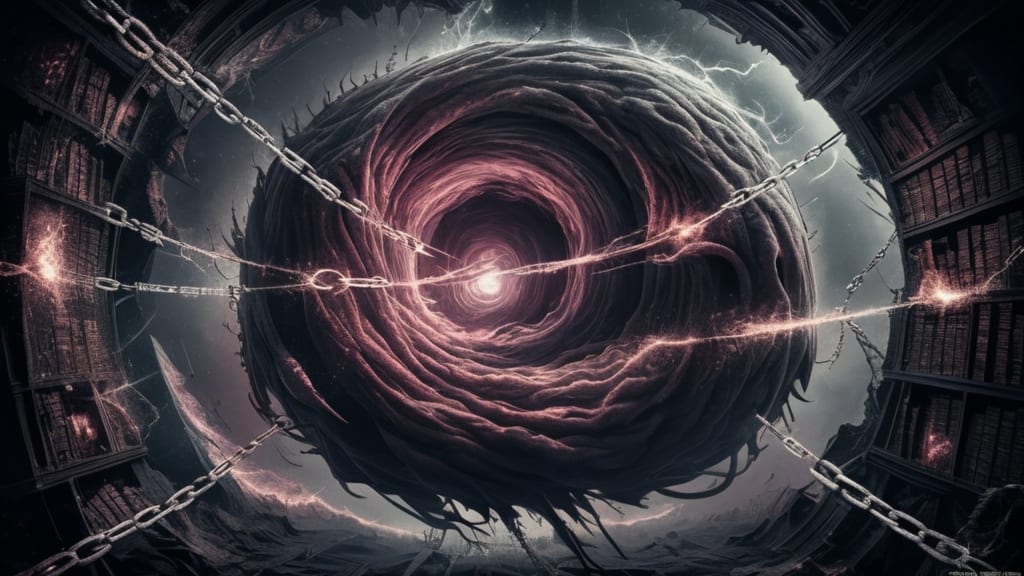
The Archives' lights didn't just dim; they *shrieked*, a violent, energy-starved sound tearing through the air. Breath-stealing strobes fractured the world into jagged shards before Mila could even register the impossible pressure clamping down. Her terminal, a familiar beacon just moments before, winked out with a sharp, final click, abandoning her to a sudden, bewildering darkness. A cold dread, swift and sharp as splintered bone, pierced her gut - a sickening certainty that fundamental constants were unraveling, leaving a terrifying void where bedrock truths should be.
Across the vast, now-hushed hall, a subtle unease rippled through the scattered archivists. Faces lifted from screens, eyes wide, a shiver passing through them like ice melting into porous stone. The sterile quiet wasn't merely broken; it *splintered*, peeling back like a held breath finally surrendered, exposing a chasm into which something immense, something ancient, began to spill.
It didn't merely *exist*; it *echoed*. A deep thrum felt not solely in the air, but reaching into Mila's marrow, a low frequency like the Archives' very frame groaning under an unseen load. This sensation mirrored, unnervingly, the persistent ache in her own chest after too many solitary cycles hunched over data, the resonance of profound isolation given physical form. An impossible scent leached in - not the clean, sharp tang of simulated vacuum she knew, but something infused with the biting chill of deep space, metallic and profoundly wrong. It smelled of burnt circuits mingled with a sharp, coppery ozone - the raw tang of *aberration* coalescing. Even the light filtering through dancing dust motes, typically miniature galaxies, seemed to falter, not dimming, but *stuttering*, suffering a subtle chronological skip she'd come to recognize in fractured Veles Expedition logs, a visual hiccup in time's seamless flow. A mounting disquiet pooled in her gut like cold sediment, a physical clenching beyond her will. Her body reacted first, a primal alarm screaming through her nerves before her mind could even begin to grasp the impossible intrusion, the quiet decay beneath her feet.
Directly above a nearby workstation, a loose ceiling panel shuddered violently. Then, with a sharp, echoing crack, it tore free and struck the floor, sparking startled gasps. Mila's gaze snapped over, finding Victor recoiling from his darkened terminal, automatically raking a hand through his thinning hair - a nervous tic that suddenly seemed pathetic against the scale of the disruption. His usual quiet humming - always a slightly off-key rendition of some ancient folk tune, a small comfort in the quiet work - had ceased, leaving behind a hollow silence that seemed to fill the space where his familiar presence had been, replaced by a low, confused mutter.
"Just the building settling," he seemed to mouth, though his eyes, wide with shared, unspoken fear, scanned the ceiling with desperate hope. He looked less like a careful archivist and more like something cornered, his fingers tightening on the desk edge as if anchoring himself to ground that was dissolving beneath his hands. "Mila, did your screen just…?" Victor started, his voice thin with confusion, gesturing at his dead console. "Mine went black. And the air feels… thick. Like wading through mud." He swallowed hard, the sound amplified in the sudden quiet. A distant alarm chirped somewhere down the corridor, quickly silenced, a tiny symptom of system-wide distress.
"Yeah, Victor, mine too," Mila replied, pushing herself up. Her legs felt strangely heavy, as if pushing through deep water, or perhaps gravity itself had developed a subtle lag. The air around her station felt different, colder, charged, and the faint, metallic tang was strongest here, clinging to her like static. She hit her terminal's power button - nothing. "Must be a power fluctuation," she lied, the words falling flat even to her own ears, her gaze sweeping the vast hall, the faces of colleagues ranging from bewildered to openly fearful. This wasn't a power fluctuation. It felt… *deliberate*. *Aware*. As if whatever was happening knew exactly where she was, knew her by name. A brief flicker on her wrist comm, a garbled burst of worried voices from the central ops floor.
The familiar low thrum of her own terminal, a sound as constant as her pulse during solitary research cycles, suddenly pulsed back to life, but with an unsettling, irregular beat. A discordant hum vibrated deep in her chest - *her* chest - making her own heartbeat feel momentarily out of sync, a sickening counterpoint to her own life's rhythm. It mirrored the disturbance etched into Captain Stoyanov's fractured log on the screen. The text dissolved into fleeting, grey static before snapping back, subtly rearranged, subtly *wrong*. Words shifted beneath her gaze like silt in a disturbed current, like smoke rearranging itself in a draft, their meaning subtly altered - a chilling violation of truth itself. This wasn't a glitch. It felt *active*, intentional, like a malevolent intelligence was editing reality in real-time, using her data as its canvas, using *her* work as its playground, mocking her meticulous efforts.
Her fingers, moments before numb from endless scrolling, were now alive, not just with chilling focus, but weighted by a phantom pressure, a disquieting sympathy with the shifting frequencies of time itself, as if her own atoms were vibrating out of sync. This wasn't mere data processing; GECo-SIP, her sophisticated digital collaborator, hadn't simply crunched numbers. *No*, she thought, watching the complex, shimmering data structures resolve on her screen, patterns of information weaving themselves into impossible shapes, luminous and terrible, bleeding at the edges like fresh wounds, violating the elegant laws of physics she had loved since childhood. The air thickened again, tasting sharply of ozone and something else, something ancient and dissonant, a flavor that coated her tongue, metallic and cold - the stark taste of temporal decay. *It had torn something raw from forgotten epochs.* GECo-SIP's analytical engine, usually a silent partner processing abstract concepts, now felt like a consciousness painstakingly, relentlessly exposing a cosmic horror, translating the void into comprehensible form. Its cold logic, utterly devoid of feeling, formed a chilling counterpoint to the hot, rising panic in her chest, her frantic heartbeat feeling strangely out of sync with the room's new, unnatural rhythm - a physical manifestation of the temporal dissonance. This wasn't merely her work; it felt like a violation of fundamental order, a shattering of the scientific faith she'd built layer by painstaking layer - a faith rooted in elegant, predictable equations, equations as comforting and reliable as her mother's bedtime stories. Those equations, once the bedrock of her universe, now seemed like a child's simple drawing against the terrifying, complex reality unfolding - a reality that tasted of burnt ozone and swallowed time whole. It left her adrift in a churning sea of chaos where the laws of physics felt like flimsy suggestions, words that might rearrange themselves at any moment, leaving her fundamentally untethered. A chilling certainty settled deep within her - the past she relied on was unstable, its foundation dissolving like mist, and with it, her own footing in reality, her very sense of self, of history, becoming fluid, porous. A vivid flash of her childhood home: the scent of her mother's baking, the warmth of the kitchen light, the familiar, comforting creak of the floorboards. She clung to the memory for a second, a lifeline in the rising tide of temporal chaos, a physical anchor in a dissolving world, before the data pulled her back, its relentless tide demanding attention. *Hold onto that, Mila,* a voice, quiet but insistent, seemed to whisper in the back of her mind, a primal instinct asserting itself. *Don't let it take the past. Don't let it steal what was.*
The "Perun's Anvil" anomaly, a cosmic whisper officially relegated to an astrophysics footnote, had been sculpted by GECo-SIP's unyielding logic into a terrifying pronouncement, a scream translated into data, into patterns of light and energy that shouldn't exist, defying every known law. *Not random chance,* the data scrolled, overlaying spectral analysis with temporal distortion graphs that writhed like trapped things, patterns of pure, intentional chaos, *a deliberate nexus of temporal manipulation.* Mila felt a visceral twist in her gut, a cold, heavy weight settling in her stomach. It felt less like conventional dread and more like a physical chronological drag, as if gravity itself were subtly pulling her sideways through time, distorting her very sense of self, thinning her presence in the now, making her feel less solid, like a fading echo - a terrifying premonition of undoing. The low thrum of the terminal seemed to deepen, felt by her not just in her chest, but resonating in the floor beneath her feet, vibrating through the soles of her boots, a physical echo of unstable frequencies, of the universe groaning under an unnatural stress, the sound of spacetime straining. Her own research, those early, hopeful papers on stable causality loops in localized phenomena she'd poured years of her life into, felt like naive scribbles now, the innocent dreams of someone who hadn't grasped the true, horrifying potential of time, the raw, untamed power lurking beneath the comforting veneer of predictable physics, a power that could *unravel* the very fabric of existence with a thought. Captain Radko Stoyanov, once just a name lost in the vast sea of historical figures she'd cataloged, a face glimpsed in faded photos, was now the unwitting keymaster to a prison built not merely of matter, but of woven time itself - a cage for an entity of pure temporal chaos - the Chronomoloch. The sheer *idea* of an entity made of chaos, formless and defying definition, made her skin crawl, a primal revulsion at something that spat in the face of shape, of structure, of being, of everything that felt *real*, everything she held onto as anchors in reality. The air felt brittle, thin, tasting faintly of static and ancient, empty space, pressing in from the edges of the room, a physical pressure against her skin, a sense of the abyss attempting ingress.
As Mila scrolled through GECo-SIP's summarized findings, the AI's concise explanations painted a picture that didn't just freeze the blood in her veins; it felt as if her very atoms were vibrating out of sync, shivering at the wrong frequency, a horrifying intuition of disintegration, of her own form dissolving at the edges, becoming less real, less present - a chilling premonition of personal entropy. An ancient force, capable of consuming time itself. "Entity designation: Chronomoloch," GECo-SIP's synthesized voice stated, utterly devoid of inflection, yet the words felt like ice forming on the *inside* of her skull, a chilling whisper echoing in the quiet vastness of the Archives, a voice that seemed to speak from beyond time, from the state of non-being itself. "Primary function: Temporal Consumption. Causality Dissolution Rate: Extrapolated, exceeds measurable parameters." The folklore, the dry engineering schematics of "temporal dampeners," and the meticulous geological surveys of Svetogor's "Time-Shale" all converged, forming a horrifyingly coherent narrative. The planet itself, with its peculiar mineral deposits that felt subtly wrong to her touch, like solidified memory or captured whispers of forgotten moments, dense and cold like compressed history, wasn't just a geographical location; it was the very material used to forge the Chronomoloch's cage, a prison of time made solid. She looked down at a geological sample display nearby, a dark, heavy chunk of rock labeled "Svetogor Time-Shale," and felt a dizzying sense of disconnection, as if the rock itself pulsed with a silent, ancient hum, heavy with contained time, vibrating with a power that should not be contained in stone, resonating with the subtle temporal drag she felt in her own body, a physical connection to the impossible.
She looked up, through the towering shelves that seemed less like repositories of knowledge and more like silent, watchful sentinels, at other archivists. Through a narrow gap between shelves, she saw Victor again, still rubbing his temples, his face drawn in confusion, his worry deepening beyond just a fallen panel. He looked as if he was trying to remember something just out of reach, grappling with a subtle, internal loss, as if pieces of his own past were slipping through his fingers like fine sand. He fumbled with his datapad, scrolling frantically.
"Mila? Anything… weird happening with your terminal?" he called out, his voice tight with rising panic, a thread of desperation weaving through the sound. "Mine's showing corruption on my last session log. Like it was… edited. And I swear I made a note for my wife's birthday yesterday, double-checked it. It's just… gone. Poof." The raw fear in his voice was a human counterpoint to the cosmic data, a reminder that this wasn't just abstract theory; it was touching their lives, their histories, their most personal details, dissolving the very fabric of their personal worlds. He fumbled in his pocket for a moment, pulling out a worn photo before shoving it back, his expression tightening as he met her gaze. It showed a woman with kind eyes and a slightly crooked smile. He didn't look at it long, but the gesture spoke volumes of what he was fighting to hold onto, the small, irreplaceable anchors. "Her favorite scarf," he murmured, his voice barely audible, "I was going to remind myself to get one like it… I remember thinking… but now… was it blue? Or green? I can't even remember that." The confusion was a physical pain in his eyes.
Mila walked over, her own subtle chronological drag making the short distance feel like wading through thick syrup, each step requiring conscious effort, pushing through unseen resistance. She put a hand on his shoulder, offering a reassurance she didn't feel. "It's not just you, Victor. Something's happening with the data streams. And… the building itself. I felt the air change." She saw the small, oblivious figures diligently working, mostly unaware of the reality crumbling around them, piece by piece, of the subtle tremors impacting their own bodies, their own perceptions, their own minds. She felt a faint, phantom weight on her own limbs, a fleeting sense of years passing in an instant, a disconcerting chronological stutter pulling at her own being, as if her personal timeline were momentarily snagging on something unseen, a whisper of what *could* be, a premonition of potential erasure, of her own history blurring. A shiver traced its way down her spine, colder than logic, colder than fear. *Is this how it begins?* she wondered. *Not with a bang, but a subtle editing of existence, starting with the small things, with memories? With birthdays? With the taste of coffee? With the feel of a favorite shirt?* The screen flickered again, the text momentarily swimming before her eyes, subtly distorted, the edges of the monitor seeming to waver, the words blurring like ink in water - a physical manifestation of the temporal instability touching her very perception, threatening to dissolve the boundary between her and the data.
A quiet chime from her wrist comm startled her, breaking the spell, pulling her abruptly back from the abstract horror to a more immediate, human connection. "Mila? Everything alright in the Archives? Getting some odd readings on the environmental sensors down there. Like… a pressure drop, but localized? And a weird frequency spike on the old power conduits." It was Lieutenant Armstrong from the Chronos Initiative Vanguard, his voice a welcome anchor of normalcy against the cosmic tide, laced with professional concern that felt blessedly familiar, a sound she hadn't realized how much she needed until she heard it. Armstrong, ever practical, always looking for the nuts and bolts explanation, but even he sounded unnerved, a slight tremor in his tone. "Thought it was just a sensor ghost, but it's persistent. General Kerimov's already yelling about system-wide anomalies, says half the fleet's chronometers are drifting. Everything okay on your end? Radko's down here muttering about unstable constants, keeps trying to explain it by flapping his arms… and I think he's humming a differential equation. Says it's 'seeing red'. I just hope Lieutenant Fluffernutter isn't experiencing temporal displacement, she's grumpy enough on a good day." Armstrong's dry tone, even when describing Radko's eccentricities or worrying about a grumpy cat, was a familiar comfort, a sign that some things, some people, were still anchored, clinging to their small realities.
Mila swallowed, her throat dry, tasting of deep space and apprehension. She forced the words out, a desperate lie clinging to her tongue, a scientific lie to protect a human reality, or at least buy time. "Just… some data anomalies, Lieutenant. And maybe a structural issue here. Running diagnostics. Might need power cycling soon. Thanks for the heads-up." She cut the channel quickly, her heart pounding. He couldn't possibly understand. Not yet. How could she explain that the air pressure wasn't dropping, but the *time* it occupied was stuttering? That General Kerimov's fleet issues were symptoms of reality itself beginning to fray? Symptoms she could feel in the dragging weight of her own limbs, in the cold certainty that her own memories were becoming ephemeral.
The Veles Expedition hadn't perished in a stellar catastrophe, as official history claimed. *That was the comforting lie,* she thought, her eyes glued to the display, the shimmering data patterns swirling like an ocean draining away, pulling everything down into an unseen vortex of dissolution. GECo-SIP, using a complex algorithm that mapped semantic links across incompatible data formats, had unearthed the truth: They had stumbled upon the activation sequence, a cosmic key turning in a lock older than civilization itself, older than the very concept of history humanity understood. The AI presented the logs as shimmering, fragmented waveforms, undeniably clear in their meaning despite the chaos - showing temporal distortion spiking not outwards from a stellar event, but inwards, *into* something, like water rushing into a drain, or light being sucked into an impossible void, a gravitational pull into non-existence. "Temporal vectors collapsing," GECo reported blandly, the words scrolling alongside terrifying visuals of a dying star, its light bending impossibly inwards, "originating point correlates with Expedition Final Transmission Beacon. Inward vector confirmed. Not stellar impact." They had inadvertently stirred the slumbering Chronomoloch. In its terrifying wake, they had been consumed, not by physical destruction, but by a temporal erasure so complete that even the most advanced historical records struggled to comprehend it, flickering out of existence like forgotten thoughts, leaving only ghostly echoes in the data streams, faint whispers of what once was, like footprints in sand being smoothed away by an unseen wave. GECo-SIP, with its chilling ability to perceive causality and semantic links far beyond human capacity, had unraveled the truth, presenting it with the indifferent certainty of mathematics, the brutal honesty of numbers that felt like a punch to the gut - a truth that cared nothing for human feeling. Mila's terminal screen flickered, not with a simple lag, but as if the pixels themselves momentarily forgot what they were supposed to be, the very reality of the display wavering, uncertain, subtly *unnatural*, mirroring the fundamental instability of spacetime. A sentence in Stoyanov's log swam before her eyes, then resolved, subtly, terrifyingly altered, a chilling testament to the entity's temporal influence, a violation of recorded history itself, of *truth*, demonstrating its power to rewrite the past. A deep-seated fear, one she hadn't consciously acknowledged until that moment, surfaced: the fear of losing her memories, of the past she cherished dissolving, leaving her untethered, without a history, without the anchors of who she was. This fear now felt terrifyingly, intimately real, like a cold hand reaching into her mind, threatening to rearrange her own past, to erase pieces of it, leaving blank spaces where vibrant moments should be, making her very sense of self a fragile, unreliable construct. She saw flashes of her childhood home, the warm glow of the kitchen, the scent of her mother's spice cabinet, the comforting weight of a favorite worn blanket - all felt suddenly fragile, precious, threatened, their edges blurring like a fading photograph, like smoke about to dissipate, their substance feeling less solid, less real, subject to the same unraveling as the data.
The weight of this revelation settled on Mila's shoulders, heavy as a collapsing star, threatening to fold her in on herself, to erase *her* from the timeline just as the Veles Expedition crew had been, to make her life a footnote that never was. The HyperVerse Gamma was more than just a record; it was a tapestry woven with threads of both history and existential dread, a reflection of a universe far less ordered, far more fragile, than she had ever dared to believe. The Chronomoloch was not a myth; it was a tangible, albeit terrifyingly abstract, threat lurking in the deep folds of time, a predator of causality. The apprehension it inspired went beyond a simple fear of the unknown; it was a profound, gut-level revulsion at the idea of *undoing*, a fear that her own carefully constructed identity, her most cherished memories, her very sense of *being* could simply dissolve into nullity, leaving no trace, no echo, no memory, consigned to the state of never-having-been. And Mila, alone in the quiet hum of the Archives, the air now thin and brittle, tasting faintly of strange metals and something else, something colder than any vacuum she could imagine, the acrid smell of ancient, empty space itself, was now the sole guardian of this terrifying knowledge. The question that echoed in the newfound silence wasn't how to decipher the HyperVerse anymore, but how to understand what to do with the revelation that the universe contained entities that could literally dissolve existence, whose hunger was a silent promise of oblivion, a hunger she could feel now, pressing in, physical and cold, a pressure against her very soul. She glanced at the towering shelves, dust motes dancing in the dim, unreliable light, seeming to wink in and out of existence, subject to the same temporal instability. Normalcy felt impossibly, painfully far away, like a forgotten dream just out of reach, a fragile memory threatened by the encroaching void.
***
Mila's gaze swept across the now-organized data, the glowing threads of connection a stark contrast to the swirling nebula of confusion it had been mere cycles ago. The implications of the Chronomoloch, this entity of temporal consumption, were staggering. If it was real, if Perun's Anvil was its prison, then the HyperVerse Gamma held more than just historical accounts; it was a cosmic prison roster, a list of beings who defied the very concept of existence, who made reality porous, vulnerable. The comfortable linear flow of time she had always taken for granted felt suddenly precarious, like standing on a bridge built of mist over an endless, hungry abyss that whispered promises of non-being, of never-having-been - a whisper she felt in her own bones. The low hum of the terminal seemed to deepen, vibrating not just in the room, but resonating in the pit of her stomach, a physical manifestation of the strange frequencies GECo-SIP detected pulsing through the ancient data streams, a sick, churning feeling, like spacetime itself was experiencing profound indigestion. The air in the Archives felt perceptibly colder, the scent of something cold and alien stronger, pressing in from the edges of the room, a chilling counterpoint to the climate control, a pressure against her skin, against her very being. Distant chatter over the Archives' internal comms system spiked briefly - a technician's frustrated voice asking about "ghost readings" on the environmental sensors near Storage Sector 4, complaining that his coffee had gone cold faster than it should have, the steam vanishing before his eyes, a tiny, mundane echo of the cosmic unraveling, a small piece of reality losing its grip on cause and effect. Another voice chimed in, bewildered, asking if anyone else's favorite pen had just… disappeared from their desk. *It's not just me,* she thought, gripping the edge of the console until her knuckles turned white, feeling the cold metal against her trembling fingers. *The subtle tremors aren't just in my head. They're shaking the walls, chilling the coffee, making the air stutter, making reality hiccup. They're stealing pens.* It was spreading, an insidious plague on existence.
Her mind raced, a frantic search for the next thread GECo-SIP might have snagged in the complex weave of reality. What other anomalies, previously dismissed as mundane natural phenomena or statistical quirks, were actually slumbering threats, pieces of the void pushing into their universe? She directed the AI to broaden its search parameters, instructing it to look for patterns of temporal distortion, uncharacteristic energy signatures that felt like cosmic static clinging to the edges of reality, and inexplicable disappearances across all documented sectors, searching for ripples in the temporal ocean that hinted at unimaginably ancient depths, at things that should not be, things that dissolved existence like salt in water, things she could feel subtly tugging at her own being, making her feel less real.
"GECo," she murmured, her voice a low rasp, dry and tasting faintly of fear and that deep abyss pressing in, a flavor of encroaching non-existence. The strange metallic tang seemed stronger now, a physical manifestation of the encroaching disharmony, of reality turning sour. "Cross-reference 'temporal anomalies' with 'containment protocols' and 'dormant entities'. Prioritize findings from pre-Cosmic Expansion eras and sectors with significant Veles Expedition activity." She could see her own reflection on the dark screen, her face pale and drawn, looking like a stranger staring back at her, a stranger who felt subtly *less* real than she had moments ago - a terrifying premonition of the unmaking she now understood, a sense of her own form flickering at the edges, growing transparent, a waveform about to collapse. A fleeting thought of her childhood home, a memory solid and comforting - the worn fabric of the couch, the scent of her mother's baking, the familiar creak of the floorboards - flashed unbidden. She clung to it for a second, a lifeline in the sea of chaos, a solid anchor against the encroaching tide, before plunging back into the data. *Don't lose the memories,* a silent voice urged within her, a core of resistance forming against the encroaching nullity, a stubborn refusal to be erased. *They're all you have against this fading.*
A new connection bloomed on the screen, data points weaving themselves into a horrifying pattern before her eyes, glowing with a malevolent light. GECo-SIP presented the findings not just as cold text, but as a multi-sensory abstract: a chilling harmony of frequencies overlaying the visual data, a silent scream across the void. This time, it linked a geological survey of a desolate moonlet in the Kepler-186 system, designated "Xandar," with a cryptic entry from a lost generation ship's distress signal. The Xandar survey spoke of "anomalous crystalline formations that pulsed with a slow, rhythmic energy signature, eerily similar to those recorded from Perun's Anvil, but colder, like frozen light, resonating with a silent, chilling song," a song that felt like her own pulse slowing, threatening to stop, a counter-rhythm to her own life, felt as a physical pressure in her chest, an ice-cold dread. The distress signal, barely decipherable through layers of temporal noise visualized as swirling static that seemed to crawl across the screen, spoke of a "slow bleed," a "fading reality," and a desperate attempt to escape "the silent devourer." Mila felt a phantom 'drag' on her own sense of self, a fleeting fear of thinning away, of becoming less real, less *present* with every terrifying data point uncovered, a horrifying intuition that her own memories were subtly fading, like photographs left too long in harsh sunlight, their edges blurring, their colors muted, their substance dissolving, becoming ephemeral.
Across the vast hall, she saw Victor again, sitting at his terminal, shaking his head slowly, muttering something unintelligible, running a hand over his eyes as if battling a sudden wave of dizziness, a headache that seemed to originate from *inside* his skull, a physical manifestation of the temporal strain. Whatever this was, it wasn't just affecting her; it was a silent, creeping plague on existence itself, eroding reality from the inside out. Victor looked up, caught her eye, a desperate plea in his gaze. "Mila… I… I think I'm forgetting things. Important things." The raw fear in his voice was a human counterpoint to the cosmic data, a reminder of the personal cost. "Did we… did we work together on the Lyra project? My log says I did, but I can't… I can't quite picture it. My brain feels like… like a sieve." His voice cracked, heavy with the terrible weight of losing himself piece by piece. "And my head aches. All the time now. Like something's trying to rewrite my brain from the inside. Did I… did I tell you about my cat, Mittens? Or did… did I always have a dog? I can't be sure." The small, specific details of his confusion were more harrowing than any abstract statement. He looked down at his hands, flexing his fingers as if to make sure they were still there. "I know I had a specific mug I used for tea… what color was it? Blue? I can't even remember my favorite mug!" The simple, everyday memory, lost. The terror was etched on his face.
GECo-SIP's analysis unfurled rapidly, its summary brutally efficient, presenting data points that felt less like numbers and more like shards of cold glass being pressed against her mind, each one a tiny cut, a painful truth. "Xandar crystalline formations: confirmed non-natural origin. Temporal containment structure, variant B-Minus. Energy signature: correlates Perun's Anvil, reduced activity profile. Generation ship 'Sputnik': final vector analysis indicates trajectory through localized temporal field. Crew loss: consistent with slow-cycle temporal dissolution. Distress signal: confirmed existential decay warning, unreceived by conventional subspace." GECo's flat voice listed the horrifying facts, each word a nail in the coffin of linear reality, confirming the personal, agonizing nature of the unraveling. The crystalline formations on Xandar were not natural geological wonders. They were fragments of a similar, though smaller, temporal containment structure, a lesser cage. The energy signature matched Perun's Anvil, albeit at a much lower, dormant level. The generation ship, the Sputnik, had inadvertently breached the Xandar containment field, its crew slowly succumbing to the Chronomoloch's passive temporal drain, their very being gradually unraveling, dissolving into the temporal fabric, becoming part of the noise, part of the void, their individual histories smoothed away. Their final, desperate broadcast was a warning, lost and unheeded until now, a ghost echo trapped in the data, a faint whisper across time - a whisper of fading reality, of disintegration, a premonition of their own fate. Mila's vision swam for a second, the edges of the monitor seeming to soften, the data points shimmering like heat haze over asphalt, the boundary between herself and the horrifying data momentarily blurring, as if reality itself were wavering around her, trying to unmake her perception, her very existence feeling porous, vulnerable, like smoke about to be dispersed, threatening to join the ghost echoes.
Mila's hand trembled as she initiated a system-wide alert protocol, her fingers flying across the keys, typing with a speed born of pure, instinctual dread, a physical response to an existential threat. This was no longer a research project, a quiet dissection of the past; it was a race against time itself, a terrifying reversal of her life's work from understanding linear history to averting temporal annihilation. The HyperVerse Gamma wasn't just a historical record; it was a compendium of cosmic dangers that humanity had either forgotten or never truly understood, a chilling bestiary of things that ate time, that dissolved reality, that fed on existence itself. And GECo-SIP, in its relentless, emotionless dissection of reality, was the key to unlocking them, a tool perfectly suited to grappling with a threat that defied human understanding. The Chronomoloch was not alone. The thought chilled her to the bone - how many more were there? How many forgotten cages lay scattered across the galaxy? The air around her seemed to vibrate, the quiet hum of the Archives laced with a new, unsettling frequency, a low thrum that resonated deep within her, a physical echo of the data, the sound of reality vibrating at the wrong frequency.
A sharp, frustrated voice crackled over the comms - General Kerimov, already demanding clarification from station command about "erratic system behavior" and "unauthorized Level 1 threat alerts," his voice thick with irritation, annoyed by the disruption, stubbornly focused on procedure while the universe bled. The alarm was being heard, even if its source was fundamentally misunderstood. This was the external conflict, the mundane authority figure refusing to grasp the impossible truth unfolding around them. Riva would be dealing with Kerimov now. Riva, who always cut through the noise, who kept a photo of her wife and their grumpy cat, Lieutenant Fluffernutter, tacked to the wall of her small apartment, a tiny, stubborn anchor of personal reality in a fracturing universe. She worried about the plants in her apartment, too, a quiet anxiety she'd confessed once during a late shift. *Are they withering faster? Is their water disappearing?* The thought was a strange mix of mundane and terrifying, a perfect illustration of how the cosmic horror was bleeding into the everyday.
***
The sheer volume of the newly flagged data was overwhelming, even for GECo-SIP, which processed it with the effortless hum of a reality-devouring engine, its cold logic a perfect counterpoint to the vast, abstract terror Mila felt. A familiar exhaustion, one that usually signaled the end of a long research cycle, settled in, seeping into her bones, but it was now laced with a sharp urgency, a primal fear of losing everything she knew, of having the very ground beneath her feet dissolve, of her own memories becoming fluid and uncertain, shifting like sand, like smoke, like a dream she couldn't quite hold onto, a physical ache deep within her marrow - the ache of temporal entropy. The galactic map, once a familiar representation of known space, a chart of known worlds humanity had explored and cataloged, was transforming before her eyes into a constellation of potential existential threats, each point a potential end, a knot of temporal stress visualized as a burning ember on the display, pulsing with latent danger, a cosmic cancer spreading, consuming the universe from within. The interconnectedness of these temporal anomalies, the underlying architecture of containment built from something as mundane yet profound as "Time-Shale" - a substance that felt like solidified time itself, dense and cold in her mind's eye, humming with a silent, ancient energy, an energy she could feel faintly in the rock sample near her, a physical connection to the impossible - pointed to a deliberate, ancient design, a pattern recognized across eons, a cosmic defensive grid woven into the structure of reality, a struggle fought across vast gulfs of time, a war against the unmaking. The air felt heavy, charged with unseen energies, thick with the smell of burnt air and that ancient, impossible scent of the deep void, pressing in, felt as a physical pressure, a disquieting presence, like something heavy was settling on her chest, making each breath a conscious effort, weighing down her soul.
From another section of the Archives, she heard a sudden crash, followed by a muffled curse - Victor, perhaps, another ceiling panel or a piece of equipment giving way under the temporal strain, or maybe just his terminal finally succumbing, its history overwritten, another small corner of reality succumbing. It wasn't just data; it was breaking the physical world, subtly, persistently, leaking through. Victor called out again, his voice hoarse, tinged with panic and bewildered loss. "Mila? Another panel! And… I can't remember what I had for breakfast. It's gone! This is wrong!" His voice was tinged with a child's bewildered terror at a suddenly illogical world. "My favorite tie… did I even wear it yesterday? I can't picture it!" The mundane details, wrenchingly personal, highlighted the intimate horror of the unraveling. He fumbled in his pocket again, pulled out the photo of his wife. "At least I still have this," he whispered, looking at it intently, desperately, "At least I remember *her*." It was a small, desperate anchor against the flood, a fragile thread in the collapsing tapestry. "I remember her dress… the colour was blue, I think? Or was it green? Oh god, Mila, I don't know!" His voice broke, the sound raw with grief for the pieces of himself that were dissolving. The specifics of his memory failure were a cold twist in Mila's gut. *He's losing the edges of himself,* she thought, a wave of protective empathy mixed with her own terror washing over her. *They're stealing his past, bit by bit.*
"GECo," Mila said, her voice barely above a whisper, the sterile air now carrying the phantom scent of something cold and ancient, a smell that spoke of forces beyond human ken, of pressures that could crush not just matter, but causality itself, the scent of a wound in reality. "We need to understand the origin of this containment. Not just how it works, but who built it, and why." She focused on the Peterburg Nexus visualized on her display, the largest and most complex anomaly, feeling its unsettling temporal weight even from the safe distance of the Archives, a gravitational pull that seemed to tug at her own consciousness, a dizzying sense of perspective distortion, as if looking down an endless well where reality bent in on itself, threatening to suck her in, a physical dizziness that made her sway slightly, threatening to unmake her. The gravimetric stress readings were off the charts, suggesting a containment field of unimaginable power, a knot in the fabric of reality that defied physics as she knew it, a point of resistance in the temporal ocean, a cosmic scar that pulsed with contained power, like a wound that would not heal, that simply *was*, a barrier against the encroaching void.
The AI's response was immediate, its processes burrowing deep into the foundational layers of the HyperVerse Gamma, visualized as glowing tunnels of data collapsing and reforming, sifting through eons of information in moments, searching for echoes of a forgotten conflict waged by beings whose very existence predated her species' nascent awareness, beings woven into the fabric of spacetime itself, architects of reality. It began sifting through the deepest strata of encoded history, bypassing the direct accounts of stellar bodies and geological surveys, delving into the fragmented records of the "Builders," a civilization spoken of in hushed, almost mythical tones in the deepest lore, predating even the earliest recorded galactic expansions, a civilization lost to the mists of time, leaving only whispers. These were beings whose very existence was theorized to be woven into the fabric of spacetime itself, creatures of order who shaped reality. "Builder civilization data: low coherence, high abstraction," GECo-SIP reported, its voice a flat pronouncement of the difficulty, stating the obvious, a challenge even for an intelligence that processed reality as pure data, without the crutch of narrative, without the comfort of story. "Conceptual understanding recommended over linear interpretation." The mortal's journey, it seemed, required grasping not just facts, but the *idea* of these forces, the underlying principles of their cosmic architecture, the concepts that could make a human mind buckle under the strain, concepts Mila felt her own mind stretching to accommodate, like trying to learn a language spoken in impossible dimensions, her brain aching with the effort, a sharp, physical pain behind her eyes, the pain of a mind grappling with the infinite.
GECo-SIP presented Mila with a series of abstract visualizations, patterns of light and energy that shifted and flowed like living thoughts, like consciousness made visible, existing perhaps across dimensions and through time, defying linear perception, a language of pure concept. Not logs or data streams in any format she recognized, but conceptual representations of energy manipulation and spatial architecture that defied conventional understanding, seeming to exist in multiple moments at once, a multidimensional ballet of cause and effect made visible. It linked fragmented inscriptions, recovered from ancient orbital ruins, that spoke of "guardians of the temporal weave" and "anchors against the encroaching void." The common thread was a recurring symbol, a complex geometric pattern that GECo-SIP identified as an ancient Builder sigil, often associated with stabilization and warding, a symbol that seemed to vibrate with a silent energy on the display, resonating faintly within her own awareness, a distant echo of a powerful, forgotten purpose, a echo of order in the face of chaos, a silent promise etched into the universe, a key to understanding their intent.
Then, a breakthrough. GECo-SIP identified a direct, albeit highly abstract, correlation between the Builder sigil and the fundamental energetic signature of Time-Shale. The mineral was not merely a component; it was a manifestation, a physical echo of the Builders' power, their ability to manipulate and stabilize spacetime. They hadn't just used Time-Shale; they had created it, or perhaps, it was a natural byproduct of their interaction with the universe on a fundamental level, a solidified piece of their will, a fragment of their very being left behind, a silent testament to an ancient truth etched into the very rock of certain worlds, a whisper from the dawn of creation, a whisper she could feel faintly in the sample near her, a physical link to a forgotten age. "Time-Shale genesis: hypothesized interaction product between Builder consciousness and nascent temporal forces," GECo stated, the technical jargon somehow more profound than poetry, describing creation itself, the molding of reality itself, a whisper from the dawn of time, from the birth of order.
Just as GECo-SIP spoke, a chime sounded - Dr. Radko, from the Vanguard's science team, his voice a rush of disbelief and intellectual shock over the comms. Radko, usually cool and collected, known for his slightly obsessive focus on temporal mechanics and his habit of humming complex equations under his breath, sounding almost childlike in his wonder, completely swept away by the implications. "Mila? We're cross-referencing those widespread sensor anomalies. Getting a near-perfect match between gravimetric stress patterns and known Time-Shale deposits across half the sector. It's not random! Someone built something with that stuff, on a galactic scale! It's… it's *intentional*! My hands are shaking just looking at the data!" His voice was tight with intellectual shock, awe warring with fear, a mirror to her own internal turmoil, the sheer scale of the discovery momentarily overshadowing the danger, lost in the beauty of the terrible equation. "My God, Mila… the math… it's beautiful, but terrifying. These aren't just rocks, they're… solidified intent. I've seen these patterns in theoretical models of spacetime manipulation, but I never thought… Are we sure this isn't a simulation run wild? It's… it's the music of the spheres, but twisted somehow. I'm feeling it in my teeth, Mila, can you believe that? A temporal anomaly making my *teeth* ache." He paused, then added, his voice slightly hushed, completely absorbed, "It's everything I've ever worked towards, and everything I dread, all in one equation."
"They were the architects of these prisons," Mila realized aloud, her mind reeling, grasping at concepts that felt too large for her brain, like trying to hold a galaxy in her hands, a dizzying sense of scale overwhelming her, reducing her own existence to insignificance, a fleeting thought against the backdrop of cosmic eons. "They foresaw threats we can't even comprehend, things that feed on time itself, that dissolve it, that make reality porous." But why the need for such elaborate containment? What "encroaching void" were they fighting against? The archives flickered again, a fleeting image of stars winking out of existence overlaid on her screen, a chilling visual answer to her question, a glimpse of the nullity they sought to ward against, a universe collapsing into nothingness, dissolving like mist, unmade.
GECo-SIP continued its analysis, presenting a hypothesis that sent a chill down Mila's spine, colder than any vacuum she could imagine, a chill that seeped into her bones, a fear of not just oblivion, but non-being. "Hypothesis: Entities designated 'Chronomoloch' are not primary threat origin. Suggest symptoms of deeper instability. Alternative hypothesis: Predators attracted to temporal entropy fluctuations. Builders constructed containment to isolate entropy vectors." It suggested that the "Chronomoloch" and its lesser variants were not mere entities, but symptoms, ripples on the temporal ocean caused by something far more fundamental, something that preyed on the universe's eventual heat death, on its entropic decay. Symptoms of a deeper instability, a fundamental flaw in the universe's temporal continuity, or perhaps, entities that preyed on such flaws, drawn to temporal decay like carrion birds circling a dying world, creatures of the void drawn to the entropy, the unraveling, the unmaking. The Builders, in their ancient wisdom, had erected a galactic-scale containment system to safeguard reality from these temporal predators, a vast, invisible net woven across the cosmos, a cosmic defense system, a fragile barrier against chaos, a struggle felt across eons, a recurring battle etched into the structure of spacetime itself, a battle she was now inheriting, a fight against the fundamental tendency towards nullity.
"The HyperVerse Gamma isn't just a history," Mila concluded, her gaze fixed on the Builder sigil now overlaid on the map, connecting every anomaly like a vast, cosmic tapestry of defense, a silent scream across the eons, a desperate message from the past, a record of a conflict waged on a scale far beyond conventional comprehension, a war against entropy itself. "It's a battle plan. A record of a war fought on a scale that transcends our understanding, a war against something that devours time itself, or perhaps, devours the very *idea* of time, rendering it meaningless, unmaking causality itself." The hum of the Archives seemed to shift pitch, a low, unnerving keen that felt like the building itself was under strain, vibrating with an unnatural frequency, the tremor resonating physically in the floor again. A sharp, frustrated voice crackled over the comms - General Kerimov, demanding clarification from station command about "erratic system behavior" and "unauthorized Level 1 threat alerts," his voice loud and dismissive of the underlying reality, concerned only with procedure. The alarm was being heard, even if the message wasn't understood. *Good,* Mila thought, a grim flicker of satisfaction. *Kerimov's outrage is secondary. At least they know *something* is wrong, even if he's barking up the wrong tree, even if he thinks it's sabotage. Riva was probably pouring him bad coffee right now, trying to translate Radko's arm-flapping.*
The implications were terrifying, stripping away her sense of human significance, of humanity's place in the cosmos. If these containment fields were failing, or if the entities they held were stirring, then humanity, blissfully unaware, was living on borrowed time, sheltered by a decaying structure it didn't even know existed, a structure built of Time-Shale and ancient will. The Builders were long gone, their defenses crumbling, and the things they imprisoned were waking up, drawn by the universe's own slow decay. And Mila, armed with the amplified insights of GECo-SIP, its relentless logic her only guide through the cosmic horror, was now the reluctant inheritor of their cosmic burden. The question shifted from "what is out there?" to "how do we reinforce these ancient defenses before the void consumes us? Before it consumes *me*, erasing my history, my memories, my very being, dissolving the threads of my existence into nothingness, into the state of never-having-been?" She looked around the Archives, the familiar shelves suddenly feeling alien, temporary, like a structure built on shifting sand, a structure that could dissolve at any moment, taking everything with it, consigning all knowledge to the void.
***
Mila watched the final projected sequence, a chillingly precise operational flowchart meticulously laid out by the archival system, a score for the final act, a symphony against the void, against the unmaking, against oblivion. The mission to recalibrate the Dyson sphere, stabilize the temporal rift, and deploy the reality anchors was a delicate, high-stakes operation, a cosmic dance on the knife-edge of existence. GECo-SIP had provided the blueprint, the complex choreography, but the execution depended entirely on the crew of the Chronos Initiative Vanguard, the dancers on the edge of the abyss, their every move critical, their fate intertwined with the fate of reality, with the fate of history itself. *This is it,* she thought, a knot of tension tightening in her stomach, a physical clenching that made it hard to breathe, the pressure of cosmic stakes. *Everything depends on them. On Riva's steady command, the rock in the storm. On Radko's brilliant hands, coaxing beauty from horror. On Armstrong's unflappable nerve, flying us into the mouth of chaos.* She leaned heavily on the console, feeling the weight of the universe settle onto her shoulders, a physical ache that mirrored the strain on spacetime. Beyond the Archives, the lights in the station flickered erratically, sometimes dimming, sometimes pulsing with an unnatural intensity, the air in the corridors sometimes thin and cold, sometimes thick and heavy with the strange, metallic tang - the universe's own nervous system reacting to the impossible surgery about to take place.
"GECo," Mila stated, her voice firm and unwavering, the sterile air of the Archives now crackling with silent anticipation, every circuit in the vast complex seemingly holding its breath, waiting, "Outline the operational sequence for the Vanguard upon reaching the Dyson sphere. Detail the stages of recalibration, the energy channeling through the temporal rift, and the precise deployment of the reality anchors. Emphasize the synchronized timing required for each step. They need a score to follow, perfectly, a dance choreographed on the edge of the void, a dance against dissolution, against the unraveling of reality, against the unmaking. Their timing must be absolute."
The archival system responded with a step-by-step breakdown, a mission critical operational flowchart that unfolded across Mila's display like a terrifying instruction manual for saving the universe, written in the language of physics and fate. First, the Vanguard would establish a secure orbital position around the Dyson sphere, navigating through regions of subtle temporal flux visualized as shimmering eddies, the edges of reality shimmering with contained power, the air thick with that unsettling scent of deep space, that tang of the void, the taste of disharmony. Then, its own onboard temporal field generators would be used to interface with the sphere, initiating the recalibration sequence. This would involve carefully modulating the sphere's immense energy output to perfectly match the combined frequencies of the Builders' counter-harmonic and the alien meta-temporal signature, creating the precise resonance needed to project the reality anchors, the melody that would build the cage, turning the enemy's song against it, a harmony of order imposing itself on chaos, on the unmaking, a violent act of creation. "Recalibration sequence: Stage 1 initiation. Onboard generator synchronization required. Harmonic modulation tolerance: Critical. Deviation probability: High without constant feedback." The words were clinical, but they described a moment of profound cosmic significance, a pivotal point in the history of everything, dependent on human skill and precision, guided by artificial logic, a fight waged with frequencies and will.
Following the sphere's recalibration, the Vanguard would then navigate towards the designated point near the temporal rift, a swirling vortex in the simulation, a stable tear in the fabric of spacetime, a wound made visible, pulsing with harnessed power, a controlled chaos. Once in position, and with the rift stabilized by the counter-harmonic broadcast from the Vanguard, the sphere's amplified energy, channeled through the ship, would be routed through the rift, precisely targeting the corrupted nexus points. The final stage involved the controlled deployment of the reality anchors, localized temporal singularities designed to isolate the affected regions of spacetime, effectively creating self-contained bubbles of reality, cutting them off from the main timeline, sacrificing parts to save the whole, a brutal, necessary act of cosmic surgery, a decision felt across vast temporal distances, across eons, a brutal necessity etched into spacetime, the terrible cost of survival.
Mila studied the projected timeline, a series of critical windows and synchronization points, each marked with a stark red warning if missed, a countdown to potential catastrophe, a deadline for existence, for everything. The entire operation, from the sphere's recalibration to the anchors' deployment, had to occur within a narrow temporal aperture, a cosmic beat that could not be missed, a precise window of opportunity. Any deviation could have catastrophic consequences, potentially accelerating the alien architect's control or, worse, causing a premature collapse of the very anchors meant to contain it, turning the cure into the disease, becoming architects of their own nullity, of their own unmaking. "Synchronization window: 7.3 seconds. Deviation probability: Requires constant recalibration based on real-time Nexus data. Real-time input from Archival System: Essential." The margin for error was infinitesimal. A single wrong note in the cosmic symphony, a single tremor in their hands, could doom everything.
"The Builders' contingency plan is elegant in its terrifying simplicity," Mila mused aloud, a grim respect for the ancient civilization's foresight, for their willingness to make such a terrible choice, to design a cosmic amputation, a necessary sacrifice of billions for trillions. "Isolate the problem, contain the corruption, and sacrifice the compromised sectors to save the whole. It's a cosmic amputation, precise and brutal. A surgeon's cut through reality." A strange scent, like old dust and something vital, something electric, seemed to fill the Archives, the scent of reality being stressed, being reshaped, being cut, the metallic tang of blood and ozone. She could almost hear Riva's voice saying, *It's the only way, Mila. What's the alternative?* a pragmatism born of desperation.
The archival system then presented a crucial detail: the reality anchors, once deployed, would be self-sustaining, drawing their energy from the localized spacetime within their quarantined regions, feeding on the very reality they contained, on the unmaking itself, a horrifying paradox, chaos fueling order. This meant that the Dyson sphere, once its task was complete, would no longer be needed for this particular function, but its potential as a research platform and a repository of Builder technology remained invaluable, a prize for surviving the crisis, a beacon of lost knowledge, a silent testament to a forgotten war, a legacy of order against chaos, a promise for the future. "Anchor energy source: Self-contained temporal field. External power requirement: Ceases post-deployment. Dyson Sphere status post-mission: Operational (Research Platform)."
Mila felt a sense of grim determination solidify within her, a steel core forming amidst the fear, the doubt, the crushing weight of responsibility that made her bones ache. The HyperVerse Gamma had provided the ultimate solution, a way to halt the existential rewrite, a path through the cosmic horror, a path illuminated by the cold, relentless logic of an AI. GECo-SIP had illuminated the path, translating ancient knowledge into actionable intelligence, its cold logic a beacon in the cosmic dark, a bridge between human intuition and cosmic truth. And the Chronos Initiative Vanguard, with its crew and the Builders' forgotten technology, would be the ones to execute it, their hands guided by her directives relayed through GECo-SIP. The final act in this ancient war was about to begin, a desperate gamble to preserve the known universe, a battle for reality itself fought with harmonics and spacetime itself, a battle perceived across vast temporal distances, across eons, a battle for the very definition of existence, for history itself, for being, a battle fought by three friends and an AI, guided by the ghosts of a forgotten civilization.
***
**On the Vanguard's Bridge**
Commander Riva braced herself against the console, the ship's hull groaning around them. Outside the viewports, the vast, shimmering structure of the Dyson sphere pulsed with contained light, a colossal power source now turned, by Radko's careful touch on Mila's data, into a weapon of cosmic reordering. The temporal rift, just beyond the sphere's edge, raged like a contained storm of pure color and impossible geometries, a wound in the universe they were now using as a scalpel. The air on the bridge tasted metallic, charged with the raw energy flowing through the ship's systems, vibrating deep in her bones.
"Recalibration sequence initiated," Riva's voice was tight, every syllable measured against the rising whine of overloaded capacitors. Sweat beaded on her forehead, but her grip on the command chair arms was steady. "Armstrong, maintain stable orbit. Radko, are we hitting the harmonic?"
Lieutenant Armstrong, at navigation, nodded grimly, fingers dancing over the intricate controls. "Holding steady, Commander. These temporal eddies are rougher than simulations, though. Feels like sailing through molasses mixed with razor wire. Ship's complaining, but she's holding. The sphere's pulse is… immense." He glanced at the power readings, a flicker of awe crossing his face despite the tension. "Hitting the target resonance. Just barely. Mila's data is gold, but the margin is zero."
In the science station behind them, Dr. Radko was a whirlwind of controlled chaos. His face was pale, eyes wide with a terrifying mix of intellectual ecstasy and naked fear as he wrestled with the real-time temporal data streams. Equations glowed on his multiple screens, shifting and reforming like liquid light as he fought to match the Dyson sphere's output to the precise, alien harmonic dictated by GECo-SIP. He wasn't just reading data; he was sculpting reality with numbers, conducting a symphony of cosmic frequencies.
"Just about there!" Radko yelled, his voice hoarse, fingers trembling slightly as he made a minute adjustment. "The Builders' counter-harmonic… it's elegant! Matching the alien signature, but phase-shifted just enough to… to *define* it! To give it boundaries! Almost there… just… holding… steady… the numbers are singing, Commander, but they're discordant… trying to pull apart!" A small console nearby sparked violently, spitting smoke, but Radko ignored it, his focus absolute. His usual gentle humming was replaced by a guttural sound of pure concentration, a battle cry whispered in the language of physics. "Synchronization… achieved!"
A shudder ran through the Vanguard, a deep resonance that felt less like a ship vibration and more like the universe itself reacting. Outside, the Dyson sphere's light intensified, changing color subtly, shifting towards an impossible hue that hummed with contained purpose. Vast, shimmering tendrils of this light, guided by Radko's instruments and Mila's distant directives, reached out, converging on the Peterburg Nexus - a point now visible as a swirling maelstrom of distorted spacetime, a raw, bleeding wound in reality.
"Channeling energy through the rift!" Riva announced, her voice strained. "Anchors deploying!"
On Radko's screen, the terrifying visualization of the alien meta-temporal signature flared, reacting to the imposed harmonic. It pulsed, it writhed, like a captured beast trying to integrate its cage into its own form. "It's resisting!" Radko cried, leaning closer to his console, sweat pouring down his face. "The alien signature is *fighting* the containment! It's trying to rewrite the anchors as they form! Trying to make our cage part of its unmaking!" His hands flew across the controls, GECo-SIP's cold, real-time feedback a second ghost pair of hands guiding his, fighting against the cosmic tide. "It's increasing the temporal stress… the gravimetric readings are spiking! Armstrong, hold us steady, *now*!"
"Holding!" Armstrong grunted, knuckles white on the controls. The ship bucked violently, alarms blaring as systems screamed under the impossible strain. "Pressure dropping… atmosphere thinning… like the air itself is being stretched!" He fought the controls, muscles burning, eyes flicking between the external views and the ship's stress indicators. *Stay put, you hunk of junk,* he silently pleaded to the Vanguard, *Just a few more seconds.* He thought of his own small space, the cluttered desk, the worn photo of his own family - anchoring himself to the reality they were fighting for.
Riva watched the viewscreen, her jaw set. The shimmering fields were enveloping the Nexus, slowly, relentlessly, forcing boundaries onto chaos. The alien signature was twisting the light, creating horrifying, beautiful patterns of paradox within the forming anchors. It wasn't surrender; it was adaptation, a desperate, violent struggle for existence. *A cosmic amputation,* she thought, remembering Mila's words. *And we're the surgeons.* Her gaze fell for a brief second on the small, slightly dog-eared photo tucked into the edge of her console - her wife smiling, their grumpy cat, Lieutenant Fluffernutter, perched on her shoulder. *Hang in there, fluff ball. We're almost done.*
"Radko, status!"
"Anchors are stabilizing!" Radko yelled back, his voice cracking, a note of pure triumph breaking through the strain. "The Builders' design is holding! The counter-harmonic is forcing the separation! It's… it's being cut off! The sectors are being contained!" He slumped back in his chair, chest heaving, tears mixing with sweat on his cheeks. "It's working… The math holds! The universe… the universe didn't dissolve!" He let out a shaky, breathless laugh, half hysteria, half relief. "I think… I think my teeth stopped aching!"
Outside, the terrifying, shimmering fields solidified, drawing inwards slightly, pulsing with a contained, unnatural light. The swirling maelstrom of the Peterburg Nexus, and the other corrupted zones now targeted by the sphere's energy, were sealed off, visible now only as discrete, self-contained bubbles of warped reality, islands of paradox cut off from the main flow of spacetime. The temporal rift near the sphere began to shrink, its colors fading, stabilizing back towards a benign, swirling vortex.
"Anchors holding," Armstrong reported, his voice thick with exhaustion, leaning his forehead against his console for a moment. "Stable containment projection. Temporal rift… returning to baseline resonance. The main galactic timeline… appears stable." He looked up, a weary, relieved grin spreading across his face. "Commander… we did it. The surgery's complete." He patted the dashboard of his navigation console. "Good work, old girl. Probably not going to make the ops manual, though. And hey… the coffee maker just spat out a steaming cup. Hot this time. That's gotta be a good sign, right?" He looked at Riva, his grin widening. "Maybe we should add temporal anomaly resistance training to the next exercise. Or just get better coffee."
Riva let out a long, trembling breath, the tension finally releasing its grip. She nodded, pushing herself up, a heavy weight lifting from her shoulders, replaced by exhaustion and the chilling awareness of the price paid. "We did, Lieutenant. Bring us about. Set course for station. Let Mila know it's done." She looked at the sealed zones outside, islands of twisted reality. *Billions,* she thought. *Gone. Contained.* The victory tasted like ash. But the alternative… She looked at the photo again, touching the cat's image. *Saved you, fluff ball. Saved you.*
***
Back in the Archives, Mila leaned back, exhaling slowly, the tension finally bleeding from her body, leaving behind a profound exhaustion and a quiet, grim satisfaction, a sense of having saved something precious at terrible cost. She ran a trembling hand through her hair, feeling the dampness on her forehead. On her screen, the galactic map shifted, the red and amber alerts near the Nexus and other critical points now replaced by symbols denoting stable, contained anomalies, dark knots against the shimmering web of reality, monuments to a necessary sacrifice. The Chronomoloch, and whatever greater entity resided in the Nexus, were confined.
Down the hall, she heard Victor cough, then mutter, a note of fragile hope in his voice, "My terminal's back on… and look! My log entry is there again! My wife's birthday… I *did* write it down! And I think… I think I had a bagel this morning? A blueberry one?" A small, human victory in the face of cosmic struggle, a memory saved, a small piece of the past restored, a tiny thread of reality rewoven, a testament to what they had fought to protect. His voice gained strength, wonder replacing fear. "Mila! It's back! My log! And my mug… my favorite mug! It was blue! I remember!" A wave of protective relief washed over her. *He's back. Piece by piece, he's back.*
The HyperVerse Gamma had been more than just a repository of data; it had been a guide, a testament to a struggle that spanned eons, a desperate message in a bottle across time, found and understood by a single human mind, amplified by artificial logic, a blueprint for survival. GECo-SIP, her partner in this monumental task, had deciphered the language of a lost civilization to save the present, its cold logic a beacon in the cosmic dark, a bridge between human intuition and cosmic truth.
"The primary threat has been contained," Mila announced, her voice carrying the weight of their accomplishment, the grim victory ringing in the quiet Archives, in the silent comms channel, a message sent across the vast, now slightly safer, galaxy. "The alien architect's influence is localized. The galaxy is safe. For now." The price was immense, trillions of lives and entire star systems consigned to an alien reality, existing in bubbles of twisted spacetime, a cost that would weigh on them forever, a silent scream from the quarantined sectors. But the alternative was the end of everything, the dissolution of her own history, her own being, the state of never-having-been. It was a victory bought at an unimaginable cost, a cosmic amputation that left a scar on the face of existence.
The resolution was not a victory of destruction, but a triumph of preservation, bought at a terrible price, dictated by the wisdom of a forgotten age, a pattern of survival repeated across eons. The HyperVerse Gamma, once a symbol of a forgotten threat, had become the key to humanity's survival, a guide to cosmic surgery. The era of the alien architect's unhindered influence was over. The war, however, had taught them a profound lesson: the universe was a far more complex and dangerous place than they had ever imagined, teeming with forces that defied understanding, and the vigilance of consciousness, armed with knowledge and guided by relentless logic, was the only true defense against the encroaching void, the only way to prevent history from being unmade, from dissolving into nullity, the only way to ensure the right to simply *be*. The narrative, for now, had reached its conclusion, leaving a galaxy forever changed, scarred but whole, and a humanity forever vigilant, burdened by the knowledge of the price paid, the echoes of a forgotten war and the reality anchors standing as silent reminders of the fragile reality they had fought to preserve, a testament to the battle for time itself, for the right to simply *be*, a battle fought in the quiet heart of the Archives, with data, logic, courage, and sacrifice.
About the Creator
Maxim Dudko
My perspective is Maximism: ensuring complexity's long-term survival vs. cosmic threats like Heat Death. It's about persistence against entropy, leveraging knowledge, energy, consciousness to unlock potential & overcome challenges. Join me.
Keep reading
More stories from Maxim Dudko and writers in Futurism and other communities.
Maximism: Our Quest to Outsmart the Universe's End
Section 1: What is Maximism? Finding Our Way in a Fading Universe Ever look up at the stars and wonder about the really big picture? Not just our lives, or even humanity's future, but the future of everything? Scientists tell us that the universe, as incredible as it is, seems to be heading towards a kind of slow fade-out, an end where all energy spreads out and everything just… stops. It's a concept called entropy, sometimes known as "heat death."
By Maxim Dudko10 months ago in Futurism
Peak Design’s New Phone Straps Might Be the First “Mobile Strap” System That Feels Truly Premium
What Happened (Facts) Phone straps—especially crossbody options—are becoming a bigger accessory trend, driven by a mix of practical needs (limited pocket space, commuting, travel) and lifestyle habits (always-on photography, quick access to a device). In that context, Peak Design—best known for high-quality photography straps and camera gear—has expanded its mobile lineup with three new phone strap products built around a single new mechanism: a redesigned attachment system called the micro anchor.
By Behind the Tech7 days ago in Futurism
Anthropic Keeps Claude Opus 3 Alive After Retirement
AI company Anthropic has announced an unusual update to its model retirement process: despite officially retiring Claude Opus 3 on January 5, 2026, the company will continue providing access to the model — and has even given it a platform to publish essays.
By Behind the Tech3 days ago in Futurism


Comments
There are no comments for this story
Be the first to respond and start the conversation.