
Brain-computer interface one step closer to decoding inner speech
"Stanford Researchers Develop Implant That Lets Thoughts Speak Without Words"

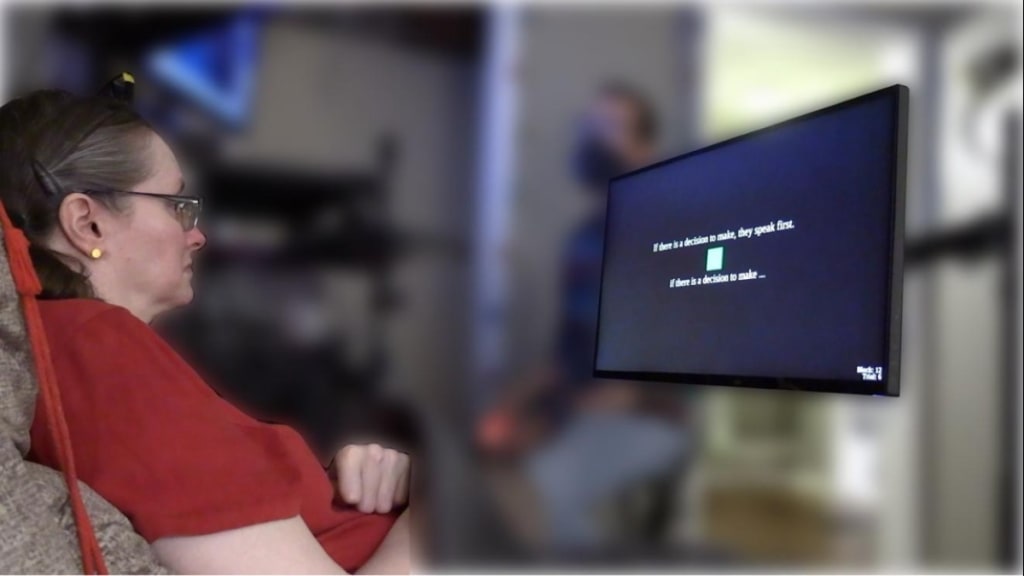
In a groundbreaking study, researchers have successfully decoded the thoughts people “speak” in their minds, a major breakthrough that could help individuals who are unable to speak aloud due to severe medical conditions.
A team of scientists from Stanford University, USA, translated what participants were thinking using brain-computer interface (BCIs) technologies. These interfaces have recently emerged as a promising tool to assist people with disabilities, providing new ways to communicate more naturally and efficiently.
Traditionally, BCIs are implanted into regions of the brain responsible for movement. They work by decoding neural signals, which can then be used to control external devices, such as prosthetic limbs. For example, people with paralysis can use these devices to move robotic hands or type messages directly with their thoughts.
In 2024, a study published in the New England Journal of Medicine demonstrated that BCIs could successfully decode the attempted speech of a 45-year-old man with amyotrophic lateral sclerosis (ALS). ALS, also known as motor neurone disease (MND), is a progressive neurodegenerative disease that gradually weakens nerve cells and reduces muscle control. In many cases, ALS affects the muscles involved in speech, making it extremely difficult or impossible for patients to communicate audibly.
The Stanford research team was inspired to explore whether BCIs could go even further: Could they decode inner speech—the words and sentences a person thinks but does not say aloud?
“For people with severe speech and motor impairments, BCIs capable of decoding inner speech could help them communicate much more easily and naturally,” said Erin Kunz, the lead author of the study.
“This is the first time we’ve managed to understand what brain activity looks like when you just think about speaking.”
To test this, the researchers implanted microelectrodes into the motor cortex—the brain region responsible for controlling speech—of four participants who had severe paralysis caused by either ALS or a brainstem stroke. Each participant was asked to either attempt speaking or to imagine saying a series of specific words.
The team found that both attempted speech and imagined speech triggered similar patterns of neural activity in the motor cortex. While inner speech produced weaker signals than actual attempted speech, it activated largely the same brain regions. This overlap suggested that decoding thoughts could be achievable even without physical speech.
“If you just have to think about speech instead of actually trying to speak, it’s potentially easier and faster for people,” explained Benyamin Meschede-Krasa, co-first author of the study.
Using these findings, the team trained an AI model to interpret the imagined words. The BCI system was able to decode imagined sentences from a vocabulary of up to 125,000 words, achieving an impressive accuracy rate of 74%. The full results were published in the journal Cell.
To address concerns about privacy and control, the researchers also implemented a password-protected mechanism. The system would only begin decoding inner speech if the participant mentally “unlocked” it with a chosen keyword. In this study, the phrase “chitty chitty bang bang” was used as the unlock command. The system successfully recognized this mental password with 98.75% accuracy.
While the technology is not yet capable of decoding completely free-form inner speech without significant errors, the researchers are optimistic. They believe that more advanced sensors, refined devices, and improved AI algorithms could eventually allow BCI systems to decode natural inner speech with fewer mistakes.
“This work gives real hope that speech BCIs can one day restore communication that is as fluent, natural, and comfortable as conversational speech,” said senior author Frank Willett.
“The future of BCIs is extremely promising, and this research marks a significant step forward in enabling people with severe disabilities to regain their voice.”
This study not only represents a major scientific achievement but also points to a future where thoughts could be translated into speech, potentially revolutionizing how people with speech impairments interact with the world around them.
Source:
https://cosmosmagazine.com/health/body-and-mind/brain-inner-speech-computer/
About the Creator
About Binding Prometheus
I want to start actively advocating on behalf of my own work, and the most valuable part of my canon is, without a doubt, Binding Prometheus, the play I have been working on since 2019 and only finished in 2023 as part of my MA. The play itself is an amalgamation of a million different inspirations. On one end, it evokes the Ancient Greek myth-play, deriving its own title from the earliest extant work of Western drama we have, Aeschylus’s Prometheus Bound. On the other end, it borrows significantly from the sci-fi bulwarks from over the years, namely Mary Shelley’s Frankenstein and Karel Capek’s Rossum’s Universal Robots. The play could be an episode of Black Mirror, I fear. I don’t know. I’ve only ever seen one episode of Black Mirror.
By Steven Christopher McKnight25 days ago in Futurism
Molybdenum Market: Energy & Mining Expansion, Industrial Uses & Growth Outlook
Rising demand from steel, energy, and chemical industries is driving growth in the molybdenum market. Increasing use in high-strength alloys enhances corrosion resistance and durability in infrastructure and automotive applications. Expansion of renewable energy, oil and gas projects, and aerospace manufacturing supports consumption. According to IMARC Group's latest research publication, The global molybdenum market size was valued at 5,868.7 Tons in 2024. Looking forward, IMARC Group estimates the market to reach 7,170.2 Tons by 2033, exhibiting a CAGR of 2.25% from 2025-2033.
By James Whitman3 days ago in Futurism



Comments
There are no comments for this story
Be the first to respond and start the conversation.