
Blueprints of the Digital Age: The Story of Computer Discovery
How brilliant minds and bold ideas built the foundation of modern computing

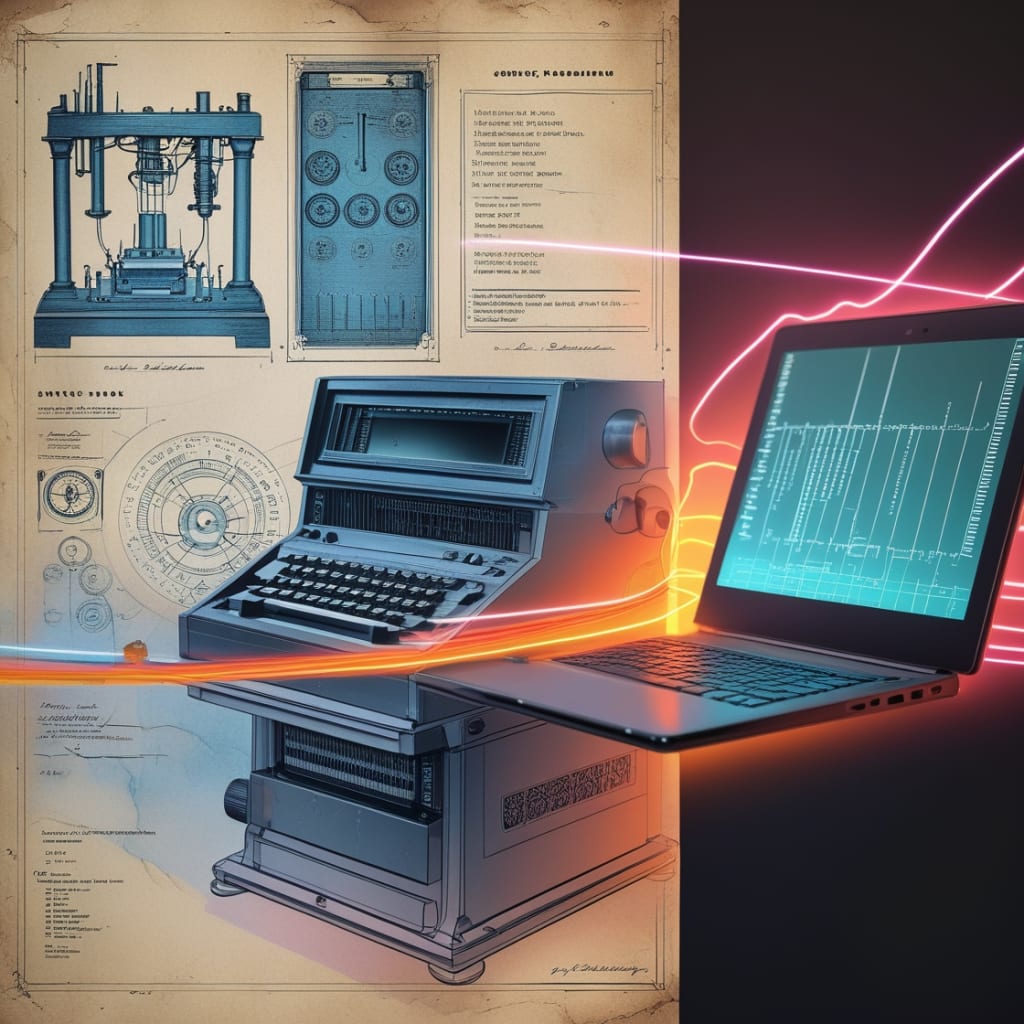
Today, nearly every task—from sending a message across the globe to analyzing complex medical data—relies on a device that fits in the palm of your hand or rests quietly on a desk: the computer. But this seemingly ordinary machine has a long, rich history that spans centuries and continents. The story of the computer isn't the tale of a single genius or a single moment. It’s a story of blueprints—sketches, ideas, experiments, and breakthroughs—contributed by brilliant minds who dared to imagine a different future. In the flickering candlelight of a small London study in 1837, Charles Babbage hunched over a table scattered with gears, rods, and sheets of hand-drawn diagrams. As the wind howled outside, he envisioned something the world had never seen before: a machine capable of performing calculations automatically, without human error or fatigue.
Babbage called it the Analytical Engine. It was, by all accounts, the first true concept of a programmable computer — a vision so ahead of its time that even his closest colleagues struggled to comprehend it fully. His friend Ada Lovelace, a gifted mathematician and daughter of the poet Lord Byron, understood. She wrote detailed notes and theoretical programs for the machine, which would later earn her the title of the world's first computer programmer.
Though the Analytical Engine was never built during Babbage’s lifetime, it laid the foundation for something that would transform human civilization forever.
Mechanical Dreams and Early Sparks
Even before Babbage, humans longed for ways to automate calculations. The 17th-century French mathematician Blaise Pascal invented a mechanical calculator known as the Pascaline, designed to help his father with tax computations. Gottfried Wilhelm Leibniz later improved on these ideas with his Stepped Reckoner. These early machines were limited but demonstrated a powerful idea: machines could relieve humans of repetitive mental labor.
Fast forward to the late 19th century, when Herman Hollerith introduced the punched card tabulating machine to process census data in the United States. His innovation reduced a decade-long task to just a few years. Hollerith's company would later become part of IBM — a name that would define an era of computing.
The Dawn of Electronic Brains
While mechanical and electromechanical machines brought progress, the real revolution began with electricity. In the 1930s and 40s, scientists started experimenting with vacuum tubes and electronic circuits to perform calculations at unprecedented speed.
In Germany, engineer Konrad Zuse developed the Z3 in 1941, the first programmable, fully automatic digital computer. Meanwhile, across the Atlantic, engineers and mathematicians at the University of Pennsylvania unveiled ENIAC in 1945 — a gigantic machine filling a room with rows of vacuum tubes and cables. Originally built to calculate artillery trajectories, ENIAC marked a leap forward in speed and complexity.
During this time, British mathematician Alan Turing played a pivotal role. Working at Bletchley Park during World War II, Turing and his colleagues developed the Bombe machine, which helped crack the Nazi Enigma codes. Turing also proposed the theoretical "Universal Machine," the conceptual ancestor of all modern computers.
The seeds of the digital age had been sown.
From Giant Machines to Personal Desks
Following World War II, computer development accelerated rapidly. Vacuum tubes gave way to transistors — smaller, more reliable, and far more energy-efficient. The 1950s and 60s saw the birth of mainframes, used by governments, research labs, and large corporations. These machines, like IBM’s System/360, were still enormous and expensive, often requiring entire rooms to house them.
But progress did not stop. In 1971, Intel introduced the first commercial microprocessor, the 4004. This tiny chip contained thousands of transistors and could be mass-produced cheaply. Suddenly, computing power that once filled rooms could fit on a single board.
The world was about to change forever.
In 1975, two young hobbyists — Bill Gates and Paul Allen — saw the potential in a small kit computer called the Altair 8800. They offered to write software for it, eventually founding Microsoft. Around the same time, Steve Jobs and Steve Wozniak built the first Apple computer in a California garage, laying the foundation for Apple Computer, Inc.
Personal computers began appearing in offices and homes, no longer the exclusive domain of scientists and governments. The IBM PC, launched in 1981, solidified the personal computer market and helped create an entire ecosystem of software and peripherals.
Connecting the World
As personal computers became common, another quiet revolution was brewing: the internet. Originally a U.S. military research project called ARPANET in the late 1960s, it grew into a vast network connecting universities and research labs.
By the 1990s, this network evolved into the World Wide Web, popularized by Tim Berners-Lee’s invention of the first web browser. Suddenly, computers weren’t just personal — they were global. Information, ideas, and cultures flowed across continents in seconds.
The computer was no longer a simple calculator or a static tool. It had become a living, breathing gateway to human knowledge and connection.
The Mobile and AI Era
As the 21st century unfolded, computers grew smaller, faster, and smarter. The rise of smartphones placed powerful computers into billions of pockets. Laptops became thinner and more powerful, tablets replaced notepads, and wearable devices began monitoring our health and connecting to the internet.
Artificial intelligence, once science fiction, now became integrated into daily life. Voice assistants like Siri and Alexa, self-driving cars, and advanced medical diagnostics all rely on computers that "think" and learn. Quantum computing, once a theoretical dream, is now emerging, promising to solve problems far beyond the reach of traditional machines.
About the Creator
FAROOQ HASSAN
Expert in "Content writting" in every language 100% human hand writting
Reader insights
Good effort
You have potential. Keep practicing and don’t give up!
Top insights
Compelling and original writing
Creative use of language & vocab
Easy to read and follow
Well-structured & engaging content
Excellent storytelling
Original narrative & well developed characters
Expert insights and opinions
Arguments were carefully researched and presented
Eye opening
Niche topic & fresh perspectives
Heartfelt and relatable
The story invoked strong personal emotions
Masterful proofreading
Zero grammar & spelling mistakes
On-point and relevant
Writing reflected the title & theme
Keep reading
More stories from FAROOQ HASSAN and writers in Futurism and other communities.
Inside the Mind of Machines: How Artificial Intelligence Works
In a world increasingly governed by algorithms, one question echoes across industries, classrooms, and living rooms alike: How does artificial intelligence actually work? We see its impact everywhere — from recommending our next movie to detecting diseases early, from self-driving cars to virtual assistants that greet us with our names. But behind these seamless interactions is a complex, layered system designed to replicate something deeply human — the ability to learn, adapt, and decide.
By FAROOQ HASSAN6 months ago in Futurism
About Binding Prometheus
I want to start actively advocating on behalf of my own work, and the most valuable part of my canon is, without a doubt, Binding Prometheus, the play I have been working on since 2019 and only finished in 2023 as part of my MA. The play itself is an amalgamation of a million different inspirations. On one end, it evokes the Ancient Greek myth-play, deriving its own title from the earliest extant work of Western drama we have, Aeschylus’s Prometheus Bound. On the other end, it borrows significantly from the sci-fi bulwarks from over the years, namely Mary Shelley’s Frankenstein and Karel Capek’s Rossum’s Universal Robots. The play could be an episode of Black Mirror, I fear. I don’t know. I’ve only ever seen one episode of Black Mirror.
By Steven Christopher McKnight20 days ago in Futurism


Comments (7)
Excellent storytelling
I Hope these are helpfull for we
Understanding to Technology is our need
Good efforts
fabolous
this a most attractive strory
Good Information