
Blockchain and the Future of Decentralized Finance
Exploring Innovations, Opportunities, and Challenges in the Evolution of Financial Systems


In the landscape of global finance, a revolutionary transformation is underway—decentralized finance (DeFi). Powered by blockchain technology, DeFi represents a paradigm shift from traditional centralized financial systems to a decentralized, peer-to-peer network of financial services and applications. This article delves into the world of blockchain and DeFi, examining their technological foundations, potential disruptions across sectors, regulatory considerations, and the promise of financial inclusion in a digitally interconnected world.
Understanding Blockchain Technology
At its core, blockchain is a distributed ledger technology that enables secure, transparent, and immutable record-keeping of transactions across a network of computers. Unlike traditional financial systems reliant on intermediaries such as banks and clearinghouses, blockchain operates on a decentralized consensus mechanism, where transactions are validated by network participants (nodes) and recorded in blocks linked chronologically.
The cryptographic security and transparency inherent in blockchain technology eliminate the need for intermediaries, reducing transaction costs, enhancing efficiency, and mitigating the risks associated with centralized control. Immutable transaction records ensure transparency and auditability, fostering trust among users and stakeholders in decentralized ecosystems.
The Emergence of Decentralized Finance (DeFi)
Decentralized finance encompasses a diverse array of financial services and applications built on blockchain platforms, including Ethereum, Binance Smart Chain, and Solana. These platforms enable the creation, issuance, trading, and management of digital assets (cryptocurrencies) and financial instruments (smart contracts) without traditional intermediaries.
Key components of DeFi include:
Decentralized Exchanges (DEXs): Platforms facilitating peer-to-peer trading of cryptocurrencies and digital assets, enabling users to swap tokens directly with one another without relying on centralized exchanges.
Lending a nd Borrowing Protocols:Smart contract-based platforms that enable users to lend their digital assets to earn interest or borrow assets against collateral, promoting liquidity and capital efficiency in decentralized markets.
Stablecoins and Payment Networks: Cryptocurrencies pegged to stable assets (fiat currencies or commodities) designed to mitigate price volatility, facilitating seamless transactions and cross-border payments within decentralized ecosystems.
Asset Management and Yield Farming: Automated strategies and protocols that optimize yield generation by staking or providing liquidity to decentralized liquidity pools, incentivizing participation and liquidity provision in DeFi markets.
Technological Innovations in DeFi
The rapid evolution of DeFi is fueled by continuous innovations in blockchain technology, smart contracts, and decentralized applications (dApps). Automated market-making algorithms, decentralized oracles, and cross-chain interoperability protocols enhance scalability, security, and usability within decentralized ecosystems, enabling seamless integration with traditional financial markets.
Smart contract platforms like Ethereum serve as the foundation for DeFi innovation, enabling developers to create programmable financial instruments and automated trading strategies that execute trustlessly without human intervention. The composability of DeFi protocols allows for the seamless integration and interoperability of decentralized applications, fostering a vibrant ecosystem of interconnected financial services and products.
Economic Implications of DeFi
The rise of DeFi presents transformative opportunities and challenges for global financial markets and economic systems. By democratizing access to financial services, DeFi promotes financial inclusion, empowering individuals worldwide to participate in digital economies, access capital, and manage their financial assets autonomously.
Furthermore, DeFi stimulates innovation in fintech, blockchain infrastructure, and digital asset management, driving economic growth, job creation, and entrepreneurship in emerging markets and developed economies alike. The proliferation of decentralized lending, automated trading, and tokenized assets unlocks new avenues for capital formation, investment diversification, and risk management strategies in a decentralized financial landscape.
Regulatory and Security Considerations
As DeFi ecosystems expand and gain mainstream adoption, regulatory oversight and compliance frameworks become increasingly paramount. The decentralized nature of blockchain and DeFi challenges traditional regulatory paradigms, necessitating collaborative efforts between regulators, policymakers, and industry stakeholders to establish clear guidelines for market participants, protect consumer interests, and mitigate systemic risks.
Security remains a critical concern in DeFi, given the prevalence of smart contract vulnerabilities, hacking incidents, and phishing attacks targeting decentralized exchanges and protocols. Robust cybersecurity measures, formal verification audits, and risk management protocols are essential to safeguarding user funds and maintaining trust in decentralized financial platforms.
Challenges and Future Outlook
While DeFi holds immense promise for transforming financial services and democratizing access to capital, several challenges must be addressed to realize its full potential. Scalability limitations, interoperability barriers between blockchain networks, and user experience friction hinder widespread adoption and usability of decentralized applications.
Moreover, addressing environmental sustainability concerns associated with blockchain's energy-intensive consensus mechanisms, such as proof-of-work (PoW), remains a pressing issue for the industry. Innovations in consensus algorithms, such as proof-of-stake (PoS) and energy-efficient blockchain protocols, aim to mitigate environmental impact while enhancing scalability and transaction throughput in decentralized networks.
Conclusion
Blockchain technology and decentralized finance represent a monumental evolution in global finance, redefining how value is exchanged, transferred, and managed in a digitally interconnected world. By leveraging the principles of transparency, autonomy, and inclusivity, DeFi pioneers a new era of financial innovation, empowering individuals, businesses, and communities to participate in a borderless and equitable financial ecosystem.
As the DeFi landscape continues to evolve, collaboration between stakeholders, proactive regulatory frameworks, and technological advancements will shape the future trajectory of decentralized finance. By embracing innovation responsibly and fostering a culture of trust and resilience, we can harness the transformative potential of blockchain technology to build a more accessible, resilient, and inclusive global financial system for generations to come.
About the Creator
Keep reading
More stories from bachir boukhalfa and writers in Futurism and other communities.
Beyond Earth: The Rise of Space Tourism and Its Transformative Impact on Exploration
The vast expanse of space, once the exclusive domain of astronauts and scientists, is now opening its doors to a new breed of explorers—space tourists. In recent years, advances in aerospace technology and the advent of private space companies have transformed the dream of commercial space travel into a tangible reality. This article delves into the burgeoning industry of space tourism, its technological underpinnings, economic implications, cultural impacts, and the ethical considerations that accompany humanity's expansion beyond Earth.
By bachir boukhalfa 2 years ago in Futurism
Australia Power Market: Renewable Energy Expansion, Grid Modernization & Energy Storage Integration
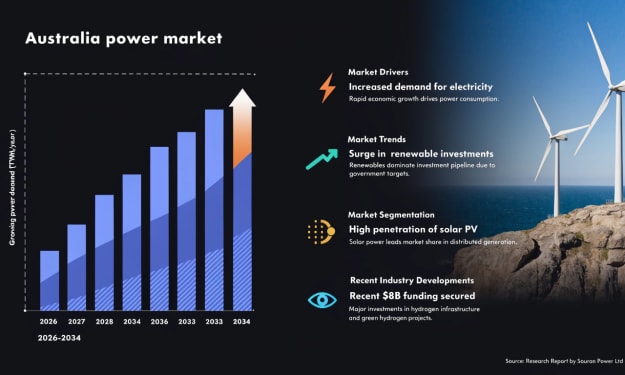
According to IMARC Group, the Australia power market reached 285.7 TWh in 2025 and is projected to reach 377.0 TWh by 2034, growing at a compound annual growth rate (CAGR) of 3.04% during 2026–2034. The market is undergoing a major transformation as Australia accelerates its transition toward cleaner and more sustainable energy systems. Rapid expansion of renewable energy sources such as solar and wind is reshaping electricity generation patterns across the country. At the same time, increasing electricity demand from industries, households and digital infrastructure is encouraging investments in power generation capacity and energy distribution networks. Government incentives supporting clean energy development, the gradual phase-out of coal-fired power plants and growing corporate sustainability commitments are also influencing the sector. Additionally, advancements in battery storage technologies and grid modernization initiatives are helping integrate renewable energy more effectively into Australia’s national electricity grid.
By Kevin Cooperabout 22 hours ago in Futurism
Battery Felts Market Report: USD 1889.4 Million by 2034 at 8.3% CAGR
Overview The Global Battery Felts Market is expected to be worth around USD 1,889.4 million by 2034, up from USD 851.2 million in 2024, and is projected to grow at a CAGR of 8.3% from 2025 to 2034. Battery felt is a specialized porous material, commonly made from carbon or graphite fibers, used in various battery technologies particularly redox flow batteries—to enhance electrical conductivity, electrolyte distribution, and overall battery efficiency.
By Hayden Kulasabout 22 hours ago in Futurism
Why Didn't Anyone Tell Us
Men, move along. This is not for you. This is for the women. I was forty-five when I began menopause. It is pretty young for that to be going on in a woman’s life, but I had undiagnosed PCOS, my entire life. Thank you to all the gynecologists I had seen my entire life. That in itself should encourage women to keep seeking second opinions, especially when you are not getting correct answers or any at all.
By Alexandra Grant2 days ago in Humans



Comments
There are no comments for this story
Be the first to respond and start the conversation.