
Blade Runner
1982


These days, androids might very well dream of electric sheep.
In 1982, not so much.
Blade Runner takes place six years in our past, as per the present timeline. Other timelines, we don't know. Perhaps there, Replicants rule the lives of meat sacks, and the Imperial Skinjobs are all as beautiful as Rutger Hauer or Daryl Hannah are in Blade Runner.
The film is a beautiful—well, really more than that—science fiction noir dream, a cyberpunk Metropolis city that is L.A. but is not. Flying cars and monstrous alien blimps and everything rain-soaked in cyberpunk neon colors, washed with the acid rain and gritty as the gutter, with shuffling hordes in vinyl raincoats, carrying umbrellas, shifty and furtive and full of the modern fear.

Harrison Ford, as Rick Deckard, is a modern, reluctant Marlowe, a Bogart for the AI age—but here, also, paradoxically, a retired assassin. He's cynical, world-weary, hard-bitten and averse to going back to active duty. His former duty was to kill cyborgs, “Skinjobs” as alluded to before, and he was, as it is intimated, the best at it.
O'Brien (M. Emmet Walsh) compels Deckard to return to his former assignment. It seems the “Nexus Six” cyborgs have escaped from an off-world colony. One of them, Leon (Brion James), has killed another Blade Runner after failing a Voight-Kampff test (which seems like a parody of Dianetics auditing). The other Replicants/Skinjobs include the beautiful Zhora (Joanna Cassidy), Pris (Daryl Hannah), and Roy Batty (Rutger Hauer)—the last a psychopathic and expert assassin. The Skinjobs have a built-in safety feature: four-year lifespans. The AIs thus never develop into a force that could ultimately threaten the masters. (But, of course, OUR AI devices have no such built-in mechanism.)

The Skinjobs are prohibited from being on Earth, and so the Blade Runners, such as Deckard, hunt them as assassins. What follows is a visually stunning tour-de-force of noir blended expertly with the cyberpunk themes that would be developed by William Gibson for his novel Neuromancer just a few years later. (Gibson has stated that, upon first seeing Blade Runner, he nearly decided to abandon Neuromancer as he feared readers would think he stole the central themes of the novel from the film.)
To complicate Deckard's journey, he falls in love with the young Replicant Rachel, played with a detached and quiet brilliance by Sean Young, who seems to have been endemic to big-budget 1980s science fiction epics. Rachel is based on the actual niece of Eldon Tyrell (Joseph Turkel), the Technocrat and Emperor who functions, from his pyramidal, high-tech compound, as the weird, reclusive, fabulously wealthy equivalent of Elon Musk in the Blade Runner world. Tyrell Corporation created and manufactured the Replicants, even creating animals—as in the original novel Do Androids Dream of Electric Sheep? by science fiction guru and mystic the late Philip K. Dick, upon which Blade Runner is based. Rachel's memories are all implanted, a theme Philip K. Dick was obsessed with, for several reasons (research his “Pink Moment,” The VALIS Trilogy, and The Exegesis).
Edward James Olmos plays the nearly cyborgian but intensely creepy Gaff, and he functions as a sort of continual sly wink at a greater, more shocking truth behind the story of Deckard and Blade Runner, but one that is as obscure as the implanted memory of a literal unicorn presented to the viewer as a dream. Gaff knows a secret that he's trying to convey, symbolically, with his twisted paper sculptures.
Blade Runner • Original 1982 Theatrical Trailer Remastered [4K]
Hauer is intensely brilliant in the final stand-off, his swan song, so to speak, becoming a kind of iconic, cult-movie moment that is heavily quoted and even memed across the internet, a cyber matrix uncreated yet in the year 1982. Or, so it seems, even 2019. Harrison Ford is figuratively and literally hanging by the thread of his calloused detachment, his hard-boiled, implacable cynicism, and his need to both love Rachel and his duty to destroy her. Does this conflict tear him in half? Hanging above a sickening drop, with Roy Batty glaring madly above him, his only salvation, his last hope, is to be rescued by a being that, in the end, seems as pitiful as he does menace. Pathos is the final jewel in the dark, glittering diadem of this motion-picture masterpiece. Every character is real, alive, and true. Even the Skinjobs.
Helmed by Ridley Scott, who directed another quintessential, iconic science fiction film, Alien, four years earlier, and whose other films, such as Legend, are known for their incredible cinematography and what was, at the time, state-of the art SFX wizardry.
Addendum
I recently had the opportunity of also reading the Marvel Comics Super Special Number 31, from 1982, which featured a condensed adaptation of Blade Runner for the comic-book-loving auds. This was rather a re-read after many decades, from childhood actually, and brought back a deluge of memories of those days. That past, wherein we viewed a future that is now, based in this timeline, also the past. The present? It is in some ways far, far more frightening.
Excelsior!
Author's Website
Author's YouTube
My book: Cult Films and Midnight Movies: from High Art to Low Trash Volume 1
Ebook
My book: Silent Scream! Nosferatu, The Cabinet of Dr. Caligari, Metropolis, and Edison's Frankenstein--Four Novels by C. Augustine.
Ebook
About the Creator
Tom Baker
Author of Haunted Indianapolis, Indiana Ghost Folklore, Midwest Maniacs, Midwest UFOs and Beyond, Scary Urban Legends, 50 Famous Fables and Folk Tales, and Notorious Crimes of the Upper Midwest.: http://tombakerbooks.weebly.com
Commercial Printing Market: Global Advertising Spend Recovery, Industry Innovation & Industry Growth
According to IMARC Group's latest research publication, global commercial printing market size reached USD 774.46 Billion in 2024. Looking forward, IMARC Group expects the market to reach USD 848.1 Billion by 2033, exhibiting a growth rate of 1.07% during 2025-2033.
By sujeet. imarcgroupabout 8 hours ago in Futurism
Medical Gases Market Overview: Aging Population, Emergency Care Growth & Industry Forecast to 2033
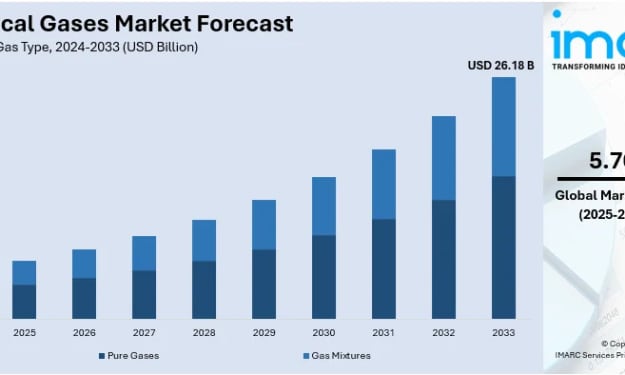
Rising healthcare investments, the growing prevalence of chronic respiratory diseases, and the rapid expansion of home-based medical care are fueling the demand for medical gases globally. According to IMARC Group’s latest data, the global medical gases market size was valued at USD 15.6 Billion in 2024. Looking forward, IMARC Group estimates the market to reach USD 26.18 Billion by 2033, exhibiting a CAGR of 5.76% from 2025-2033.
By Andrew Sullivanabout 4 hours ago in Futurism
Boundless
A geographical map could take you there. To the places I've been, to the sights I've seen, to the landscapes I've climbed. But no compass could point you in the direction of my memories. To the experiences I've lived, to the happiness I've felt, to the wonder I've held so close to my heart.
By Alyssa Musso3 days ago in Writers



Comments (3)
Awesome review. It's interesting to watch/see movies that were made in the past that are now in our past.
Great review. Have seen the movie many times and still strikes me as spooky that the BR future is now our past, in more ways the one. I sometimes think this and other Ridley movies are a little OTT and smack of the arti-student project but, then again, I think the excess is forgivable. If you haven't already done so, do read Do Androids Dream of Electric Sheep. A very different story but one that adds a new dimension to the understanding or the story. One of a long line that stem from Shelley's original Frankenstein. Congrats on the TS
The present can always seem more impressive than our imagined future.