
Billionaires vs. Astronauts
Who’s Really Winning the Space Travel Race?


Space travel has long been the domain of highly trained astronauts, backed by national space agencies like NASA and Roscosmos. But in recent years, billionaire entrepreneurs have stepped in, launching their own space missions and redefining what it means to explore the final frontier. This raises an important question: Who is really leading the race in space travel—billionaire-funded private companies or government-backed astronauts? Let’s take a deep dive into both sides of the equation.
## The Rise of Billionaires in Space Travel
SpaceX: Elon Musk’s Vision for Mars
Elon Musk’s SpaceX has revolutionized the space industry with reusable rockets and ambitious plans to colonize Mars. The company’s Starship rocket is designed for interplanetary travel, bringing Musk’s dream of a multi-planetary civilization closer to reality.
Blue Origin: Jeff Bezos’ Dream of a Spacefaring Civilization
Jeff Bezos, the founder of Amazon, created Blue Origin with the vision of making space travel accessible. His goal? Establishing floating space colonies where millions of people can live and work.
Virgin Galactic: Richard Branson’s Push for Space Tourism
Unlike SpaceX and Blue Origin, Richard Branson’s Virgin Galactic focuses on space tourism, offering suborbital flights that allow passengers to experience weightlessness for a few minutes.
## The Role of Professional Astronauts
NASA’s Legacy and Continuing Missions
NASA has been at the forefront of space exploration for decades, sending astronauts to the Moon and running the International Space Station (ISS). Future missions aim to return humans to the Moon and eventually reach Mars.
The European Space Agency (ESA) and International Collaborations
The ESA, along with partners like Japan and Canada, continues to advance human spaceflight through collaborative missions and cutting-edge technology.
The Role of China and Russia in Space Exploration
China and Russia have ambitious space programs, with China’s Tiangong space station and Russia’s lunar exploration plans challenging Western dominance in space.
## How Billionaires Are Changing the Space Industry
The Privatization of Space Travel
SpaceX, Blue Origin, and Virgin Galactic have shown that space travel is no longer exclusive to government agencies. Private companies are making it more accessible, efficient, and innovative.
Competition Driving Innovation and Cost Reduction
The rivalry between billionaires has accelerated technological advancements, reducing the cost of space travel through reusable rockets and efficient spacecraft design.
Space Tourism: A Luxury or a Gateway to the Future?
While current space tourism is limited to the ultra-rich, it may pave the way for commercial space travel, making it more affordable for ordinary people in the future.
## Challenges Faced by Billionaire Ventures vs. Astronaut Programs
Safety and Risk Management
Space travel is inherently dangerous. While NASA has decades of experience handling risks, private companies are still proving their reliability.
Ethical and Environmental Concerns
Critics argue that billionaire space travel is an ego-driven luxury that contributes to climate change, while others see it as an essential step for human survival.
The Cost of Space Exploration
Government agencies rely on taxpayer money, whereas billionaires fund their projects privately. The debate over which model is more sustainable continues.
## Future of Space Travel: Who Will Lead?
Colonization of Mars and Beyond
Both NASA and SpaceX have their eyes on Mars. The question remains: Who will get there first, and how will it change humanity’s future?
The Role of AI and Robotics in Future Missions
Artificial intelligence and robotic technology are expected to play a major role in future space missions, reducing the need for human astronauts in high-risk environments.
Government vs. Private Sector: A Collaborative Future?
Rather than competing, space agencies and private companies may find a way to collaborate, leveraging each other’s strengths to push the boundaries of exploration.
## Conclusion
The space race is no longer just between nations—it’s also between billionaires and astronauts. While government-backed space agencies bring expertise and experience, private companies bring innovation and funding. Ultimately, a collaborative approach may be the key to unlocking the next era of space exploration.
## FAQs
1. Are billionaires making space travel more accessible?Yes, private companies like SpaceX and Blue Origin are reducing costs and paving the way for commercial space travel.
2. Will NASA still play a role in space exploration?Absolutely! NASA continues to lead deep-space exploration and collaborate with private companies.
3. Who is closer to sending humans to Mars, NASA or SpaceX?SpaceX has ambitious plans, but NASA’s Artemis program lays the groundwork for eventual Mars missions.
4. Is space tourism just for the wealthy?For now, yes. But as technology advances, prices may drop, making it more accessible to the public.
5. What is the biggest challenge facing space colonization?Sustaining life on another planet with limited resources and technological constraints remains the biggest challenge.
About the Creator
Apleetech
Apleetech is a Professional Technology Platform. Here we will provide you only interesting content, which you will like very much. We're dedicated to providing you with the best of Technology, with a focus on dependability and Tech.
About Binding Prometheus
I want to start actively advocating on behalf of my own work, and the most valuable part of my canon is, without a doubt, Binding Prometheus, the play I have been working on since 2019 and only finished in 2023 as part of my MA. The play itself is an amalgamation of a million different inspirations. On one end, it evokes the Ancient Greek myth-play, deriving its own title from the earliest extant work of Western drama we have, Aeschylus’s Prometheus Bound. On the other end, it borrows significantly from the sci-fi bulwarks from over the years, namely Mary Shelley’s Frankenstein and Karel Capek’s Rossum’s Universal Robots. The play could be an episode of Black Mirror, I fear. I don’t know. I’ve only ever seen one episode of Black Mirror.
By Steven Christopher McKnight13 days ago in Futurism
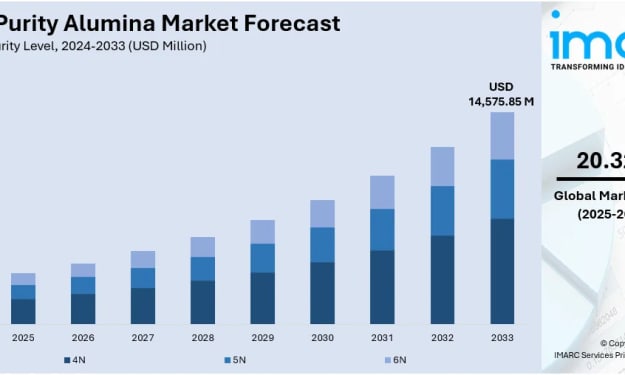
High Purity Alumina Market: Clean Energy Adoption & Material Innovation Trends
According to IMARC Group's latest research publication, global high purity alumina market size reached USD 2,547.04 Million in 2024. Looking forward, IMARC Group expects the market to reach USD 14,575.85 Million by 2033, exhibiting a growth rate (CAGR) of 20.32% during 2025-2033.
By Andrew Sullivana day ago in Futurism



Comments
There are no comments for this story
Be the first to respond and start the conversation.