
Beneath the Pomegranate Tree
A Forbidden Love Blossoms Between an American Nurse and an Afghan Interpreter in War-Torn Kandahar
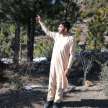

The sun had barely risen above the jagged mountains surrounding Kandahar when Emma’s boots crunched over the dry earth of the clinic courtyard. She adjusted her scarf, more out of respect than necessity—though in southern Afghanistan, it helped blend in. Her blonde hair was tucked under the cloth, her blue eyes scanning the line of women and children waiting for medical attention. She had come to Afghanistan as part of a humanitarian mission—one she had fought tooth and nail to join. As a nurse with Doctors Beyond Borders, her job was clear: treat the sick, offer help, and remain neutral.
But nothing was neutral about the man who would soon change everything.
Zahid was a local interpreter, hired by the NGO for his perfect English, but it was his quiet demeanor, sharp eyes, and gentle patience that Emma noticed first. He moved through the clinic with grace, explaining procedures to nervous mothers and helping Emma communicate with patients whose pain could not be eased with words alone.
Their first conversation had been brief, almost transactional.
“Can you ask her how long the child has had the fever?” Emma asked, pointing to the sweating baby in the woman’s arms.
Zahid nodded and translated swiftly, then turned back. “Since yesterday morning. The mother says he hasn’t eaten.”
Emma knelt beside the baby, but she glanced up at Zahid. “Thank you. You make this easier.”
He didn’t smile, not yet. “I do what I can.”
Over the following weeks, they found themselves working side by side every day. Conversations grew longer. At first about the patients, then about books, then music—Emma loved jazz, Zahid preferred the poetry of Rumi and Ahmad Zahir’s songs. One afternoon, during a rare break, they sat beneath the pomegranate tree in the clinic’s shaded courtyard.
“Why did you come here?” Zahid asked her quietly.
Emma hesitated. “I wanted to help. But I also… I think I wanted to understand. America always talks about Afghanistan like it’s just war and dust. But there’s so much more here. People, beauty, pain. I wanted to see the truth.”
He nodded slowly. “Most foreigners don’t care about that.”
“I’m not most foreigners.”
He finally smiled. “I noticed.”
Their bond deepened, carefully and quietly. In Kandahar, a place of ancient traditions and wary eyes, even a glance held weight. A smile exchanged at the wrong moment could spark rumors. They kept their growing feelings hidden, buried under the routines of work. Yet every shared glance, every brush of hands as they passed medical supplies, spoke volumes.
It was Zahid who confessed first.
One evening, after a long day treating burn victims from a nearby village explosion, he walked Emma to the edge of the compound.
“My father would never approve of this,” he said quietly, not looking at her. “An American woman. A foreigner. It is not the life he wants for me.”
“I understand,” Emma whispered, heart pounding.
“But…” He turned to her then, eyes full of turmoil and tenderness. “I would be a fool to ignore what I feel.”
Emma took a breath, feeling the weight of the world in that moment. “You’re not alone.”
From that day, their love became a secret garden amid the dust and danger of Kandahar. They shared poems under moonlight, exchanged letters passed through Zahid’s younger cousin, and once—recklessly—they stole a moment to hold hands beneath the almond trees outside the city.
But reality was never far behind. Rumors began to swirl. The clinic director warned Emma to be cautious. Zahid’s uncle visited his home to scold him for “entertaining Western foolishness.” The Taliban were growing bolder again in the province.
Then came the letter.
Emma’s rotation was ending. She was to be transferred to another region. She had one week left.
They met, one last time, in the courtyard by the pomegranate tree. The branches were heavy with fruit, just beginning to ripen.
“I can’t ask you to leave your life,” she said, trying not to cry.
“And I can’t ask you to stay in danger,” he replied.
They stood in silence.
“I’ll come back,” she said eventually. “Somehow. When it’s safer. When it’s possible.”
“I’ll wait,” he whispered. “If it takes years.”
As she left Kandahar, Zahid stood on the rooftop of his home, watching the convoy drive away in a cloud of dust. He held in his hand the note she had given him—a single line of Rumi's poetry:
"Out beyond ideas of wrongdoing and rightdoing, there is a field. I’ll meet you there."
About the Creator
About Binding Prometheus
I want to start actively advocating on behalf of my own work, and the most valuable part of my canon is, without a doubt, Binding Prometheus, the play I have been working on since 2019 and only finished in 2023 as part of my MA. The play itself is an amalgamation of a million different inspirations. On one end, it evokes the Ancient Greek myth-play, deriving its own title from the earliest extant work of Western drama we have, Aeschylus’s Prometheus Bound. On the other end, it borrows significantly from the sci-fi bulwarks from over the years, namely Mary Shelley’s Frankenstein and Karel Capek’s Rossum’s Universal Robots. The play could be an episode of Black Mirror, I fear. I don’t know. I’ve only ever seen one episode of Black Mirror.
By Steven Christopher McKnight16 days ago in Futurism
Japan LED Modular Display Market Size & Forecast 2025–2033
Japan LED Modular Display Market at a Glance The Japan LED Modular Display market is anticipated to grow to US$ 1,009.54 million by 2033, rising from US$ 380.54 million in 2024, registering a robust CAGR of 11.45% during 2025–2033. This growth is driven by the increasing demand for high-resolution digital signage across retail, transportation, entertainment, and public infrastructure, combined with the adoption of energy-efficient, customizable display systems for Japan’s expanding smart city initiatives.
By Aaina Oberoia day ago in Futurism
Miss Persephone's Manual to a Seemingly Ordinary Life
Miss Persephone was found at the dining table, her blue eyes swollen, her tears arriving and retreating like the tides of the ocean. Earlier that day, her family had visited her in the retirement home where she had lived for eight years. It was her eightieth birthday.
By Imola Tóth2 days ago in Fiction


Comments
There are no comments for this story
Be the first to respond and start the conversation.