
Australia Steel Market: Production Capacity, Demand Dynamics & Sustainability Initiatives
How shifting domestic demand patterns, evolving production capacities and increasing sustainability initiatives are shaping Australia’s steel market
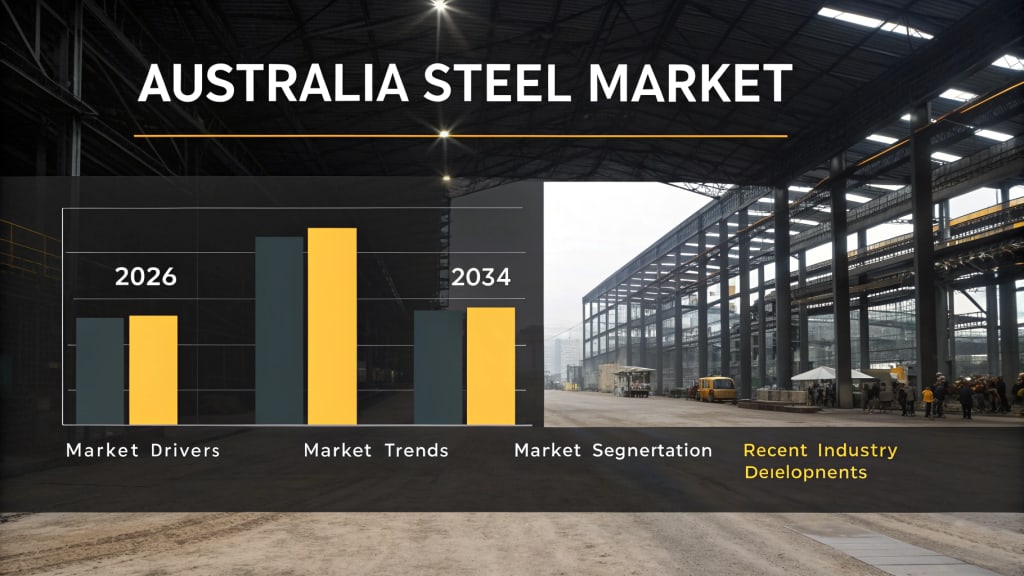
According to IMARC Group, the Australia steel market reached a value of USD 20.1 Billion in 2025 and is projected to expand to USD 26.2 Billion by 2034, exhibiting a compound annual growth rate (CAGR) of 2.91% during 2026–2034. While growth remains moderate, steel continues to serve as a foundational pillar of industrial development and infrastructure expansion across Australia. The market’s trajectory reflects evolving domestic demand patterns, ongoing investments in renewable energy and transportation infrastructure, and gradual modernization of production facilities. As Australia balances economic growth with decarbonization objectives, the steel sector is undergoing a strategic transformation focused on efficiency, sustainability and value-added manufacturing.
Why Should Smart Buyers and Investors Know About the Australia Steel Market?
Stable, Infrastructure-Linked Demand
Steel demand remains anchored in essential economic sectors such as construction, mining and energy infrastructure.
Moderate but Predictable Growth Outlook
With a projected CAGR of 2.91%, the market offers steady expansion supported by structural industrial demand.
Strategic Role in the Energy Transition
Steel is indispensable in renewable energy infrastructure and grid modernization projects.
Sustainability-Driven Innovation Opportunities
Low-carbon production technologies and recycling initiatives create avenues for differentiation and long-term value creation.
Critical Contribution to Industrial Resilience
A strong domestic steel industry enhances supply chain security and supports national economic stability.
Recent Trends & Developments in the Australia Steel Market
June 2025:
Steel manufacturers increased investments in energy-efficient production technologies to reduce emissions and improve operational performance.
March 2025:
Infrastructure-driven demand strengthened as large-scale transportation and renewable energy projects advanced across multiple states.
October 2024:
Export volumes to key Asian markets improved, supporting capacity utilization amid fluctuating domestic construction cycles.
The Australia steel market reflects a mature yet strategically evolving industrial sector positioned at the intersection of infrastructure development, manufacturing modernization and sustainability transition. Supported by IMARC’s steady growth projections, the industry continues to benefit from strong demand across construction, mining and renewable energy segments. While growth rates remain moderate, the market’s long-term relevance is reinforced by its essential role in national development and decarbonization initiatives. As Australia advances toward a more sustainable and resilient industrial framework, steel producers that embrace technological innovation, production efficiency and low-carbon pathways will be best positioned to capture enduring value. For investors and industry stakeholders, Australia’s steel market represents not merely a commodity segment, but a foundational pillar supporting future-ready economic momentum.
Australia Steel Market Vision 2050
1. Transition to Low-Carbon Steel Production
By 2050, steel production in Australia is expected to increasingly incorporate low-emission technologies, including electric arc furnaces, renewable-powered operations and green hydrogen integration.
2. Growth in High-Value and Specialty Steel Products
Future growth will emphasize advanced steel grades designed for renewable infrastructure, energy-efficient buildings and precision manufacturing.
3. Digitalization and Smart Manufacturing
Automation, artificial intelligence and predictive maintenance systems will enhance operational efficiency, reduce waste and improve production quality.
4. Circular Economy and Recycling Expansion
Steel’s recyclability positions it well within circular economy frameworks. Increased scrap utilization and recycling infrastructure will support emissions reduction goals.
5. Integration With National Sustainability Objectives
The steel industry will play a critical role in supporting Australia’s broader decarbonization and infrastructure resilience strategies.
What Are the Key Growth Drivers in the Australia Steel Market?
Strong Construction and Infrastructure Demand
Construction remains the primary consumer of steel products in Australia. Residential housing, commercial real estate and large-scale infrastructure projects—including highways, rail networks and ports—continue to drive demand for structural steel, reinforcement bars and fabricated components.
Government Investment in Renewable Energy and Transport
Public funding directed toward renewable energy installations, grid expansion and transportation modernization is generating additional steel demand. Wind turbine towers, transmission infrastructure and rail systems rely heavily on steel inputs, reinforcing long-term consumption visibility.
Resilient Mining and Resource Sector Activity
Australia’s mining industry supports steel consumption through equipment manufacturing, processing facilities and supporting infrastructure. Demand for durable and high-strength steel products remains stable within resource extraction and mineral processing operations.
Expansion of Domestic Manufacturing Capabilities
Efforts to strengthen local manufacturing capacity and reduce reliance on imported finished steel products are contributing to market stability. Investment in advanced fabrication and downstream processing is enhancing supply chain resilience.
Export Opportunities to Asian Markets
Regional trade relationships with fast-growing Asian economies provide export opportunities for Australian steel and steel-related products. Export diversification supports production stability and enhances international competitiveness.
About the Creator
Keep reading
More stories from Shrestha Roy and writers in Futurism and other communities.
Australia Energy Storage Market: Renewable Integration, Grid Resilience & Technology Advancements
According to IMARC Group, the Australia energy storage market reached a capacity of 4.72 GW in 2025 and is projected to expand significantly to 19.81 GW by 2034, exhibiting a strong compound annual growth rate (CAGR) of 17.28% during 2026–2034. This rapid expansion underscores the central role of energy storage in Australia’s accelerating clean energy transition. As renewable energy penetration increases and coal-fired generation is progressively phased out, storage systems are becoming indispensable for balancing supply and demand. From utility-scale battery projects to distributed residential systems, energy storage is emerging as a foundational infrastructure layer supporting grid stability, renewable integration and energy security across Australia.
By Shrestha Royabout 22 hours ago in Futurism
Saudi Arabia Generic Drug Market: Healthcare Expansion, Cost-Effective Therapies & Growth Outlook
According to IMARC Group's latest research publication, Saudi Arabia generic drug market size reached USD 4.1 Billion in 2025. The market is projected to reach USD 8.1 Billion by 2034, exhibiting a growth rate (CAGR) of 7.88% during 2026-2034.
By Faisal Al-Harbiabout 21 hours ago in Futurism
Camel Dairy Market Intelligence: Key Producers & Strategic Insights
Rising demand for high-resolution aerial imaging, expanding commercial applications across agriculture and construction, and increasing defense spending on surveillance technologies are driving robust growth in the drone camera market. According to IMARC Group's latest data, the global drone camera market size was valued at USD 10.9 Billion in 2024. Looking forward, IMARC Group estimates the market to reach USD 83.5 Billion by 2033, exhibiting a CAGR of 23.42% from 2025-2033. North America currently dominates the market, holding a market share of over 32.9% in 2024.
By sujeet. imarcgroup7 days ago in Futurism
When True Love Never Questions Your Soul
“And she’s going to learn that this life will hit you, hard, in the face, wait for you to get back up, just so it can kick you in the stomach but getting the wind knocked out of you is the only way to remind your lungs how much they like the taste of air.” — Sarah Kay’s Poem — If I Should Have a Daughter
By Chantal Christie Weiss4 days ago in Humans




Comments
There are no comments for this story
Be the first to respond and start the conversation.