
Australia Energy Storage Market: Renewable Integration, Grid Resilience & Technology Advancements
How increasing renewable energy integration, focus on grid resilience and rapid advancements in storage technologies are shaping Australia’s energy storage market
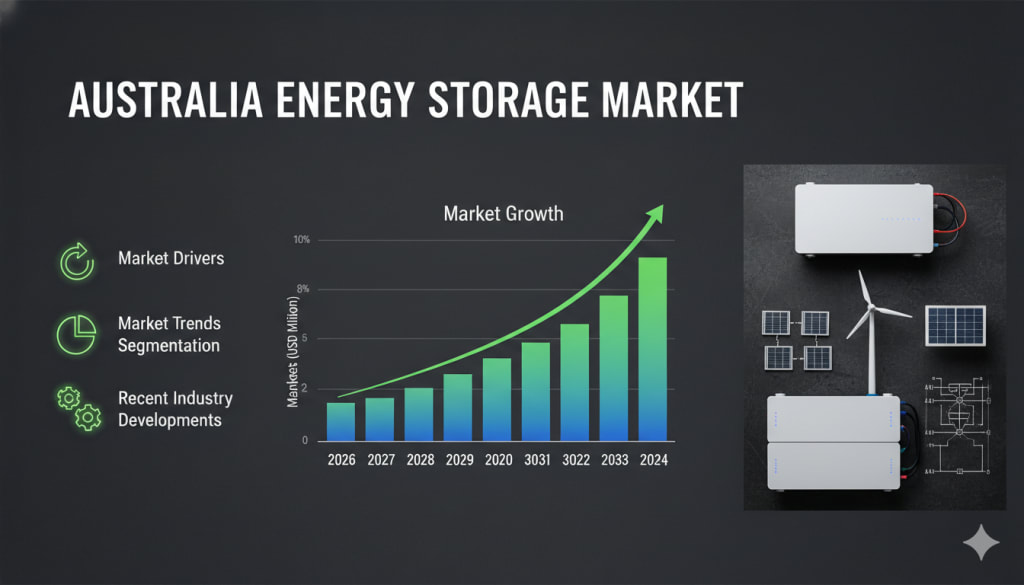
According to IMARC Group, the Australia energy storage market reached a capacity of 4.72 GW in 2025 and is projected to expand significantly to 19.81 GW by 2034, exhibiting a strong compound annual growth rate (CAGR) of 17.28% during 2026–2034. This rapid expansion underscores the central role of energy storage in Australia’s accelerating clean energy transition. As renewable energy penetration increases and coal-fired generation is progressively phased out, storage systems are becoming indispensable for balancing supply and demand. From utility-scale battery projects to distributed residential systems, energy storage is emerging as a foundational infrastructure layer supporting grid stability, renewable integration and energy security across Australia.
Why Should Smart Buyers and Investors Know About the Australia Energy Storage Market?
One of the Fastest-Growing Energy Segments
With a projected CAGR of 17.28%, energy storage represents a high-growth opportunity within Australia’s energy infrastructure landscape.
Essential Enabler of Renewable Expansion
Storage systems are critical for maintaining reliability as renewable energy capacity continues to grow.
Diversified Revenue Streams
Storage assets can generate revenue through multiple services, including energy arbitrage, frequency control and capacity markets.
Alignment With Sustainability and Decarbonization Goals
Energy storage supports emissions reduction and climate targets, making it attractive for ESG-aligned investment strategies.
Long-Term Infrastructure Value
Large-scale storage projects offer infrastructure-like characteristics with long operational lifespans and recurring income potential.
Recent Trends & Developments in the Australia Energy Storage Market
June 2025:
Utility-scale battery projects expanded rapidly to support renewable integration and enhance grid frequency control services.
March 2025:
Residential battery adoption increased as households sought energy independence and protection against volatile electricity prices.
October 2024:
Pilot projects exploring long-duration storage technologies gained momentum, targeting deeper renewable penetration and grid stability.
The Australia energy storage market exemplifies how technological innovation, renewable integration and policy alignment are converging to reshape the national energy landscape. Supported by IMARC’s strong growth projections, storage systems are transitioning from supplementary assets to core infrastructure components underpinning grid stability and clean energy deployment. As Australia accelerates its energy transition, investments in battery capacity, long-duration storage and digital energy management will play a decisive role in ensuring reliability and economic competitiveness. For utilities, technology providers and infrastructure investors, the energy storage market represents not just rapid capacity growth, but a forward-looking cornerstone of Australia’s future-ready, resilient and renewable-powered electricity system.
Australia Energy Storage Market Vision 2050
1. High-Renewable, Storage-Enabled Power System
By 2050, Australia’s electricity system is expected to operate with high renewable penetration supported by diverse storage technologies that ensure reliability and affordability.
2. Long-Duration and Advanced Storage Technologies
Emerging storage solutions with longer discharge durations will complement lithium-ion batteries, enabling seasonal energy balancing and deeper decarbonization.
3. Virtual Power Plants and Aggregated Storage Networks
Aggregated residential and commercial batteries will form virtual power plants (VPPs), providing grid services and enabling distributed participation in wholesale markets.
4. Integration With Electric Vehicle Ecosystems
Energy storage systems will increasingly integrate with electric vehicle batteries, leveraging vehicle-to-grid capabilities to enhance system flexibility.
5. AI-Driven Energy Management
Advanced analytics and artificial intelligence will optimize storage dispatch, forecast demand patterns and improve overall grid efficiency.
What Are the Key Growth Drivers in the Australia Energy Storage Market?
Increasing Renewable Energy Integration
Australia’s abundant solar and wind resources have led to rapid renewable capacity additions. However, the intermittent nature of these sources requires complementary storage solutions to ensure stable electricity supply. Batteries and other storage systems enable time-shifting of energy, smoothing fluctuations and improving reliability.
Growing Focus on Grid Resilience and Stability
Extreme weather events, aging infrastructure and rising electricity demand have highlighted the need for a more resilient power grid. Energy storage enhances grid flexibility by providing frequency control, peak shaving and backup power capabilities.
Declining Battery Costs and Technology Improvements
Advancements in lithium-ion battery technology, improved energy density and economies of scale are reducing capital costs. At the same time, innovation in alternative storage technologies—such as flow batteries and long-duration systems—is broadening application possibilities.
Supportive Government Policies and Market Incentives
Federal and state-level incentives, renewable energy targets and grid modernization initiatives are accelerating storage deployment. Regulatory frameworks increasingly recognize storage as a critical asset class within energy markets.
Rising Adoption of Distributed Energy Resources
Residential and commercial solar installations are often paired with behind-the-meter battery systems. This trend empowers consumers to manage energy consumption, reduce reliance on the grid and participate in demand response programs.
About the Creator
Keep reading
More stories from Shrestha Roy and writers in Futurism and other communities.
Australia Frozen Potato Products Market: Consumption Trends, Retail Expansion & Product Innovation
According to IMARC Group, the Australia frozen potato products market reached a value of USD 1,147.6 Million in 2025 and is projected to grow to USD 1,771.2 Million by 2034, exhibiting a compound annual growth rate (CAGR) of 4.79% during 2026–2034. This steady expansion reflects evolving consumer eating habits, strong demand from quick-service restaurants (QSRs) and continuous improvements in cold chain infrastructure. Frozen potato products—ranging from fries and wedges to hash browns and specialty formats—have become staple items across both foodservice and retail channels. As convenience, consistency and extended shelf life become increasingly important, frozen potato products are playing a strategic role in Australia’s modern food ecosystem across Australia.
By Shrestha Roya day ago in Futurism
Higher Education Market Shifts: Public–Private Collaboration & Industry Expansion to 2034
The higher education sector is experiencing significant growth as rising demand for skilled professionals, increasing adoption of online and hybrid learning models, and substantial government investments reshape the educational landscape worldwide. According to IMARC Group's latest data, the global higher education market was valued at USD 28.36 Billion in 2024. Looking forward, IMARC Group estimates the market to reach USD 116.71 Billion by 2033, exhibiting a CAGR of 19.34% from 2025-2033. North America currently dominates the market, holding a market share exceeding 30%.
By Andrew Sullivan3 days ago in Futurism
Beyond the Refresh Button: How to Actually Speed Up Your PC in 2026
We’ve all been there—staring at a spinning circle while a simple app takes ages to load. In 2026, our PCs are handling more AI-integrated software and heavier browser tasks than ever before. Most people think their hardware is getting old, but more often than not, it's just buried under layers of digital "junk." After spending weeks troubleshooting my own system’s lag, I realized that PC optimization isn't just about deleting a few files—it’s about a smarter workflow. In this guide, I’m sharing the exact steps I used to reclaim my computer’s speed.
By Muhammad Owaisabout 15 hours ago in Futurism




Comments
There are no comments for this story
Be the first to respond and start the conversation.