
Australia Steel Market: Industrial Backbone, Infrastructure Demand & Economic Momentum
How construction activity, manufacturing needs and global trade dynamics are shaping Australia’s steel industry
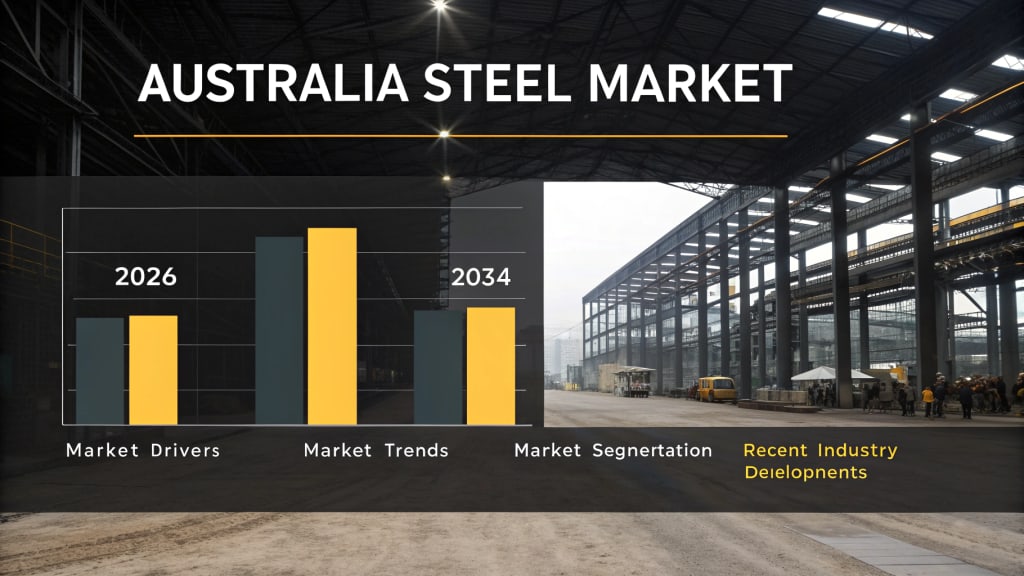
According to IMARC Group, the Australia steel market reached a value of USD 19.5 Billion in 2024 and is projected to grow to USD 25.8 Billion by 2033, exhibiting a compound annual growth rate (CAGR) of 3.16% during 2025–2033. This steady expansion highlights steel’s enduring role as a foundational material underpinning Australia’s industrial economy. Steel remains critical to construction, infrastructure, mining, manufacturing and energy development, forming the physical backbone of national growth. While the market operates within global commodity cycles and competitive international trade dynamics, domestic demand fundamentals and policy-backed infrastructure investment continue to provide resilience. As Australia accelerates spending on transport networks, renewable energy projects and industrial modernization, steel demand remains structurally embedded across economic activity in Australia.
Why Should Smart Buyers and Investors Know About the Australia Steel Market?
Stable Demand Anchored in Core Economic Sectors
Steel demand is closely linked to infrastructure, construction and mining—sectors that receive long-term policy and capital support.
Moderate but Predictable Growth Profile
With a CAGR of 3.16%, the market offers steady expansion and lower volatility compared to more cyclical commodity segments.
Strategic Role in Energy Transition
Steel is essential for renewable energy infrastructure, positioning the industry as a key enabler of Australia’s clean energy ambitions.
Opportunities in Low-Carbon and High-Value Steel
Technological innovation and sustainability requirements create opportunities for premium products and process upgrades.
Importance to National Industrial Resilience
A strong domestic steel sector supports supply-chain security, employment and industrial self-sufficiency.
Recent Trends & Developments in the Australia Steel Market
May 2025:
Steel producers increased focus on recycled content and energy-efficient production methods to reduce emissions and align with sustainability commitments.
December 2024:
Infrastructure-led steel demand strengthened as government-funded transport and renewable energy projects progressed across multiple states.
August 2024:
Export activity to Asian markets improved, supported by stable regional demand and competitive pricing for Australian steel products.
The Australia steel market reflects the enduring importance of foundational materials in driving economic development, infrastructure resilience and industrial capability. Supported by IMARC’s positive growth outlook, the sector continues to evolve alongside national priorities in construction, renewable energy and manufacturing modernization. While global competition and commodity cycles remain inherent challenges, long-term demand drivers rooted in infrastructure investment, energy transition and regional trade provide stability and strategic relevance. As Australia balances industrial growth with sustainability objectives, steel will remain a critical enabler—supporting not only physical infrastructure, but also the country’s broader vision for resilient, future-ready economic momentum.
Australia Steel Market Vision 2050
1. Transition Toward Low-Carbon Steel Production
By 2050, steelmaking in Australia is expected to increasingly adopt low-emission technologies, including electric arc furnaces, green hydrogen integration and recycled scrap utilization to align with global decarbonization targets.
2. Steel as a Pillar of Renewable Infrastructure
Steel will remain central to renewable energy deployment, forming the structural foundation of wind turbines, solar installations and energy storage systems.
3. Advanced Manufacturing and High-Value Steel Products
Future growth will emphasize high-grade, specialty and engineered steel products tailored for infrastructure resilience, energy efficiency and advanced manufacturing applications.
4. Digitally Optimized Steel Production
Automation, data analytics and artificial intelligence will improve yield optimization, energy efficiency and predictive maintenance across steel manufacturing operations.
5. Resilient and Regionally Integrated Supply Chains
Australia’s steel sector will increasingly focus on supply-chain resilience, balancing domestic capability with strategic regional trade partnerships.
What Are the Key Growth Drivers in the Australia Steel Market?
Strong Construction and Infrastructure Demand
Public and private investment in infrastructure remains a primary driver of steel consumption. Large-scale transport projects, urban development, commercial buildings and residential construction continue to generate consistent demand for structural steel, reinforcing bars and fabricated products.
Expansion of Mining and Resource-Linked Industries
Australia’s mining sector relies heavily on steel for equipment, processing facilities and supporting infrastructure. Ongoing investment in resource extraction and mineral processing sustains demand for high-strength and specialty steel products.
Government Investment in Renewable Energy and Transport
Steel demand is increasingly supported by government-backed renewable energy initiatives, including wind farms, solar infrastructure and transmission networks. Transport investments—spanning rail, ports and logistics hubs—also require significant steel inputs, reinforcing long-term consumption visibility.
Growth in Domestic Manufacturing Capability
Efforts to strengthen domestic manufacturing and reduce supply-chain dependence are supporting steel demand across machinery, equipment and value-added fabrication. Local production enhances supply security while supporting downstream industrial activity.
Export Demand and Regional Trade Integration
Australia’s steel industry benefits from proximity to fast-growing Asian markets. Export activity, supported by regional trade relationships, provides an additional demand channel that balances domestic consumption cycles.
About the Creator
Keep reading
More stories from Shrestha Roy and writers in Futurism and other communities.
Australia Organic Food Market: Clean Eating Trends, Consumer Awareness & the Future of Sustainable Nutrition
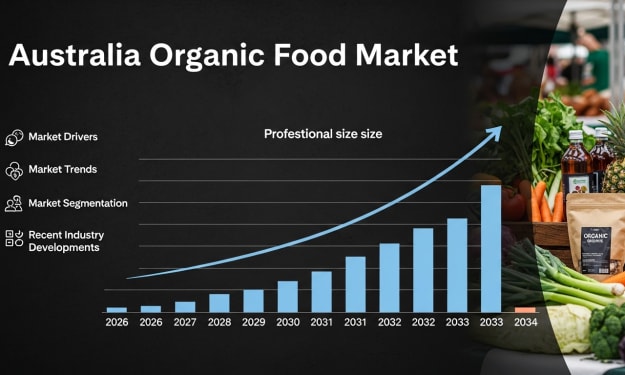
According to IMARC Group, the Australia organic food market reached a value of USD 1.1 Billion in 2024 and is projected to grow to USD 2.2 Billion by 2033, exhibiting a compound annual growth rate (CAGR) of 7.49% during 2025–2033. This sustained growth reflects a fundamental shift in consumer attitudes toward food quality, transparency and long-term health outcomes. Organic food is increasingly viewed not just as a premium dietary choice, but as a safer, more sustainable alternative aligned with clean-label consumption and environmental responsibility. As awareness of chemical residues, food processing practices and nutritional integrity rises, organic products are gaining mainstream acceptance across households, retailers and foodservice channels throughout Australia. The market’s expansion is closely tied to lifestyle-driven purchasing decisions, supportive retail infrastructure and growing confidence in certified organic supply chains.
By Shrestha Roya day ago in Futurism
Energy Efficiency and Smart Lighting Driving the Global LED Driver Market
Rising adoption of energy-efficient lighting, supportive government regulations, and replacement of traditional lighting technologies are driving growth in the LED driver market. According to IMARC Group's latest research publication, The global LED driver market size reached USD 14.1 Billion in 2024. Looking forward, IMARC Group expects the market to reach USD 57.2 Billion by 2033, exhibiting a growth rate (CAGR) of 16.01% during 2025-2033.
By Michael Richard2 days ago in Futurism
Drone Camera Industry Outlook: Commercial Applications & Market Expansion
Rising demand for high-resolution aerial imaging, expanding commercial applications across agriculture and construction, and increasing defense spending on surveillance technologies are driving robust growth in the drone camera market. According to IMARC Group's latest data, the global drone camera market size was valued at USD 10.9 Billion in 2024. Looking forward, IMARC Group estimates the market to reach USD 83.5 Billion by 2033, exhibiting a CAGR of 23.42% from 2025-2033. North America currently dominates the market, holding a market share of over 32.9% in 2024.
By sujeet. imarcgroupabout 11 hours ago in Futurism
Why Black History Matters in America?
The United States of America is celebrating their 250th anniversary in 2026. I'm proud to be an American and as someone who was born here, I wouldn't imagine myself living anywhere else. This is a country where opportunities are possible. Where anyone can be successful in anything they desire to do. Equality, community, and togetherness are the backbones of what America is and should be about. However, we have an administration who wants to erase and disregard those who have made positive, meaningful impacts in our country, specifically Black figures, such as Martin Luther King, Jr., Rosa Parks, and Maya Angelou. President Trump and his administration have been constantly complaining and fighting against what they call the "Woke agenda". They use this excuse as a distraction from other issues they refuse to address, such as the high cost of living, climate change, and inflation. That equality is dividing America, when in reality, it's bringing us together. Being woke is not tied to a specific political party. No matter where you stand on the political spectrum, you can still care about other people and their plights. Compassion and empathy for others isn't tied to a political party, either. We were taught as children to treat others the way we want to be treated and not judge others because they're different from us. Caring about others isn't a personal attack on your beliefs. It doesn't make you any less of a person. People who are easily offended over African American figures, past or present, or anything related to it, are grasping at straws. Current and future generations need to know who people like Harriet Tubman and Shirley Chisholm were, especially in the classroom. Black History is part of American History. It should be recognized, not hidden or forgotten. Besides, you can't shield children from everything, just because your feelings are easily hurt.
By Mark Wesley Pritchard 4 days ago in The Swamp



Comments
There are no comments for this story
Be the first to respond and start the conversation.