
Australia Insulation Materials Market: Demand Growth, Energy Efficiency & Construction Expansion
How rising construction activity, regulatory focus on energy performance and increasing retrofit investments are shaping Australia’s insulation materials market
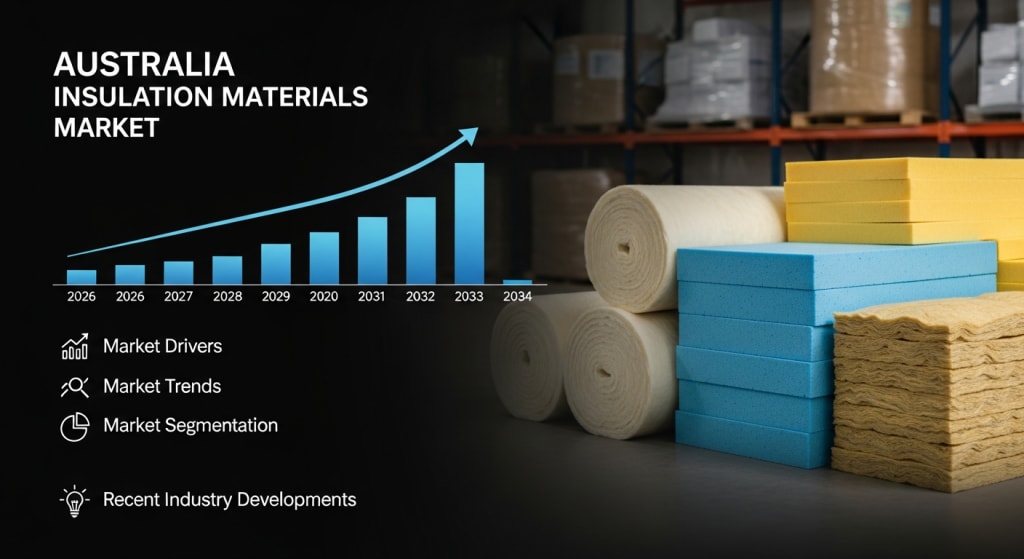
According to IMARC Group, the Australia insulation materials market was valued at USD 2.22 Billion in 2025 and is projected to reach USD 4.01 Billion by 2034, growing at a compound annual growth rate (CAGR) of 6.80% during 2026–2034. This robust growth trajectory reflects insulation’s evolving role within Australia’s construction and energy-efficiency ecosystem. Once treated as a secondary building component, insulation materials are now recognized as essential infrastructure for reducing energy consumption, improving thermal comfort and meeting sustainability targets. Rising construction activity, stricter energy-performance regulations and large-scale retrofit programs are accelerating adoption across residential, commercial and industrial buildings throughout Australia. As energy costs increase and climate variability intensifies, insulation has become a strategic investment rather than a compliance obligation.
Why Should Smart Buyers and Investors Know About the Australia Insulation Materials Market?
Strong and Predictable Growth Outlook
With a projected CAGR of 6.80%, the insulation materials market benefits from long-term structural demand driven by construction activity and energy-efficiency mandates.
High Return on Investment for End Users
Insulation offers one of the most cost-effective pathways to energy savings, making it attractive for residential, commercial and public-sector stakeholders.
Regulatory and Policy Support
Government policies and building codes provide strong demand visibility, reinforcing insulation adoption across new builds and retrofits.
Opportunities in Sustainable and Premium Materials
Advanced and eco-friendly insulation products offer differentiation, pricing power and alignment with ESG-focused investment strategies.
Central Role in Future-Ready Construction
Insulation materials are foundational to smart, energy-efficient and climate-resilient buildings, ensuring long-term relevance across the construction value chain.
Recent Trends & Developments in the Australia Insulation Materials Market
June 2025:
Construction firms increased adoption of high-performance insulation products in residential developments to meet updated energy-efficiency requirements.
February 2025:
Manufacturers expanded offerings of environmentally friendly insulation materials, responding to growing demand for sustainable building products.
September 2024:
Retrofit programs gained momentum as property owners invested in insulation upgrades to reduce energy costs and improve building performance.
The Australia insulation materials market highlights how energy efficiency, regulatory momentum and construction growth are reshaping the built environment. Supported by IMARC’s strong growth projections, the market is transitioning from a compliance-driven segment into a strategic enabler of sustainable construction and long-term energy performance. As Australia accelerates efforts to reduce emissions, manage energy costs and improve building resilience, insulation materials will remain central to achieving these objectives. For manufacturers, investors and construction stakeholders, the sector represents not only a growing commercial opportunity but a forward-looking foundation for future-ready, energy-efficient and sustainable buildings across the country.
Australia Insulation Materials Market Vision 2050
1. Insulation as a Core Energy-Efficiency Infrastructure
By 2050, insulation is expected to be recognized as critical national energy infrastructure, playing a central role in emissions reduction and energy demand management.
2. Advanced High-Performance Insulation Solutions
Next-generation insulation materials offering superior thermal efficiency, durability and fire resistance will become the industry standard, particularly in high-performance buildings.
3. Integration With Smart and Sustainable Buildings
Insulation systems will increasingly integrate with smart building technologies, supporting real-time energy monitoring, climate control and performance optimization.
4. Growth of Sustainable and Low-Carbon Materials
Bio-based, recycled and low-carbon insulation materials will gain wider adoption as sustainability requirements and ESG expectations intensify.
5. Climate-Resilient Construction Strategies
Insulation will play a vital role in climate-resilient construction, helping buildings withstand heatwaves, cold extremes and moisture-related challenges.
What Are the Key Growth Drivers in the Australia Insulation Materials Market?
Expanding Residential and Commercial Construction Activity
Population growth, urban development and infrastructure investment continue to support steady construction activity across Australia. New housing developments, commercial buildings and public infrastructure projects are integrating insulation as a standard design requirement, supporting consistent material demand.
Strong Regulatory Focus on Energy Efficiency
Building codes and energy-performance standards are becoming increasingly stringent. Regulations emphasizing reduced energy loss, lower emissions and improved building efficiency are pushing developers to adopt higher-performance insulation solutions across walls, roofs and floors.
Rising Retrofit and Renovation Investments
Beyond new construction, insulation retrofitting in existing buildings is emerging as a major growth driver. Government incentives, energy-efficiency programs and rising utility costs are encouraging homeowners and commercial property owners to upgrade insulation systems.
Growing Awareness of Long-Term Cost Savings
Insulation delivers measurable reductions in heating and cooling costs over a building’s lifecycle. As energy prices rise, property owners are increasingly prioritizing insulation upgrades as a cost-effective way to improve operating efficiency and asset value.
Innovation in Insulation Materials and Performance
Technological advancements are expanding the range of insulation materials available, including products with improved thermal resistance, fire safety, acoustic performance and moisture control. These innovations are increasing adoption across diverse climatic and structural conditions.
About the Creator
Keep reading
More stories from Shrestha Roy and writers in Futurism and other communities.
Australia Industrial IoT Market: Smart Factories, Connected Infrastructure & Digital Industry
According to IMARC Group, the Australia industrial IoT (IIoT) market reached a value of USD 9.1 Billion in 2025 and is projected to expand significantly to USD 27.3 Billion by 2034, exhibiting a strong compound annual growth rate (CAGR) of 12.54% during 2026–2034. This rapid growth reflects the accelerating digital transformation of Australia’s industrial base as organizations adopt connected technologies to enhance productivity, resilience and global competitiveness. Industrial IoT solutions enable real-time monitoring, automation and data-driven decision-making across manufacturing, mining, utilities and infrastructure sectors. As businesses face rising operational complexity, labor constraints and cost pressures, IIoT is emerging as a foundational technology supporting the shift toward smarter, more efficient industrial operations across Australia.
By Shrestha Roy6 days ago in Futurism
Top 10 Generative AI Development Companies in US
Generative artificial intelligence has rapidly transformed how businesses innovate, create content, automate workflows, and improve customer experiences. From startups focused on customized AI solutions to industry giants powering massive AI ecosystems, the United States is home to some of the most influential generative AI development companies in the world. This article explores the top 10 organizations leading the charge in generative AI development, offering services from model training and deployment to enterprise-grade AI integrations.
By Steve Waugh4 days ago in Futurism
Rising Demand for Minimally Invasive Procedures Driving the Global Anastomosis Devices Market
According to IMARC Group's latest research publication, The global anastomosis devices market size reached USD 3.6 Billion in 2024. Looking forward, IMARC Group expects the market to reach USD 6.4 Billion by 2033, exhibiting a growth rate (CAGR) of 6% during 2025-2033.
By James Whitmana day ago in Futurism




Comments
There are no comments for this story
Be the first to respond and start the conversation.