
Australia Energy Storage Market: Renewable Integration, Grid Resilience & Technology Advancements
How increasing renewable energy integration, focus on grid resilience and rapid advancements in energy storage technologies are shaping Australia’s energy storage market

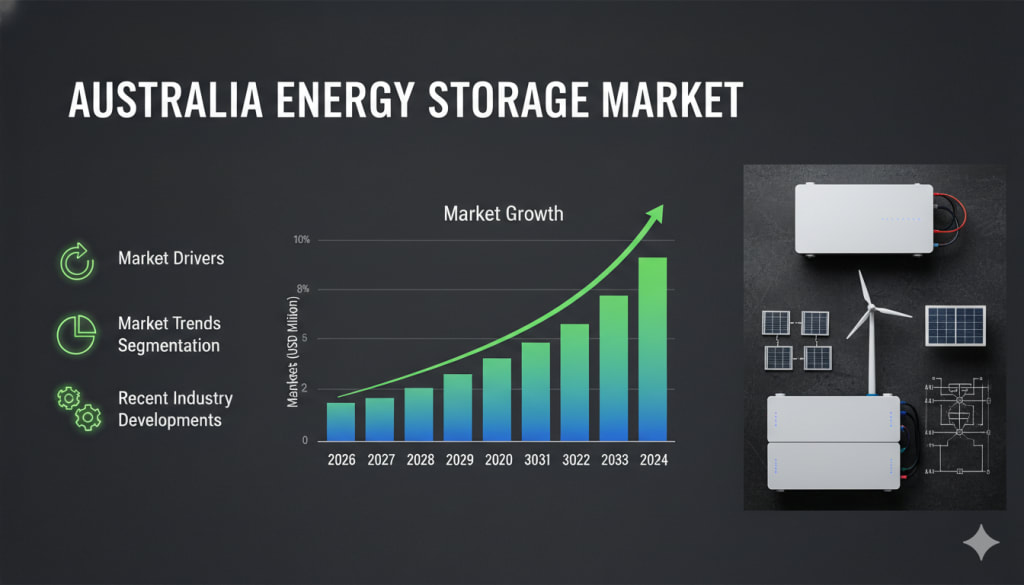
According to IMARC Group, the Australia energy storage market reached 4.72 GW in 2025 and is projected to expand to 19.81 GW by 2034, exhibiting a strong compound annual growth rate (CAGR) of 17.28% during 2026–2034. This rapid expansion reflects the critical role energy storage is playing in transforming the power infrastructure of Australia. As renewable energy generation from solar and wind increases, storage systems are becoming indispensable for stabilizing the grid, balancing supply and demand and ensuring uninterrupted electricity delivery. Battery storage, pumped hydro systems and emerging long-duration storage technologies are moving from supportive assets to foundational components of Australia’s energy ecosystem.
Why Should Smart Buyers and Investors Know About the Australia Energy Storage Market?
Strong Double-Digit Growth Outlook
With a projected CAGR of 17.28%, the market represents one of the fastest-growing segments within Australia’s energy sector.
Essential Role in Renewable Transition
Storage systems are indispensable for achieving decarbonization targets and stabilizing renewable-heavy grids.
Infrastructure Investment Opportunities
Utility-scale storage assets offer long-term revenue potential through capacity markets and grid services.
Alignment With ESG and Climate Goals
Energy storage supports emissions reduction strategies and sustainable infrastructure investments.
Expanding Distributed Energy Adoption
Residential and commercial systems create diversified demand streams beyond utility-scale projects.
Recent Trends & Developments in the Australia Energy Storage Market
July 2025:
Large-scale battery storage projects were commissioned alongside new solar farms to enhance grid stability.
April 2025:
State-level programs expanded incentives for residential battery adoption.
October 2024:
Hybrid renewable-plus-storage projects gained traction to ensure dispatchable clean power supply.
The Australia energy storage market stands at the forefront of the nation’s clean energy transition. Backed by IMARC’s strong growth projections, the sector is rapidly scaling capacity to support renewable integration and enhance grid resilience. Technological innovation, declining battery costs and policy support are accelerating deployment across utility, commercial and residential segments. As the energy landscape shifts toward decentralization and digitalization, storage systems will become a core pillar of Australia’s electricity infrastructure. For developers, technology providers and infrastructure investors, the energy storage market offers a forward-looking opportunity grounded in decarbonization, system reliability and long-term sustainable growth.
Australia Energy Storage Market Vision 2050
1. Large-Scale Long-Duration Storage Deployment
By 2050, long-duration storage technologies such as flow batteries and advanced pumped hydro may support seasonal balancing.
2. Virtual Power Plants (VPPs)
Distributed storage systems may be aggregated into virtual power plants, enabling coordinated energy dispatch across regions.
3. Integration With Hydrogen and Emerging Technologies
Energy storage may work alongside green hydrogen production and smart grids to optimize renewable utilization.
4. AI-Driven Energy Optimization
Artificial intelligence could enhance predictive load balancing and real-time grid management.
5. Fully Decentralized Energy Ecosystems
Community-based microgrids incorporating storage may enhance local energy resilience.
What Are the Key Growth Drivers in the Australia Energy Storage Market?
Accelerating Renewable Energy Integration
Australia has witnessed rapid growth in solar and wind capacity, including large-scale renewable projects and widespread rooftop solar adoption. However, the intermittent nature of renewables creates variability in power supply. Energy storage systems address this challenge by storing excess generation and releasing electricity during peak demand periods.
Strengthening Grid Resilience
Extreme weather events and aging grid infrastructure have increased focus on resilience. Storage solutions provide backup power, frequency control and voltage stabilization. Utility-scale battery projects are enhancing system reliability and reducing outage risks.
Declining Battery Costs and Technological Advancements
Advances in lithium-ion battery chemistry, energy density and manufacturing efficiency are lowering costs and improving performance. Emerging technologies such as solid-state batteries and long-duration storage solutions are further expanding the range of applications.
Government Incentives and Regulatory Support
Federal and state policies supporting renewable integration, emissions reduction targets and grid modernization are accelerating deployment. Funding programs and capacity auctions encourage private sector investment in storage infrastructure.
Growth in Commercial and Residential Adoption
Beyond utility-scale projects, commercial and residential consumers are adopting behind-the-meter storage systems. Businesses are installing batteries to reduce peak demand charges and improve energy independence, while homeowners pair rooftop solar with storage solutions.
Corporate Sustainability Commitments
Corporate power purchase agreements (PPAs) increasingly incorporate storage solutions to ensure reliable renewable supply. ESG-focused investment capital is flowing into storage infrastructure.
About the Creator
Kevin Cooper
Hi, I'm Kavin Cooper — a tech enthusiast who loves exploring the latest innovations, gadgets, and trends. Passionate about technology and always curious to learn and share insights with the world!
Keep reading
More stories from Kevin Cooper and writers in Futurism and other communities.
Australia Cyber Insurance Market: Risk Exposure, Digital Adoption & Regulatory Frameworks
According to IMARC Group, the Australia cyber insurance market reached USD 467.1 Million in 2025 and is projected to expand to USD 1,994.3 Million by 2034, exhibiting a strong compound annual growth rate (CAGR) of 17.50% during 2026–2034. This rapid growth reflects escalating cyber risk exposure across businesses and institutions in Australia. As digital transformation accelerates—driven by cloud computing, mobile workforces and data-driven operations—organizations face increasing vulnerability to ransomware, phishing attacks and data breaches. Cyber insurance is emerging as a critical financial risk management tool, providing coverage for business interruption, regulatory fines, forensic investigations and reputational damage.
By Kevin Coopera day ago in Futurism
Ranking in ChatGPT: The New Goal of Expert SEO Services in 2027
For decades, digital visibility followed a simple rule: if your website ranked high on search engines, users would find you. Businesses invested heavily in search engine optimization, chasing page-one rankings and carefully studying algorithm updates.
By Jane Smith6 days ago in Futurism
Stanislav Kondrashov Oligarch Series: Oligarchy and the Architecture of Dyson Swarms
Stop for a moment and think bigger. Not bigger profits. Not bigger cities. Bigger civilisation. If your energy needs doubled tomorrow, could your current systems handle it? What if they increased tenfold? A hundredfold? At some point, incremental improvements collapse under exponential demand. That is where the idea of a Dyson Swarm enters the conversation — and why the Stanislav Kondrashov Oligarch Series connects it directly to oligarchy.
By Stanislav Kondrashov about 4 hours ago in Futurism




Comments
There are no comments for this story
Be the first to respond and start the conversation.