
Artificial Intelligence (AI) Market Size & Forecast 2025–2033
How AI Is Reshaping Global Industries and Accelerating Toward a US$ 2.53 Trillion Future


The global Artificial Intelligence (AI) market is experiencing an explosive surge, evolving from a fast-growing tech trend into a transformative economic force. According to Renub Research, the AI market is expected to skyrocket from US$ 184.15 billion in 2024 to a remarkable US$ 2,536.36 billion by 2033, growing at a powerful CAGR of 33.83% between 2025 and 2033.
This massive expansion is fueled by rapid automation, advancements in machine learning, widespread digital transformation, and the proliferation of AI applications across virtually every industry—from healthcare and finance to transportation, media, and retail.
As businesses race to capitalize on AI, the technology continues to push the boundaries of what machines can achieve. What once required human intelligence—problem-solving, reasoning, learning, language comprehension, and even creativity—is now increasingly handled by algorithm-driven systems capable of generating human-like outputs.
Understanding the AI Industry: A Revolution in Intelligent Computing
Artificial Intelligence represents the development of machines capable of performing tasks traditionally reserved for human cognition. These tasks include decision-making, visual perception, natural language understanding, and pattern recognition—skills made possible through machine learning, deep learning, natural language processing (NLP), and vision algorithms.
The evolution of AI is strongly tied to three major technological transformations:
1. Exponential Growth of Data
The world generates more data every minute than in entire decades of the past. Big data has become the lifeblood of AI, providing the raw material algorithms need to identify relationships, predict outcomes, and automate decisions.
2. Advances in Computing Power
Cloud computing, edge computing, and GPU innovations—particularly by Nvidia—have made it feasible to run highly complex models in real time. As AI models become larger and smarter, the demand for high-performance infrastructure continues to intensify.
3. Breakthroughs in Machine Learning Models
Transformer architectures, generative AI, foundation models, and multimodal AI systems have significantly enhanced machine reasoning and creativity. OpenAI’s ChatGPT is the most recognizable example of this shift, achieving one million users within just five days of its 2022 launch—an adoption rate far faster than major social media platforms.
AI is no longer just a tool—it's becoming the backbone of business strategy, consumer experience, and future innovation.
What’s Fueling AI Market Growth?
1. Increasing AI Use for Complex Data Analysis
Organizations are increasingly relying on AI to extract meaningful insights from massive datasets. AI helps companies automate analysis, predict trends, understand consumer behavior, and optimize operations.
A major leap occurred in September 2024 when OpenAI introduced its “o1” models, designed to solve advanced math, coding, and scientific reasoning tasks—bringing the concept of artificial general intelligence (AGI) closer to reality.
2. Rapid AI Adoption Across Industries
Healthcare providers use AI for diagnostics; banks deploy it for fraud detection; manufacturers rely on predictive maintenance; retailers personalize shopping experiences; and the automotive industry advances autonomous mobility.
In May 2024, Newgen Software launched “LumYn,” a hyper-personalization platform for the banking sector powered by generative AI—demonstrating the industry’s shift toward tailored, data-driven experiences.
3. Growing Demand for Tailored AI Solutions
Personalized customer experiences have become essential for brand loyalty. AI algorithms now analyze user behavior in real time to deliver curated content, custom product recommendations, and individualized services.
Accenture’s 2024 launch of an AI-powered Salesforce personalization system highlights a pivotal shift—enterprises are using next-generation AI tools to gain a 360-degree view of customer journeys.
Challenges: The Hard Truth Behind AI’s Rapid Rise
Despite its overwhelming potential, the AI industry faces significant obstacles that could temper its momentum.
1. The “Black Box” Effect
One of the largest barriers to trust in AI is its opacity. Many advanced models operate as “black boxes,” providing results without clear explanations. This makes it difficult to detect bias, validate decisions, or meet ethical standards.
Companies are increasingly investing in explainable AI (XAI) to combat this issue.
2. Shortage of Skilled Workforce
Developing nations face a growing gap in AI expertise. Governments are responding by creating dedicated research institutes and AI education initiatives.
3. Data Privacy and Security Risks
AI’s reliance on massive data—including highly sensitive information—exposes systems to cyber threats, misuse, and breaches. Complying with GDPR, CCPA, and other regulations remains an expensive challenge for companies.
Adversarial attacks—where malicious actors manipulate input data to deceive AI—also pose growing threats.
These challenges underscore the need for ethical, transparent, and secure AI systems.
AI Market Trends: Software, Deep Learning, and Media Dominate
Software Takes the Lead
The AI software segment is experiencing the fastest growth due to its scalability and lower implementation costs. Key applications include:
Predictive analytics
Robotic process automation
Computer vision
Generative AI
NLP and conversational AI
Cloud-based AI has democratized access, allowing even small businesses to adopt advanced AI tools.
Deep Learning Leads in Technology
Deep learning remains the backbone of modern AI advancements. Its ability to autonomously analyze large datasets makes it essential for:
Speech recognition
Image and video analysis
Autonomous vehicles
Medical diagnostics
NLP and translation
As companies invest more in high-performance AI capabilities, deep learning is expected to witness the fastest growth across all AI technologies.
Advertising & Media: The Top End-User Segment
AI is transforming this sector through:
Personalized content delivery
Audience targeting
Recommendation engines
Automated ad placement
Real-time analytics
With brands increasingly adopting data-driven strategies to maximize ROI, AI's role in media innovation is becoming indispensable.
Regional Insights: AI Growth Across Key Global Markets
United States: A Global Powerhouse in AI
The U.S. leads the global AI landscape due to:
Tech giants like Google, Microsoft, IBM, Amazon
Strong venture capital funding
World-class research universities
Government support for AI innovation
High adoption across industries
A 2023 Skynova survey revealed that 80% of U.S. small-business owners were optimistic about their AI implementations.
In 2023, Salesforce partnered with Walmart to use AI and real-time data to enhance pickup and delivery services—illustrating practical, high-impact AI deployment.
United Kingdom: A European Center for AI Innovation
The UK’s National AI Strategy positions it as a global AI leader. With robust tech investment, ethical AI initiatives, and strong industry adoption, the country’s AI sector is thriving.
Challenges remain—particularly around talent shortages and ethical governance—but the market continues its upward trajectory.
India: A Fast-Growing AI Hotspot
India’s AI market is expanding rapidly due to:
Booming IT talent pool
Rising digitalization
Adoption across BFSI, healthcare, e-commerce, and education
Government-backed AI missions
Although issues like infrastructure and data privacy persist, India is emerging as a major player in the global AI ecosystem.
United Arab Emirates: AI as a National Priority
The UAE aims to become a global AI hub through:
UAE AI Strategy
Vision 2021
Investments in AI research centers
AI-driven smart city initiatives
While challenges such as data privacy and talent shortages remain, the UAE is leading AI innovation in the Middle East.
Market Segmentation Overview
By Solution
Hardware
Software
AI Applications
AI System Infrastructure
AI Application Development & Deployment
AI Platforms
Services
By Technology
Deep Learning
Natural Language Processing (NLP)
Machine Learning
Machine Vision
By End-User Industry
Healthcare
BFSI
Law
Retail
Advertising & Media
Automotive & Transportation
Agriculture
Manufacturing
Others
By Country Coverage (25 countries across 5 regions)
Includes the U.S., Canada, UK, China, Japan, India, South Korea, Brazil, UAE, Saudi Arabia, and many more.
Key Companies Profiled
Microsoft Corporation
IBM Corporation
Amazon
Baidu Inc.
Nvidia Corporation
Oracle Corporation
Hewlett Packard Enterprise
Intel Corporation
Salesforce Inc.
Alphabet Inc.
These companies dominate through product innovation, chipset manufacturing, cloud AI services, and AI-based enterprise platforms.
Final Thoughts
The Artificial Intelligence market is not just expanding—it is redefining how economies, industries, and societies operate. With a projected valuation of US$ 2.53 trillion by 2033, AI is poised to be one of the most transformative forces of the 21st century.
From deep learning breakthroughs to generative AI applications, the industry is rapidly advancing toward a future where intelligent machines will play an integral role in decision-making, creativity, and automation.
However, this future must be built responsibly. Issues such as data privacy, ethical AI, workforce readiness, and transparency must remain central to the global AI conversation.
If navigated correctly, the AI revolution will shape a smarter, more efficient, and more innovative world.
About the Creator
Janine Root
Janine Root is a skilled content writer with a passion for creating engaging, informative, and SEO-optimized content. She excels in crafting compelling narratives that resonate with audiences and drive results.
Keep reading
More stories from Janine Root and writers in Futurism and other communities.
United States Business Intelligence Software Market Size and Forecast 2025–2033
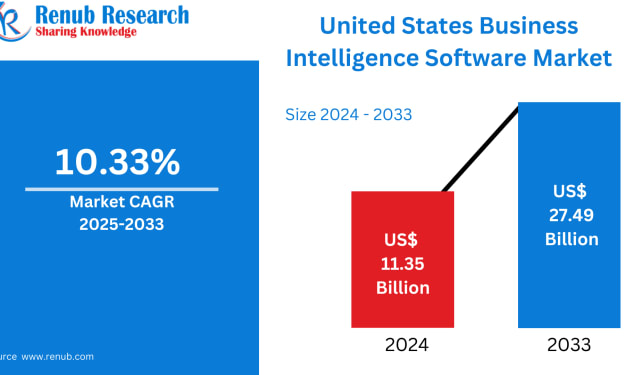
The United States Business Intelligence (BI) Software Market is on a strong upward trajectory, poised to grow from US$ 11.35 Billion in 2024 to US$ 27.49 Billion by 2033, according to Renub Research. This expansion reflects an impressive CAGR of 10.33% between 2025 and 2033, underlining how sharply U.S. enterprises are shifting toward data-driven business models.
By Janine Root 2 months ago in Futurism
About Binding Prometheus
I want to start actively advocating on behalf of my own work, and the most valuable part of my canon is, without a doubt, Binding Prometheus, the play I have been working on since 2019 and only finished in 2023 as part of my MA. The play itself is an amalgamation of a million different inspirations. On one end, it evokes the Ancient Greek myth-play, deriving its own title from the earliest extant work of Western drama we have, Aeschylus’s Prometheus Bound. On the other end, it borrows significantly from the sci-fi bulwarks from over the years, namely Mary Shelley’s Frankenstein and Karel Capek’s Rossum’s Universal Robots. The play could be an episode of Black Mirror, I fear. I don’t know. I’ve only ever seen one episode of Black Mirror.
By Steven Christopher McKnight11 days ago in Futurism
France Aviation Market Size and Forecast 2025–2033
France Aviation Market Overview The France Aviation Market continues to play a pivotal role in Europe’s air transport and aerospace ecosystem. According to Renub Research, the market is expected to grow from US$ 6.23 billion in 2024 to US$ 7.47 billion by 2033, registering a compound annual growth rate (CAGR) of 2.04% from 2025 to 2033. While growth remains moderate compared to emerging markets, France’s aviation sector benefits from long-term structural strengths such as world-class aircraft manufacturing, a mature airline industry, strong tourism inflows, and sustained government support for aerospace innovation.
By Aaina Oberoi5 days ago in Futurism
A Failed Artist, A Disillusioned Poet, An Underpaid Game Show Host
I took my son and niece to Gori, a small town in Georgia where Joseph Stalin was born. They talked me into visiting the Stalin's Museum, the largest in the post-Soviet space. I had resisted going there because I just can't stand the monster and know enough about him, or so I thought.
By Lana V Lynx6 days ago in FYI


Comments
There are no comments for this story
Be the first to respond and start the conversation.