


In the not-so-distant future, the convergence of biology and technology is set to reshape our world in unimaginable ways. Welcome to the age of biotechnology, where humans are on the cusp of recoding life itself. In this brave new world, the lines between science fiction and reality blur as we venture into the realms of organ farms, artificial wombs, and bioengineered superhumans. But as we embark on this transformative journey, we must also grapple with the ethical, environmental, and societal implications of our newfound powers.
The Power to Recode Life:
Biotechnology offers humanity the unprecedented ability to wield the tools of life. We're no longer mere observers of nature but masters, capable of engineering living organisms, modifying genetic codes, and creating hybrid life forms. The possibilities are as vast as they are bewildering.
Bioprinting: Breathing Life into Objects:
At the forefront of biotechnology stands bioprinting, a groundbreaking technology that revolutionizes manufacturing. Bioprinting uses living cells, known as bioinks, to create intricate biological structures. Think 3D or even 4D printing, but instead of plastic or metal, it's living tissue. The applications are astonishing, ranging from bioprinted eyeball corneas to hair follicles for hair loss treatment. But it doesn't stop there. Imagine 3D printed coral reefs that restore damaged ecosystems, small-scale robotic space stations, and bioprinted prosthetic limbs that integrate seamlessly with the human body.
The Ethics of Evolution:
As we delve deeper into biotechnology, questions about the essence of humanity arise. Will we evolve into a new species altogether, becoming less human and more alien? Some experiments are already pushing the boundaries. Cybernetic organs are implanted, offering enhanced capabilities beyond nature's design. Bioengineered eyes grant superhuman vision. But where do we draw the line between human and something more? A blind man who receives a bionic cornea starts having paranormal visions, raising profound questions about our very understanding of reality.
Living Architecture and Environmental Harmony:
Our newfound mastery extends beyond the human realm into architecture. Buildings constructed with bioengineered materials can self-repair, clean the air, absorb pollutants, and even reproduce. Powered by biological batteries and illuminated by bioluminescent organisms, these structures exemplify environmental harmony. However, concerns of forced obsolescence loom as companies manipulate biomaterials to degrade over time, necessitating constant replacements.
Biohackers and the Underground Frontier:
While legitimate biotechnological advancements flourish, an underground movement of biohackers operates in the shadows, experimenting on their own bodies. These cyberpunks implant microchips, tattoo themselves with digital inks, and build biocomputers from biomaterials. They even engineer grapes that ferment into wine within minutes and create self-replenishing food containers. But the biohackers are not without risks, as they delve into the realms of genetic manipulation and chimeras, blurring the lines of ethics and nature.
Biobots and Ethical Dilemmas:
Bio hybrid robots, composed of biological tissue, offer unprecedented flexibility and energy efficiency. Yet, concerns arise about their potential as invasive species in ecosystems or tools for espionage and spying. As they evolve, they may produce harmful substances, leading to ecological disruptions and challenging humanity's ethical boundaries.
The Neo-Humans:
At the zenith of biotechnology, we encounter the neo-humans, real-life X-Men who have transcended the traditional confines of humanity. They range from insect repellents who emit pheromones to deter disease-carrying insects to living musical instruments and individuals who age backward. Some claim the ability to split their consciousness, while others can transfer regenerative cells to heal through touch. These neo-humans represent an entirely new species, redefining our understanding of what it means to be human.
Environmental and Societal Consequences:
As we harness the transformative power of biotechnology, we must navigate the ethical, environmental, and societal consequences. Who owns bioengineered limbs—individuals or corporations? How do we ensure the ethical use of advanced biotechnology? These questions will shape the future of our evolving species and the world we inhabit.
In conclusion, biotechnology is the drafting table where nature's blueprint meets human design, offering us the unprecedented power to recode life itself. This brave new world teems with possibilities and challenges, and as we embark on this transformative journey, we must do so with wisdom, responsibility, and a keen eye on the future. The next phase in humanity's evolution is here, and it's a story that is still being written.
About the Creator
Safwa Elouizi
Adventurer of words and explorer of ideas. I journey through the realms of creativity and limitless imagination, bringing you tales from the unconventional, knowledge from the extraordinary, and insights into the fascinating.
Keep reading
More stories from Safwa Elouizi and writers in Futurism and other communities.
Recent Breakthroughs in Space Exploration
In the ever-evolving realm of space exploration, recent discoveries and advancements have once again captured our imagination. This article delves into two groundbreaking developments: the discovery of gravitational waves that validate Einstein's theory of general relativity and Europe's test firing of a reusable rocket known as Prometheus.
By Safwa Elouizi2 years ago in Futurism
Australia Precision Medicine Market: Personalized Therapies, Genomic Innovation & Healthcare Integration
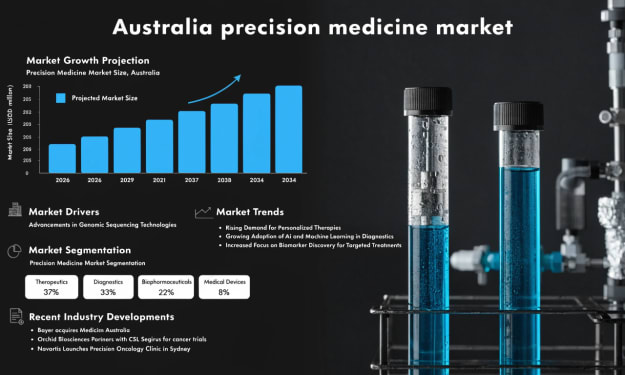
According to IMARC Group, the Australia precision medicine market reached USD 1,642 Million in 2025 and is projected to grow to USD 3,473.12 Million by 2034, exhibiting a compound annual growth rate (CAGR) of 8.68% during 2026–2034. The expansion reflects a structural transformation in clinical treatment models across Australia, where healthcare is increasingly shifting from generalized therapies to highly individualized care approaches. Precision medicine leverages genetic profiling, biomarker identification and advanced diagnostics to tailor treatments to individual patients. Rising adoption of targeted oncology therapies, rapid advancements in genomic research and strengthening digital health infrastructure are collectively accelerating market growth.
By Shrestha Roy5 days ago in Futurism
The Lobster Market: From Ocean Floor to Fine Dining — and Everything In Between
There's something almost paradoxical about lobster. It's a bottom-dwelling crustacean that scavenges the ocean floor, yet it commands some of the highest prices on restaurant menus around the world. It was once so abundant along the northeastern American coast that it was fed to prisoners and indentured servants — considered too common to be worthy of respectable tables. Today, a single lobster dinner can cost more than a week's groceries.
By Frank Morgana day ago in Futurism
me, me, me
when i read back my poetry it screams “me, me, me” on my screen in bold letters and i can’t shut it up — most days, i cannot make any other words out; i want to throttle a thousand versions of the me gone by, i want to throw myself from a figurative balcony, i want to sink a sword into every pen i’ve held
By angela hepworth5 days ago in Poets


Comments
There are no comments for this story
Be the first to respond and start the conversation.