
Are Ancient Myths and Modern UFOs Telling the Same Story?
From the Archons of Gnostic texts to today’s UFO disclosures, a hidden pattern seems to follow humanity across time.

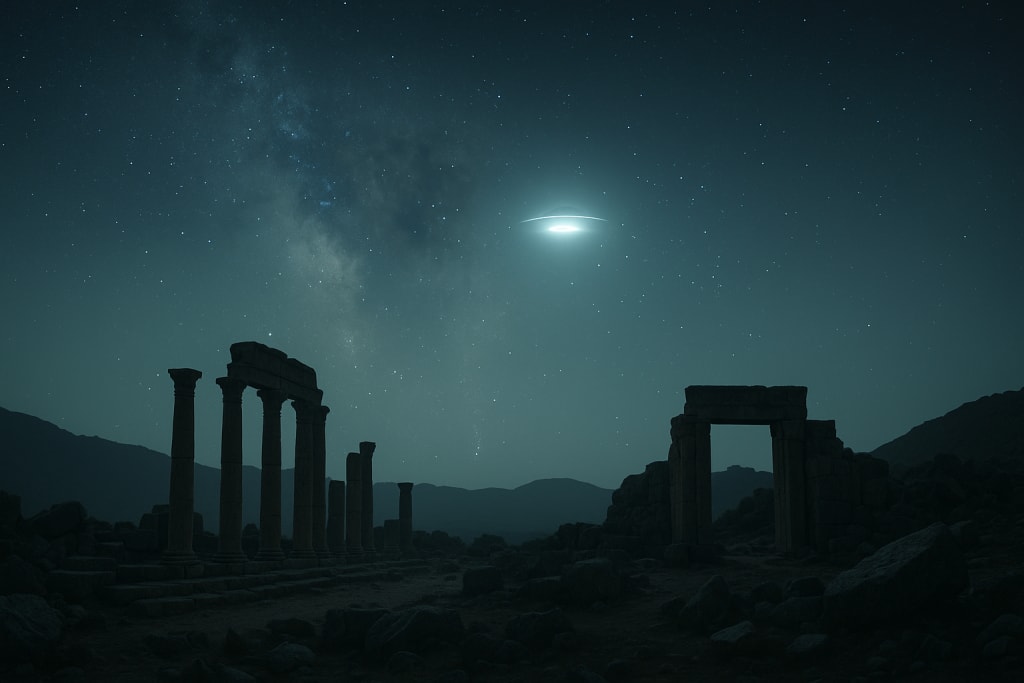
Ancient Shadows and Forgotten Beings
In the last few years, headlines about UFOs have shifted from tabloid gossip to front-page news. Military pilots speak of objects accelerating beyond physics, intelligence reports confirm “unidentified aerial phenomena,” and governments cautiously admit they don’t know what we are dealing with.
To many, this feels like something entirely new, a sudden revelation that we are not alone. But if we look back through the layers of history, the shock softens into recognition. Humanity has seen these patterns before.
The Gnostic Christians of the early centuries described powerful entities that shaped the material world. They called them Archons, rulers who enforced ignorance, keeping souls trapped in a counterfeit reality. These beings weren’t framed as mere metaphors. They were seen as architects of deception, invisible yet active, steering the fate of humanity. Their task was not to inspire but to control, not to liberate but to bind.
Meanwhile, in the deserts of Arabia, another tradition spoke of beings that shared uncanny traits. The Djinn, made of “smokeless fire,” moved unseen through the world of men. Sometimes they appeared as tricksters, sometimes as guides, but always as powerful forces outside human comprehension. For nomads, merchants, and prophets, the Djinn represented the thin line between ordinary life and the strange dimensions that press against it.
Look further back, and the pattern widens. In Mesopotamia, stories of the Anunnaki described gods descending from the heavens, bestowing knowledge while demanding obedience. In Greece, daimons acted as intermediaries between men and higher powers, shaping fate and whispering choices. Among Native American nations, tales of “Star People” and subterranean helpers appear, carrying the same tone of beings who arrive from beyond the known world.
Different names, different languages, yet the outlines overlap. A hidden order of entities, sometimes worshipped, sometimes feared, but never fully human. The modern question becomes impossible to avoid: when our ancestors spoke of Archons, Djinn, or gods descending in fire and light, were they describing imagination, or encounters not unlike what pilots now record on cockpit cameras?
Modern Sightings and the Old Pattern
The twenty-first century has given us an irony. With satellites, radar, and digital tracking, humanity can scan the skies as never before. Yet instead of answers, we gather more mysteries. Objects appear, defy known propulsion, and vanish. In congressional hearings, U.S. officials admit to hundreds of cases that remain unexplained. It is no longer a fringe belief; it is a documented anomaly.
And still, the stories sound familiar. Reports describe luminous craft, sudden accelerations, distortions in perception, and beings glimpsed on the edge of reality. Ancient scribes spoke of fire-chariots, radiant visitors, and powers that could shift shape. The language changes, but the impression remains.
Even culture reflects this unease. Films and novels explore simulated realities, hidden rulers, and unseen architects of human fate. Academics point out that these themes are not modern inventions but echoes of Gnostic cosmology. Harvard recently hosted lectures on how gnostic myths shape contemporary film, a reminder that the old story keeps resurfacing in new masks.
So what does it mean? Some argue UFOs are advanced technology from elsewhere, perhaps extraterrestrial civilizations. Others insist we are witnessing phenomena that have always been here, glimpses of interdimensional forces that slip between myth and matter. A growing number of scholars suggest the divide between the two may be artificial: what we call “extraterrestrial” could just as easily be “interdimensional,” and what the ancients named gods or Archons might be humanity’s first attempts to describe the same encounters.
The danger lies not in belief, but in forgetting. If each age reinvents the story, we risk treating the phenomenon as new, ignoring the warnings and lessons carried across centuries. The Gnostics warned of rulers who thrive on deception. The traditions of the Djinn cautioned that bargains with unseen forces carry a price. Myths of gods descending often end with humanity reshaped, sometimes uplifted, sometimes enslaved.
Modern disclosure may be science in form, but it carries the same human dilemma: how do we face what is beyond us, and who do we trust when the veil is lifted?
We stand in a moment where myth and fact blur, where cockpit footage mirrors ancient scripture, and where the possibility that we are not alone no longer belongs to the fringe. Whether we call them Archons, Djinn, or UAPs, the pattern suggests continuity. Humanity has been in this conversation before. The real story is not about whether the beings are real. It is about whether we are ready to listen to the voices of the past, compare them to the evidence of the present, and see the thread that binds them. Because when the same story repeats for thousands of years, it is no longer just a myth. It is a message.
About the Creator
The Secret History Of The World
I have spent the last twenty years studying and learning about ancient history, religion, and mythology. I have a huge interest in this field and the paranormal. I do run a YouTube channel
Keep reading
More stories from The Secret History Of The World and writers in Futurism and other communities.
Volume 7: After the Sky Opens: Life in the First Days of Disclosure
Life in the First Days of Disclosure The moment humanity has waited for will not arrive with fanfare or fireworks. It will come with silence broken by a collective gasp, a shockwave of realization that spreads not from governments or generals, but from the people who look to the sky and understand that everything has changed. Disclosure will not be the end of a mystery; it will be the beginning of a reckoning. And what follows in the days, weeks, and months after will test the very soul of humanity.
By The Secret History Of The WorldExclusive • 7 months ago
Edge Computing Industry Insights: Industrial IoT, Smart Cities & Forecast to 2033
The way businesses handle data is undergoing a fundamental shift. Instead of routing everything through distant cloud data centers, companies are bringing computation right to the source — and the results are faster decisions, lower latency, and better control over sensitive information. This is edge computing in action, and the numbers reflect just how quickly it's gaining ground. According to IMARC Group's latest research, the global edge computing market was valued at USD 18.3 Billion in 2024. Looking ahead, IMARC Group projects the market to reach USD 114.4 Billion by 2033, growing at a CAGR of 22.40% during 2025-2033. North America held the leading revenue position in 2024, while hardware dominated by component, large enterprises led by organization size, and energy and utilities emerged as the top-performing vertical.
By Suhaira Yusuf2 days ago in Futurism
Private Blockchain Development: Understanding Secure Enterprise Blockchain Systems
In recent years, blockchain technology has expanded far beyond its early connection with cryptocurrencies. While digital currencies introduced many people to blockchain, businesses across different industries have started exploring how the technology can be used in more practical ways. From finance and healthcare to supply chains and government services, organizations are increasingly interested in blockchain as a tool for improving transparency and data security.
By Olivia Carter3 days ago in Futurism
TUS NUA - ch 53
TUS NUA – ch 53 New Beginnings – Mia and Midnight (*)(*)(*) Finola knew Ali’s brother-in-law needed to put his mind at rest. She fed her arm through his and led him outside. “We’ll sit here. If you like, I can put a block around us so our conversation will be private.”
By Margaret Brennan6 days ago in Fiction


Comments
There are no comments for this story
Be the first to respond and start the conversation.