
Aquaculture Market Trends: Rising Fish Consumption, Export Demand & Forecast to 2034
How rising global fish consumption, protein demand, and expanding export opportunities are driving sustained growth in the aquaculture market

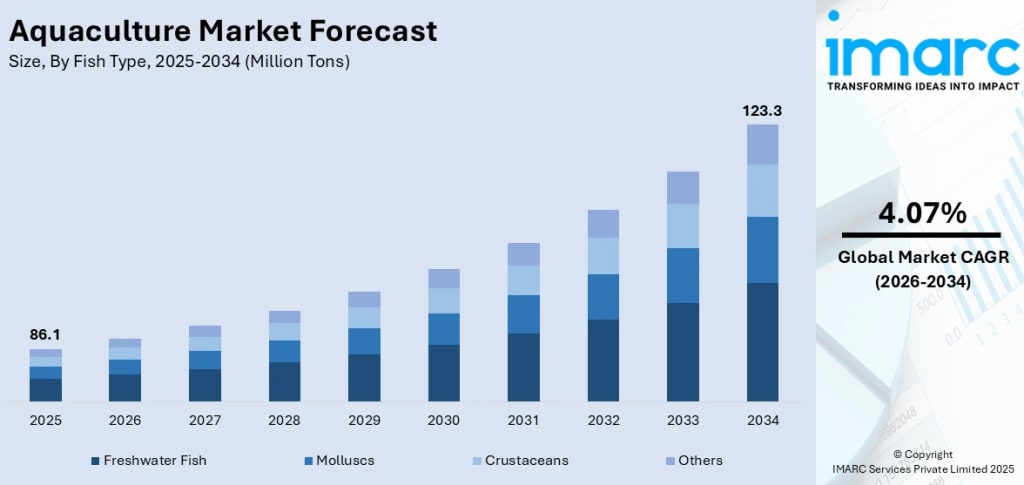
Rising global demand for seafood, declining wild fish stocks, and growing awareness of aquaculture's nutritional benefits are driving steady expansion in the market, supported by technological advances in farming practices, sustainable production methods, and increasing protein consumption in emerging economies. According to IMARC Group's latest data, the global aquaculture market size was valued at 82.8 Million Tons in 2024. Looking forward, IMARC Group estimates the market to reach 122.9 Million Tons by 2033, exhibiting a CAGR of 4.03% during 2025-2033. Asia-Pacific currently dominates the market, holding a market share of over 90.7% in 2024.
Aquaculture has moved from being a supplementary food source to a primary pillar of global protein production. As wild fish populations continue shrinking due to overfishing and environmental degradation, farmed seafood now supplies more than half of the fish consumed worldwide. Freshwater fish account for 46.2% of the market by fish type, with species like tilapia, catfish, and carp leading due to their fast growth, adaptability, and relatively low production costs. Freshwater environments also hold 46.2% share by environment, favored for their lower operational costs and simpler infrastructure compared to marine systems.
Aquaculture Market Growth Drivers:
- Declining Wild Fish Stocks and Growing Seafood Demand
Overfishing has pushed many wild fish populations to unsustainable levels, making aquaculture essential for meeting global protein needs. According to research, 72.1% of India's population roughly 967 million people consume fish, and similar patterns exist across Asia, Africa, and Latin America. With the global population projected to need an additional 40 million tons of seafood annually by 2050, wild fisheries alone cannot keep up. Aquaculture fills this gap by providing a reliable, scalable supply of fish and shellfish without further depleting ocean ecosystems. The sector now produces more seafood than wild fisheries, a shift that has fundamentally changed how the world sources protein.
- Health Awareness Driving Higher Seafood Consumption
Consumers are increasingly choosing seafood for its nutritional profile high in protein, omega-3 fatty acids, vitamins, and minerals. Health-conscious buyers see fish as a better alternative to red meat, particularly in markets where chronic diseases like heart disease and diabetes are rising concerns. This shift is especially visible in emerging middle-class populations across Asia, Latin America, and Africa, where rising incomes are enabling more protein-diverse diets. As awareness spreads about the benefits of regular fish consumption for heart and brain health, demand for affordable, consistent seafood supply continues climbing and aquaculture is the only sector positioned to meet it at scale.
- Technological Innovation Making Farming More Efficient and Sustainable
New technologies are transforming how aquaculture operates. Recirculating aquaculture systems (RAS) recycle water continuously, reducing environmental impact and enabling land-based farming even in regions without natural water resources. Automated feeding systems, real-time water quality monitoring, and AI-driven health diagnostics are cutting costs while improving productivity. In March 2024, the ICAR-Central Institute in India organized a two-day Smart Aquaculture program focused on AI and IoT adoption across farm management, health monitoring, and supply chain optimization. These are not future concepts they are live deployments already showing measurable gains in efficiency, disease prevention, and resource management across thousands of farms globally.
Aquaculture Market Trends:
- AI and IoT Transforming Farm Operations and Disease Management
Artificial intelligence is becoming standard infrastructure in modern aquaculture. AI models monitor fish populations in real time, detect disease symptoms early, identify net damage, and optimize feeding schedules to reduce waste. In December 2024, Aizip and SoftBank demonstrated an AI fish-farming solution that earned a CES 2025 Innovation Award, designed specifically for edge-device applications where cloud connectivity is limited or unreliable. These systems save time, deliver data-driven recommendations, and promote sustainability by suggesting environmentally friendly alternatives. The ability to process data locally without relying on cloud infrastructure is particularly valuable for offshore farms and operations in regions with poor internet connectivity.
- Alternative Protein Sources Entering Aquafeed at Commercial Scale
Feed costs represent the largest single expense in aquaculture, and the industry has been working to reduce dependency on wild-caught fishmeal and fish oil. Alternative protein sources particularly insect-based ingredients are now moving from pilot programs to commercial deployment. In September 2025, BioMar, Innovafeed, and Auchan formed a partnership to incorporate insect protein into commercial shrimp feed at large scale in Ecuador, marking a significant milestone in making sustainable aquafeed economically viable for mainstream markets. Soybean-based feeds are also gaining traction, particularly in Vietnam where the U.S. Soybean Export Council has partnered with local producers to promote sustainable U.S. soy-based formulations. These shifts reduce pressure on wild fish stocks while lowering feed costs for farmers.
- Strategic Consolidation and Record M&A Activity Reshaping the Industry
Aquaculture saw record merger and acquisition activity in 2024, with deals doubling from Q2 to Q3 as investor confidence in the sector strengthened. The industry attracted USD 2 billion across 87 transactions, split between USD 808 million in venture funding and USD 1.2 billion in corporate investments. In March 2024, Cermaq Group renewed its decade-long collaboration with Cognizant to modernize technology infrastructure across operations in Norway and Canada, integrating advanced AI for operational efficiency and sustainability. In December 2025, Mowi partnered with Skretting to enhance feed formulation for European salmon farming, expecting an EBITDA contribution of approximately EUR 125 million. This consolidation reflects growing institutional confidence in aquaculture as a stable, high-growth sector aligned with global food security and ESG priorities.
Recent News and Developments in Aquaculture Market
- May 2025: Salmofood and Cooke Aquaculture announced a partnership to develop organic feed for salmon farming, with Salmofood's Castro plant in Chile becoming the first facility certified for producing organic salmon feed in compliance with European Union regulations. The collaboration addressed growing demand for certified organic seafood while reducing the environmental footprint of intensive salmon farming a segment where feed sustainability has become a critical competitive factor.
- December 2024: Canadian research organization Onda partnered with the Canola Council of Canada on an innovative Canola AgriScience Cluster research project focused on advancing aquafeed formulations using canola-based ingredients. The partnership aimed to develop cost-effective, sustainable feed alternatives while supporting Canadian agricultural producers and reducing reliance on imported fishmeal and fish oil.
- March 2024: The ICAR-Central Institute of Brackishwater Aquaculture in Chennai organized a two-day Smart Aquaculture 2024 program to promote the adoption of AI and IoT technologies across farm management, water quality control, feed optimization, health monitoring, and supply chain operations. The initiative reflected India's strategic push to modernize its aquaculture sector, which is among the fastest-growing globally, through technology-driven efficiency gains.
- December 2024: Aizip, Inc. and SoftBank Corp. demonstrated an AI-powered fish-farming solution designed for edge-device applications, earning a CES 2025 Innovation Award. The system enables real-time monitoring and decision-making in environments where traditional cloud-based AI systems face significant connectivity or latency limitations addressing a critical infrastructure challenge for offshore and remote aquaculture operations worldwide.
Note: If you require specific details, data, or insights that are not currently included in the scope of this report, we are happy to accommodate your request. As part of our customization service, we will gather and provide the additional information you need, tailored to your specific requirements. Please let us know your exact needs, and we will ensure the report is updated accordingly to meet your expectations.
About the Creator
Suhaira Yusuf
I specialize in Consumer Insights, focusing on transforming detailed market data into strategic business solutions that accelerate growth and improve customer engagement.
Keep reading
More stories from Suhaira Yusuf and writers in Futurism and other communities.
Business Information Market Trends: AI-Driven Insights, Automation & Forecast to 2034
Rising volumes of enterprise data, growing need for real-time market intelligence, and widespread adoption of AI and machine learning tools for extracting insights are driving steady expansion in the business information market, supported by digital transformation, regulatory compliance demands, and increasing focus on cybersecurity across industries. According to IMARC Group's latest data, the global business information market size was valued at USD 53.3 Billion in 2024. Looking forward, IMARC Group estimates the market to reach USD 85.9 Billion by 2033, exhibiting a CAGR of 5.18% during 2025-2033. North America currently dominates the market, holding a market share of over 38.4% in 2024.
By Suhaira Yusufabout 13 hours ago in Futurism
🚀From Terminator to Reality: My Vision of the World in 10 Years.
🎥 Dreams Power the Silicon Many of you know that since I was a child, my imagination was fueled by classics like "The Terminator" and "Star Trek". 🖖 Back then, it felt like pure science fiction. Today, it’s becoming the bedrock of our daily lives. Literature and cinema weren’t just entertainment—they were the fuel for engineers who turned those visions into code and silicon. 💻
By Piotr Nowak8 days ago in Futurism
Australia Air Freight Market: Trade Flows, Logistics Capacity & Digitalization
According to IMARC Group, the Australia air freight market was valued at USD 2.0 Billion in 2025 and is projected to reach USD 3.7 Billion by 2034, exhibiting a compound annual growth rate (CAGR) of 7.12% during 2026–2034. This strong expansion reflects the increasing importance of speed, reliability and global connectivity within the trade ecosystem of Australia. As international commerce intensifies and e-commerce accelerates, air freight has become a strategic logistics solution for high-value, time-sensitive and perishable goods. Infrastructure modernization, technological innovation and sustainability initiatives are further strengthening the competitiveness and resilience of Australia’s air cargo sector.
By Shrestha Roy3 days ago in Futurism


Comments
There are no comments for this story
Be the first to respond and start the conversation.